Quick Take
- Narration: David Smalley’s performance matches the book’s irreverent but informed tone, delivering Fitzgerald’s material with the confident energy of someone who has thought hard about exactly these questions.
- Themes: Mormon history and institutional concealment, the mechanics of religious belief, historical scrutiny of founding mythology
- Mood: Wry, thorough, and openly partisan, written for readers already skeptical of the subject matter
- Verdict: A well-researched and genuinely entertaining deep-dive into LDS history for listeners who want their religious criticism served with both rigor and consistent humor.
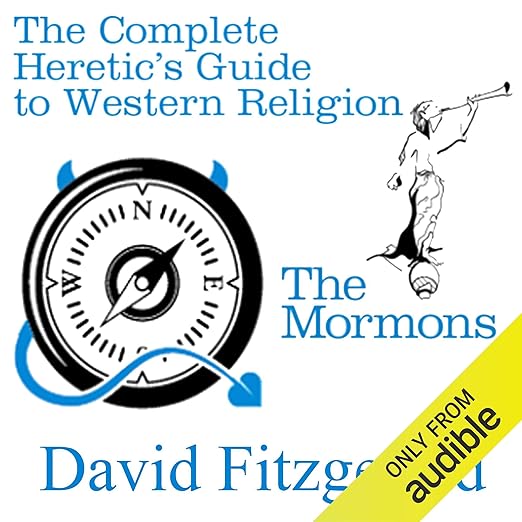
I was introduced to David Fitzgerald’s work by a reader who had a specific question: she had a family member considering conversion to the LDS church and wanted a resource that was both accurate and accessible. She had tried the standard academic histories and found them too dry. She had tried the official church materials and found them, predictably, incomplete. Fitzgerald’s Heretic’s Guide was what she eventually landed on, and she wanted to know what I made of it.
I spent eight and a half hours with David Smalley narrating Fitzgerald’s take on the Church of Jesus Christ of Latter-day Saints, and came away with a clear assessment: this is not the book for someone approaching Mormonism with genuine open-minded curiosity. It is the book for someone who has already concluded that the institutional claims do not hold up and wants a structured, thoroughly sourced account of why. That framing is not a criticism. It is an accurate description of the audience the book is written for, and within that audience the book delivers consistently.
What Fitzgerald Actually Covers
The synopsis leads with Joseph Smith and the founding mythology, which is the right place to start for any critical account of LDS history. But Fitzgerald covers considerably more than the origin story. The financial structure of the modern church, the archaeological record that fails to support the Book of Mormon’s historical claims, the practice of plural marriage and Smith’s specific relationships, and the institutional suppression of inconvenient history are all given substantive treatment. One reviewer described it as a very thorough history documented by facts, not scripture, easily verifiable through the excellent sources Fitzgerald provides. That sourcing is genuinely notable and separates this from mere polemic.
The book includes links and references for further reading, which reviewers consistently praised. Fitzgerald’s other major work, Nailed: Ten Christian Myths that Show Jesus Never Existed at All, is named in the synopsis, and readers familiar with that book will recognize the approach: thorough historical research delivered with a sense of humor and without pretense of neutrality.
The Humor as a Deliberate Structural Choice
Fitzgerald’s stated intention is that religion is not just wrong but hilarious, and the book delivers on the second premise with more consistency than most skeptical religious history attempts. The chapter on Mormon archaeology and the anachronisms in the Book of Mormon is genuinely funny in ways that do not require you to be hostile to religion to appreciate as comedy. Fitzgerald has a gift for presenting absurdity without embellishment, which is the correct approach: the material does the work when treated with deadpan accuracy rather than exaggeration.
One reviewer wrote simply that the book was fun, and that is worth taking seriously as a criterion. Academic religious history can be essential and unreadable in equal measure. Fitzgerald’s approach trades some analytical depth for accessibility and entertainment, and for the audience this book is built for, that trade is worth it. You will not come away with a sophisticated understanding of why Mormon theology has evolved as it has or what its institutional appeal is. You will come away with a thorough account of what the church’s own records show, and you will occasionally have laughed out loud while getting there.
David Smalley and the Register of Informed Skepticism
Smalley is the right narrator for this material. His voice has the quality of a knowledgeable friend explaining something he has looked into carefully, which maps precisely onto the book’s own register. When Fitzgerald’s humor lands, Smalley does not oversell it. When the historical material gets dense, Smalley does not let it become a lecture. The eight-and-a-half hour runtime is appropriate for the subject matter, and Smalley maintains consistency and energy throughout.
The publisher is Dogma Debate, LLC, which tells you something important about the context in which this book was produced. It is part of a broader skeptical and atheist media ecosystem, and Smalley is himself a prominent figure in that community. For listeners within that world, the production will feel familiar and comfortable. For listeners approaching from outside it, the ideological framing is worth being aware of upfront, not because it makes the historical information less accurate, but because the lens is explicit rather than hidden.
Who This Book Is and Is Not For
If you are an ex-Mormon, someone researching LDS history from a critical perspective, or a skeptic who wants a structured and frequently funny account of the church’s institutional history, this is a well-organized and extensively sourced audiobook. The humor makes the material less exhausting than it might otherwise be, and Fitzgerald’s willingness to provide sources separates this from mere entertainment.
If you are a practicing Mormon, an academic religious historian seeking balanced treatment, or someone genuinely undecided about the LDS tradition, look elsewhere. Fitzgerald is explicit about his perspective from the first chapter, and the book does not pretend to objectivity. That transparency is honest, if not neutral, and it allows the right reader to engage with exactly the kind of account they came looking for.
Frequently Asked Questions
Is The Complete Heretic’s Guide to Western Religion appropriate for someone currently investigating Mormonism with an open mind?
Not really. Fitzgerald is writing for people who have already concluded that the institutional claims of the LDS church do not hold up. He is not writing a balanced introductory survey. For someone genuinely undecided, the openly skeptical framing may feel hostile rather than informative. Scholarly alternatives exist for readers who want more neutral treatment.
How well-sourced is Fitzgerald’s historical material?
Multiple reviewers specifically praised the sourcing. Fitzgerald provides links for further reading and draws from historical documents rather than relying solely on scriptural argument. One reviewer described it as documented by facts, not scripture, with sources easily verifiable. This distinguishes it from purely polemical skeptical writing.
Does David Smalley’s narration reflect his own views on the subject matter?
Smalley is a prominent figure in the atheist and skeptical community and founder of the Dogma Debate podcast. His narration is not neutral in tone, but it avoids becoming contemptuous. He delivers the humor with timing and the historical material with appropriate seriousness. Listeners familiar with his work will find the tone familiar; those who are not should be aware of his perspective going in.
Is this a complete treatment of Mormonism or does it focus on specific aspects?
It focuses primarily on the founding history, Joseph Smith’s life and relationships, Mormon archaeology and its failures, and the institutional structure of the modern church. It does not cover the full theological tradition or the diversity within contemporary Mormon practice. Fitzgerald is more interested in the historical record and institutional behavior than in the lived experience of faith.