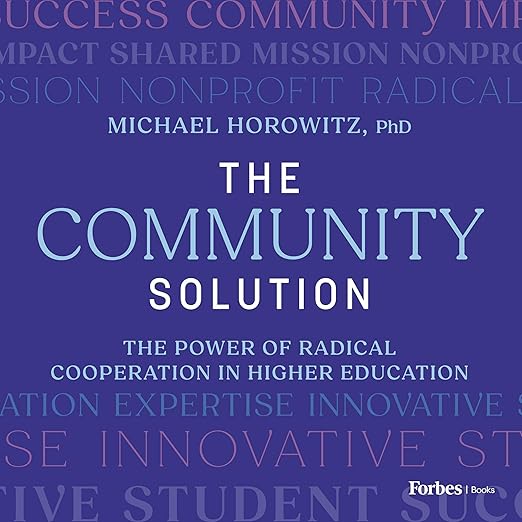
How many college presidents actually admit their own institution is one bad semester away from closing? Michael Horowitz built The Community Solution around institutions willing to have exactly that conversation, and this four-hour-and-forty-seven-minute audiobook, narrated by Sean McIntyre, lays out a specific framework for higher-education leaders facing declining enrollment and real financial pressure without necessarily having to merge or close outright. Horowitz brings direct, personal credibility to the argument: he actually founded The Community Solution Education System, a real network of six colleges collectively educating more than 13,000 students, and that hands-on record is the direct evidence base for everything the book argues.
McIntyre Narrates Niche Superpowers With Conviction
The book's central move is proposing collaboration without erasure, institutions keeping their distinct identities and missions while sharing resources, expertise, and strategic vision rather than the more common alternatives of full merger or continued isolated struggle. Reviewer Faithful calls this 'almost unthinkable,' crediting Horowitz and his colleagues with a genuinely new business model proven to work for 'a mainly adult student population' specifically. McIntyre's narration carries the case-study sections, from institutions Horowitz describes rescuing near closure to ones where his framework helped launch new medical schools, with the kind of measured, credible authority this material needs to land as substantive rather than aspirational.
Horowitz structures his argument around seven distinct named elements, from what he calls 'niche superpowers' at one end to 'continuous urgency' at the other, with two-way learning, productive humility, healthy risk-taking, a global perspective, and an inspired vision filling out the middle of the list. That's a genuinely actionable framework rather than vague inspirational language, and reviewer TeddyBlaze's enthusiastic short review, 'I LOVED learning how to build a community to radicalize cooperation,' reflects how directly the book translates its central idea into a checklist a listener could actually apply to their own institution.
Niche superpowers is a deliberately punchy piece of framework language worth close reading against the more common, blander alternative a typical strategic-planning book might use, something like core competencies or areas of institutional strength. Horowitz's specific word choice matters because it reframes a defensive posture, protecting what a struggling institution has left, into an offensive one, actively identifying and doubling down on whatever makes a specific college genuinely distinct in a crowded and shrinking market. McIntyre's delivery treats that reframing with real conviction rather than reading it as just another business buzzword, which helps the whole seven-element framework land as a coherent philosophy rather than a disconnected list of nice-sounding principles.
TeddyBlaze's review, brief as it is, closes with a small but telling detail: enthusiasm specifically for learning about 'the higher education system' itself, not just the collaborative framework Horowitz proposes. That distinction matters because it suggests the book succeeds as genuine education about how higher-ed institutions actually function and struggle, not merely as a persuasive pitch for one specific model, which broadens its usefulness even for a reader who ultimately isn't convinced the seven-element framework fits their own institution.
Rescuing Colleges and Launching New Medical Schools
Reviewer Andrew R Wilson brings genuine relevant credibility to his praise here: he currently works in higher education and has served on institutional boards himself, and specifically notes that 'Michael's impact in the industry has become well known' among people currently working in the field. That kind of firsthand professional validation matters more for a niche leadership title like this than it would for general-audience nonfiction, since the book's core audience is exactly the kind of reader who would recognize whether Horowitz's framework actually holds up against real institutional experience.
At 4.8 stars across a small but consistently positive set of ratings, the reception here tracks closely with how narrowly and specifically this book is aimed: it isn't trying to appeal broadly, it's trying to give a specific professional audience genuinely useful tools, and the reviews reflect exactly that kind of targeted satisfaction rather than broad crossover appeal.
The case studies Horowitz cites, rescuing colleges on the brink of closure and helping launch new medical schools, represent genuinely high-stakes institutional outcomes rather than incremental efficiency gains, and that scale of consequence is part of what gives the seven-element framework its real-world credibility. Launching a medical school specifically is an enormously complex undertaking involving accreditation, clinical partnerships, and massive capital investment, so citing that as a direct outcome of applying this collaborative model is a meaningful claim about the framework's practical power, not just its theoretical appeal.
Briefing-Style Pacing for Busy College Presidents
General self-help or business listeners outside higher education administration will find almost nothing here built for them, since every case study and framework element assumes a campus budget line, an accreditation process, and a board of trustees to answer to. This is not a book that translates its lessons into universally applicable business advice; the seven elements are specifically calibrated for the structure and constraints of nonprofit higher education.
At four hours and forty-seven minutes, this moves efficiently through its framework and case studies without extensive padding, which is a genuine strength for busy administrators but means anyone wanting exhaustive data, financial modeling detail, or a longer academic treatment of higher-education economics should look toward more research-heavy alternatives instead.
It's worth being specific about the book's format for a moment: at under five hours, this moves at the pace of an extended keynote address or an executive briefing rather than a deep dive into the sector's broader economics, which is a deliberate choice given its stated audience of busy college presidents and trustees rather than researchers or graduate students. That briefing-style pacing means broader systemic questions, state funding formulas, the student loan landscape, demographic enrollment pressure facing the entire sector, get acknowledged as context rather than explored in the kind of depth a dedicated higher-education policy book would provide. Listeners wanting Horowitz's specific, actionable framework will find the pacing exactly right; listeners wanting the full macro picture of why American higher education is under this pressure in the first place will need supplementary reading.
Written for College Leaders, Not Corporate Boards
College and university leadership, especially at small or tuition-dependent institutions facing real enrollment pressure, is really the specific audience this book is written for, and it delivers genuine, actionable value within that narrow lane. The book explicitly names its target readers as college leaders, board members, and other change agents inside higher education, and that group will get the most direct application from Horowitz's seven-element framework. Board members trying to understand the operational reasoning behind a proposed inter-institutional partnership will also find real clarity here. That narrow focus is a genuine strength, not a limitation, for the audience it actually serves.
Corporate or general-audience business listeners will find almost nothing transferable here, since every case study assumes a nonprofit governance structure and a mission-driven board rather than shareholders or a typical corporate org chart. Anyone wanting exhaustive financial modeling should look toward a more research-heavy alternative instead.
Key Details
- Narrator: Sean McIntyre delivers Horowitz's case studies and framework with measured, credible authority suited to an institutional-leadership audience.
- Subjects: Higher-education collaboration, institutional sustainability, cross-college resource sharing
- Tone: Focused and practical, aimed squarely at working professionals rather than general readers
- Bottom line: A genuinely useful, narrowly targeted leadership audiobook for higher-education administrators specifically, not a general-audience business book.