Quick Take
- Narration: Nesteroff narrates his own history with the authority of an insider and the pacing of someone who genuinely loves the material; his voice suits the brisk, anecdote-dense structure well.
- Themes: Comedy as cultural mirror, show business and organized crime, the evolution of the comedian’s social role in America
- Mood: Dense and exhilarating, packed with personalities and period detail across a full century
- Verdict: The most rigorous and entertaining single-volume history of American comedy available in audio, essential for anyone who takes the subject seriously.
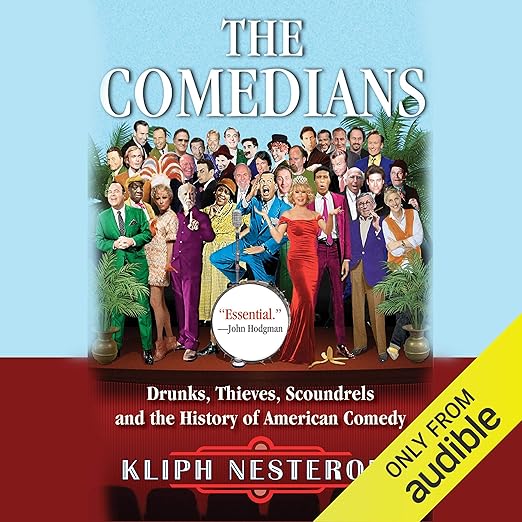
I started this one on a Tuesday morning commute and was still thinking about it three days later, which is the response a book earns when its subject turns out to be far stranger and more consequential than you expected. Kliph Nesteroff is a comedy historian by calling, and The Comedians is the fullest expression of what that vocation looks like when applied with genuine rigor: 200 original interviews, extensive archival research, and a narrative spine that runs from vaudeville to the present without losing its thread or its energy.
The genre tag of comedy-humor is technically accurate but undersells what this book actually is. This is cultural history, sociology, and biography bound together by a through-line argument: that American comedians have consistently been the first to say what the culture is not yet ready to hear, and that the conditions that produced comedians at any given moment tell you as much about America as the comedians themselves do. Nesteroff makes this case not through thesis paragraphs but through accumulation of specific, often startling detail.
The Mafia and the Microphone
The early chapters, covering vaudeville’s collapse and the rise of Prohibition-era entertainment, contain material that most comedy fans will not have encountered elsewhere. The argument that Mafia-run supper clubs replaced vaudeville impresarios as the comedian’s primary employer after Prohibition’s repeal is not a throwaway observation. Nesteroff pursues it through specific clubs, specific owners, and specific comedians who had to navigate the reality of being paid by organized crime. This context reframes figures like Don Rickles and Frank Sinatra in ways that feel genuinely revisionist without being sensationalist.
The chapter covering the 1950s is where the book finds its deepest groove. The late-night talk show arriving as a national platform at the same moment that Lenny Bruce, Mort Sahl, and Jonathan Winters were attacking conformity in coffeehouses creates a tension that Nesteroff traces carefully. The parallel development of comedy as mainstream entertainment and comedy as cultural rebellion is not a contradiction he resolves tidily, which is correct: it was not tidily resolved at the time either.
What the Disagreements in the Reviews Reveal
One of the more interesting critical responses available is the reviewer who wishes Steven Wright, Emo Philips, and Henny Youngman received more attention while Dane Cook gets coverage. This complaint contains a real insight: Nesteroff is writing the history of comedy as a cultural and commercial phenomenon, which means cultural impact takes precedence over critical reputation. Cook’s presence in the book reflects his cultural moment, not Nesteroff’s endorsement. Wright and Philips are critically beloved but had narrower cultural footprints, which is precisely the kind of distinction a serious history has to make even when it frustrates admirers of the overlooked figures.
The 15 hours and 6 minutes is ambitious but justified. The material genuinely requires this length to make its argument. A compressed version would have to sacrifice either the research depth or the narrative continuity, and Nesteroff’s great achievement is that both are present in full. The cocaine-fueled comedy club boom of the 1980s gets as much time as the Civil Rights movement’s relationship to comedy, which is as it should be: both are complex and both changed the form.
Nesteroff as Narrator of His Own Archive
The self-narration works better than it might have. Nesteroff has spent years telling these stories to comedy fans and on podcasts, and that experience shows in his delivery. He reads with the authority of someone who has had the arguments about this material many times and knows where the pressure points are. He does not perform the comedy; he narrates history. But he has enough timing that the genuinely funny material lands rather than lies flat in the telling.
Who Should Listen and Who Should Skip
Listen if you have any serious interest in American comedy as a cultural form, in entertainment industry history, or in the relationship between comedians and the social conditions that produce them. This is required listening for stand-up fans who want to understand why the form looks the way it does. The material on Lenny Bruce and the First Amendment alone justifies the runtime.
Skip if you are looking for a book that makes you laugh rather than one that makes you think about laughing. The Comedians is analysis, not performance. It is rigorous in a way that not all listeners categorized under comedy will find comfortable.
Frequently Asked Questions
Does the book cover female comedians as part of the main history or as an addendum?
They appear throughout the main narrative, though the degree of coverage reflects the historical reality that women faced systematic exclusion from comedy venues and television bookings for much of the period covered. Nesteroff addresses this as a structural condition rather than merely noting individual exceptions.
How does the book handle more controversial figures in comedy history?
Nesteroff covers controversial figures as cultural phenomena rather than making moral arguments about them. Their presence in the book reflects their cultural impact during specific periods. The history he is writing is descriptive rather than prescriptive.
Does the book require familiarity with most of the comedians discussed, or does it work as an introduction?
It works well as an introduction to figures you do not know, partly because Nesteroff’s research means even familiar names are contextualized in ways that feel new. You do not need to be a comedy scholar to follow the argument or enjoy the anecdotes.
The history ends around the early 21st century, does it feel dated for listeners in 2025?
The ending acknowledges the media-driven celebrity era without predicting the podcast revolution or the streaming comedy landscape, which means the final chapters feel like a prologue to a story still being written. The historical core from vaudeville through the 1990s is essentially complete and does not date.