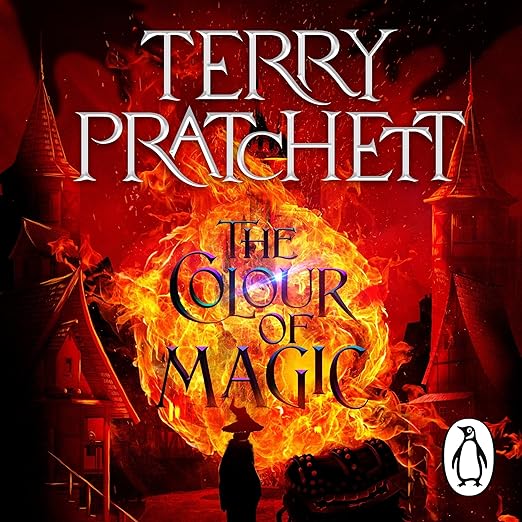
Quick Take
- Narration: Colin Morgan anchors the novel with a slightly wonder-struck quality that suits Rincewind’s terrified incompetence, while Bill Nighy’s footnotes and Peter Serafinowicz’s Death are the production’s genuine highlights.
- Themes: Tourist-as-plot-engine, parody as world-building, death as a patient bureaucrat
- Mood: Anarchic and gleeful, with an underlying fondness for the genre conventions it is simultaneously dismantling
- Verdict: The Penguin Audio production of the Discworld launch novel is an event recording, Nighy, Serafinowicz, and Morgan together make this the definitive audio version of a forty-year-old classic.
I was halfway through my morning commute when Peter Serafinowicz first spoke as Death, and I had to suppress a laugh so badly that the person next to me on the train gave me a sideways look that I entirely deserved. The Colour of Magic is not the best Discworld novel, Pratchett himself said he was still finding the voice, and the shape of the series becomes much clearer by Guards! Guards! or Small Gods, but this Penguin Audio production makes a strong argument that it might be the best Discworld audiobook.
The novel itself is the origin point: Rincewind, the world’s most comprehensively failed wizard, is press-ganged into serving as a guide for Twoflower, who is the Disc’s very first tourist. Twoflower is from a distant city, carries a camera-like device called an Iconoscope, and has enough gold to destabilize local economies. He is also completely fearless in a way that has nothing to do with bravery and everything to do with being too naive to recognize mortal danger when it is standing in front of him holding a weapon. Rincewind, who recognizes mortal danger in absolutely everything, finds this combination intolerable and is stuck with it anyway. The journey that follows takes them across a Disc that is clearly being invented in real time, Pratchett is building the world as he writes it, and there is an improvisational energy to the early Discworld novels that later disappeared as the setting became more established.
What Three Voices Do for One Novel
The production of this audiobook is significantly more elaborate than a standard solo narrator recording. Colin Morgan is the primary voice, Rincewind, Twoflower, the connective tissue of the narration. He brings a slightly breathless, perpetually startled quality that suits the novel’s pace, though his performance is occasionally more efficient than inspired. The production’s real investment is in the supporting roles.
Bill Nighy reads the footnotes. This matters more than it might sound. Pratchett’s footnotes are not marginal, they frequently contain the best jokes in the chapter, the philosophical asides that give Discworld its intellectual texture, the observations about the nature of magic and gods and human foolishness that separate these novels from genre parody. Nighy’s delivery, which is characteristically slow and weighted and slightly amused, gives each footnote the status it deserves. He reads them as things worth pausing for, which they are.
Peter Serafinowicz’s Death is a different achievement entirely. Death appears throughout the Discworld novels as a figure who is fundamentally more interested in humans than in dying, a character who speaks in small capitals on the page and who has developed a genuine fascination with the mortal experience he administers. Serafinowicz plays him with a grave, patient cadence that is somehow both menacing and warmly comic at once. His Death does not seem to enjoy his job so much as accept it with the equanimity of someone who has done it since before time began and finds mortals increasingly interesting.
Entry Point or Mid-Series Gateway
The Penguin Audio edition notes that The Colour of Magic is the first book in the Discworld series but adds the caveat that the novels can be listened to in any order. The second part of that statement is more true for books five and onward than for the opening volumes. The early Discworld is a different animal from the mature series, more explicitly satirical of sword-and-sorcery fantasy, more interested in the mechanics of genre parody, less emotionally sophisticated. Readers who came to Discworld through Death or the Witches or the City Watch may find the opening novel slightly thinner than what they encountered first.
That is not a criticism so much as context. The Colour of Magic is brilliant for what it is: a debut novel by a writer who was clearly going to be extraordinary, working at about eighty percent of what he would eventually become. James Hannigan’s new theme tune, mentioned in the production notes, adds a dimension that the text alone cannot provide, Discworld with a score is Discworld with a slightly different emotional register, and it works.
Who Should Listen / Who Should Skip
Listen to this if you are new to Discworld and want to begin at the beginning, if you are returning to a series you love and want a production-quality recording, or if you want to hear Bill Nighy read footnotes, which is, I promise, a more compelling experience than that sentence makes it sound. Skip this if you are a Discworld completist looking for the emotionally richest entry: that is not this book’s strength. Also know that this novel ends on a deliberate cliffhanger, plan to have The Light Fantastic ready to follow immediately.
Frequently Asked Questions
Why does this production have multiple voice actors, and do they work together cohesively?
The Penguin Audio edition casts Colin Morgan as the primary narrator, Bill Nighy for the footnotes, and Peter Serafinowicz as Death. The three voices are used consistently and deliberately, creating a production that feels closer to a drama than a standard reading. They work extremely well together.
Is The Colour of Magic the best place to start Discworld, or should new listeners begin elsewhere?
It depends on what draws you to the series. Beginning at Book 1 provides the foundation. However, Discworld’s mature strengths, emotional depth, fully realized world-building, complex satire, are more evident from Book 8 onward. Many Discworld fans recommend starting with Guards! Guards! or Mort alongside this first volume.
How prominent are Bill Nighy’s footnote readings, and are the footnotes important to the novel?
Pratchett’s footnotes carry some of the best jokes and observations in the book. Nighy appears frequently throughout the recording, and his unhurried delivery gives the asides the weight they deserve.
Is The Colour of Magic genuinely standalone, or does it end on a cliffhanger?
It ends on a deliberate cliffhanger resolved in the second novel, The Light Fantastic. It is more accurately described as the first half of a duology than a standalone entry, plan to listen to both.