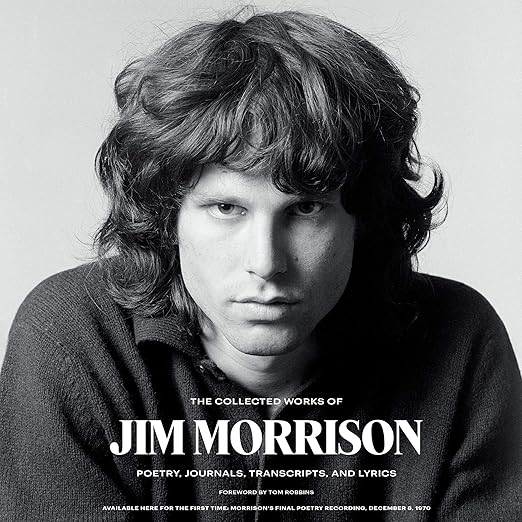
How much of the man behind the Doors actually survives in his own handwriting, in his own voice, in notebooks he never intended anyone else to read? This audiobook edition of The Collected Works of Jim Morrison answers that question about as completely as any single production could, built around his final poetry recording, made at the Village Recorder in West Los Angeles on his twenty-seventh birthday, December 8, 1970.
The Posthumously Discovered List Titled Plan for Book
This is not a single-narrator audiobook in any conventional sense. Morrison's own archival recording anchors the production, and it is joined by a cast of readers assembled with his estate's direct collaboration: Patti Smith, Liz Phair, Oliver Ray, Tom Robbins, Frank Lisciandro, Anne Morrison Chewning, Sefton Graham, and Ian Morrison each take on portions of the poetry and notebook material drawn from twenty-eight privately held notebooks. The project traces back to a posthumously discovered list Morrison himself titled 'Plan for Book,' which makes this less an editor's assembly of scattered work and closer to the book he intended to publish, finally realized decades later.
Reviewer Amazon Customer offers the most personal account attached to this listing: someone who discovered the Doors at fifteen, is now fifty-eight, and once read their own original poetry at Morrison's grave in Paris in October 2016. That kind of decades-long relationship with the material is the audience this production is built for, and the audiobook rewards it, treating Morrison's writing with the same seriousness his estate clearly intended when they greenlit a nearly six-hundred-page anthology built around it.
Morrison saw himself as a poet first, publishing two collections, The Lords and The New Creatures, during his own lifetime, well before most of the wider public understood him as anything beyond the Doors' frontman. That self-image is the entire organizing principle behind this collection, and it explains why the estate assembled a production this literary in ambition, complete with a foreword from novelist Tom Robbins, rather than a simpler audio version of previously published lyrics.
The Real Jim Morrison Rather Than the Rock-Star Myth
Reviewer Jeddy 3 calls this the book fans have been waiting for across half a century, and the scale of the production supports that claim: a foreword from Tom Robbins, an introduction and notes from editor Frank Lisciandro, and a prologue from Morrison's sister, Anne Morrison Chewning. Reviewer Tome Raider, initially hesitant to spend this much on what they expected to be simply another Doors product, came away convinced by the argument that Morrison stands as a genuinely important twentieth-century artist independent of the band, calling this the real Jim Morrison rather than the rock-star myth.
Hearing Morrison read his own poetry aloud, even in a recording made on his last birthday, carries an intimacy that a printed page of the same words cannot fully replicate. Multi-performer audiobooks built around a poet's own archival voice are rare, and this one uses that rarity well, giving listeners access to a document, a man reading his own final testament in a recording studio, that most fans assumed no longer existed in any usable form.
The Short Film Never Released During His Lifetime
The physical book this audiobook accompanies is described as an oversized, visually dense collector's item, with one hundred sixty visual components including handwritten notebook facsimiles and rare photographs, and a supplemental enhancement PDF is included alongside the audio specifically to carry that visual material. Listeners who want the full collector's-item experience, seeing Morrison's actual handwriting rather than hearing it read aloud, will need to open that companion PDF rather than expecting audio alone to replicate it.
This is fundamentally a poetry and archival document, not a linear narrative, so pacing expectations should shift accordingly. It rewards browsing and returning to specific sections rather than one continuous sit-through, closer to how a listener might revisit a favorite album than how they would binge a novel. The rating currently sits at 4.8 from only two listeners, an encouraging but very small sample worth knowing before treating it as a fully proven quantity.
The notebooks excerpted here include material from Morrison's 1970 Miami trial, a genuinely turbulent, controversial chapter of his life connected to a 1969 concert, and hearing that material read aloud rather than encountered as a historical footnote gives listeners a more direct sense of what he was actually thinking and writing during one of the hardest stretches of his public life. His sister Anne Morrison Chewning's prologue adds a layer of family authentication that a purely commercial anthology could not claim.
The collection also includes the shooting script and stills from HWY, an experimental short film Morrison made himself and never released commercially during his lifetime, a genuinely obscure artifact that most fans have only heard about secondhand. Including it here, alongside his poetry and notebooks, reinforces the anthology's larger argument: that Morrison saw himself as a working artist across multiple mediums, not simply as a rock frontman who happened to write. A real tension, worth sitting with as a listener, runs between the chaotic public image most people associate with Morrison and the evidence here of a private, disciplined creative practice sustained across notebooks he kept for years.
Hearing His Actual Voice, Recorded on His Final Birthday
This audiobook is built for serious Doors fans, poetry listeners drawn to archival readings by the writers themselves, and literary historians interested in Morrison's work outside the band's music entirely. The involvement of Patti Smith and Tom Robbins alongside Morrison's own family signals a production made with real care for his actual literary legacy.
Skip this one if what you actually want is a biography of Morrison or the Doors, since this audiobook is built from his own writing rather than anyone's account of his life. For the audience it is made for, hearing his actual voice, recorded on his final birthday, read alongside performers his own estate chose to carry the rest, is a genuinely rare listening experience.