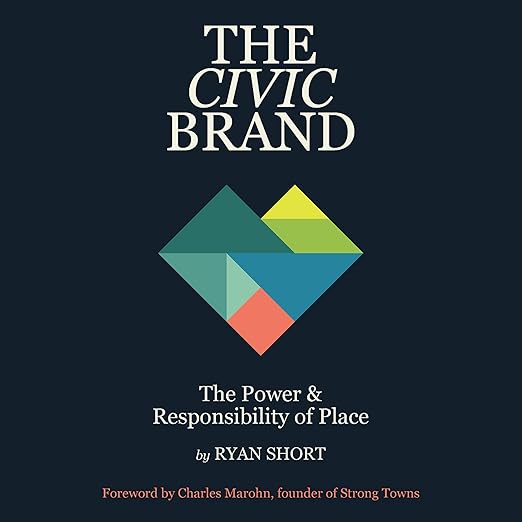
I came across The Civic Brand when I was looking for something that sat at the intersection of urban policy and communication strategy, a narrow shelf, and not one I expected to yield a genuinely engaging audiobook. Ryan Short's book, narrated by David Bryant over a brisk five and a half hours, turned out to be something closer to a manifesto than a manual: a direct, sometimes impassioned argument for why cities need to stop treating branding as a logo exercise and start treating it as a framework for governing their own futures.
Short brings years of practical experience working with municipalities across the United States, and that ground-level credibility runs through the book's best passages. He is not writing from theory alone, he is writing from rooms where the wrong decisions were made and from towns where the right ones turned everything around. The book was released in September 2025, and it lands in a moment when questions of place identity, who belongs, who benefits, who shapes the story of a community, feel genuinely urgent.
A Triple Bottom Line for Civic Branding
The book's central argument is that fragmented civic efforts, siloed departments, surface-level marketing campaigns, development strategies disconnected from community identity, leave cities vulnerable to exactly the forces they are trying to navigate: overtourism, decline, gentrification, disengagement. Short proposes a "triple bottom line" framework for place branding that integrates equity, economic vitality, and community pride rather than treating them as competing priorities.
What makes this worth listening to is not so much the framework itself, which is broadly sensible and not radically new, but the quality of the field stories Short uses to illustrate it. Reviewers consistently note that he makes connections that seem obvious once named but that are genuinely absent from most planning conversations. One listener described his thinking as seeing things "other people don't" and connecting them in ways that feel earned rather than forced. Bryant's narration supports that quality: clear, measured, never flashy, letting Short's arguments carry their own weight.
Bryant's Delivery Honors Short's Direct Writing
The audiobook format works well for this kind of practitioner-focused nonfiction. At just over five hours, Short covers enough ground to build a complete argument without overstaying his welcome. The material is dense enough to reward focus but accessible enough that listeners without a background in urban planning will follow without difficulty. Short's writing is direct, he is not trying to impress you with vocabulary, he is trying to change how you think about a problem, and Bryant's delivery honors that directness.
For anyone working in economic development, city planning, tourism policy, or community engagement, the value proposition is clear. Short challenges what he calls the "logos and slogans" conception of place branding and replaces it with something more ambitious: a call to use identity as a policy tool, a way to unite competing interests around a shared civic narrative. Whether that argument is new to you or confirms what you already believed, the field stories give it enough texture to remain interesting throughout.
Seven Reviews and a Fairly Specific Audience
The book's audience is fairly specific, and listeners outside that audience may find some sections feel aimed past them. If you are not professionally engaged with questions of municipal planning or community development, the case studies may read as interesting but somewhat abstract. Short does his best to universalize the argument, framing place-shaping as something that concerns everyone, not just city leaders, but the book's strongest moments are the ones pitched directly at practitioners.
The rating count is low (seven reviews at time of writing), which reflects the book's recent release and specialized audience rather than any quality issue. The reviews that exist are enthusiastic and specific, citing Short's ability to make the connected nature of tourism, planning, and engagement visible in ways that standard siloed thinking obscures.
Essential Listening for Civic Leaders and Residents
Essential listening for anyone in civic leadership, economic development, place marketing, or urban planning who has felt the limits of conventional branding thinking. Also worthwhile for engaged residents and community organizers who want a vocabulary and framework for the kinds of arguments they are already making intuitively. General nonfiction listeners with an interest in cities and community identity will find it accessible, even if some sections speak more directly to professionals. Short has written a book that rewards the people already in the room and may convince a few who were not sure they needed to be there.