Quick Take
- Read by: Sabrina Pellerito reads a leadership title whose own description promises it absorbs easily on the move, a claim that suits the board-communication chapters better than the quantification ones
- At its heart: The security chief moving from technical operator to executive, risk priced in financial terms, boards and regulators raising the bar
- Vibe: Direct and pragmatic, written for people already in the room
- Short version: Genuinely useful for security leaders who need the business argument, and the wrong format for anything you plan to look things up in.
Board meetings, cyber insurance, and the question of what counts as material are not what most people picture when they imagine a security chief's working day, and that gap is exactly the argument being made. The CISO 3.0 holds that the job stopped being a technical one some time ago and that a great many people doing it have not noticed yet. This audiobook runs twenty-one hours, which is a serious commitment for a leadership title.
Pellerito's Reading Cannot Fix Risk Quantification
Cybersecurity leadership has changed while the playbooks have not, according to the framing on this page, and the promised correction is a move away from technical controls and compliance checklists toward being trusted as a business and risk leader. That is a real transition and a genuinely difficult one, because it asks somebody to give up the part of the job they were good at in favor of a part nobody ever trained them for.
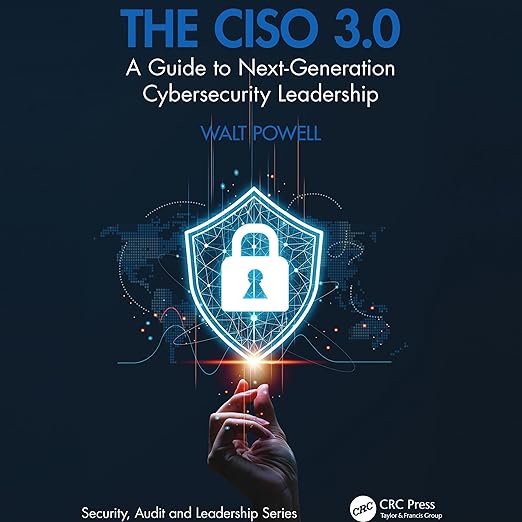
Powell's credentials are stated rather than demonstrated on the listing: veteran Field CISO and executive advisor, drawing on experience advising hundreds of organizations. Notice what the listing does not carry. The full title is The CISO 3.0: A Guide to Next-Generation Cybersecurity Leadership, and that subtitle appears only inside the description, never in the title field itself. A browser scanning search results sees three words and a version number.
Sabrina Pellerito is credited with the reading, and the description makes a specific claim about the format that deserves testing: that it makes board-level communication strategies, modern risk frameworks and leadership insights easy to absorb while on the move. Some of that travels beautifully. Communication strategy is verbal by nature. Risk quantification is not. It runs on numbers, matrices and worked comparisons, and none of those improve by being spoken aloud in traffic.
Five Months Separate the Review From the Recording
Everything in here rests on quantification, which is also why the book exists at all. The description lists risk quantification, cyber insurance, materiality, metrics, resilience and AI as the subjects broken down in actionable language, and that list is a fair map of what a security executive now has to argue about in front of people who do not care about controls. Translating technical exposure into financial terms is the entire job now.
Materiality in particular has become unavoidable, and it is the sort of subject that punishes vagueness ruthlessly. The stated position is that this is not theory or abstract leadership advice, and that the practical guidance covers earning executive trust, prioritizing investments, justifying budgets, and moving security from a cost center to something the business treats as an enabler. Whether it delivers on the specifics is not something the response pool can yet confirm.
One response exists, five stars from September 2025, and it is warm without being detailed: a no-brainer for seasoned cybersecurity professionals and for novices wanting to learn more, well written, easy to follow, and destined to serve as a reference guide for years to come. That final phrase is the most useful thing in the note, and also the most awkward, for reasons the next section takes up.
Dates on this page do not line up either. That single response was posted on September 9, 2025, while this recording did not reach listeners until February 16, 2026. Five months of daylight sit between them, which means the one endorsement anybody can read was written by somebody holding a text rather than listening to audio. That remains a perfectly valid endorsement of the writing. It says nothing whatsoever about the reading.
Both Votes Are Fives, One Wrote Nothing
Reference guide is the phrase that gives me pause. A book somebody expects to return to for years is a book they expect to look things up in, and audio is the worst format ever devised for lookup. You cannot scan twenty-one hours. You cannot flip to the materiality section in the hour before a board prep. If the recording is your only copy, the format is working against the purpose.
The rating line carries its own gap. Two ratings, a 5.0 average, which means both votes are fives and one of the two people never wrote a word. A perfect average across two votes is not evidence about quality; it is evidence of a very small sample. Anybody treating that 5.0 as a signal is reading noise, and on a book aimed squarely at people who quantify risk for a living, the irony is difficult to miss.
Metadata around the edges is loose as well. The publisher field simply repeats the author's name, which usually indicates independently produced audio rather than a house release, and the series field names Security, Audit and Leadership with no number attached, so nothing on the page tells you where this volume sits inside that run or whether it assumes any of the others.
It Is a Leadership Book in a Security Jacket
Security leaders already carrying the title, or one promotion short of it, are the target and will take the most from this. The vocabulary is the vocabulary of a board conversation, and anybody who has had to justify a security budget in front of a finance committee will recognize the problems within the first hour. Aspiring CISOs get the roadmap. Sitting CISOs get the argument they have been struggling to phrase.
Practitioners wanting technical depth should look elsewhere without hesitation. Nothing here concerns architecture, detection engineering, or how any individual control actually behaves under pressure. The book explicitly moves past technical controls, which is the entire point and also the disappointment for anybody hoping a long cybersecurity title would spend some of that length on security itself.
The CISO 3.0 is a leadership book wearing a security jacket, and it is honest about that from the first line of its description. Take it if the hard part of your week is the meeting rather than the incident. Skip it if what you want is something to look things up in later, because this format cannot support that use no matter how good the underlying material turns out to be.
Frequently Asked Questions
Is this audiobook technical enough for hands-on security engineers?
No, and it says so. The stated aim is to move past technical controls and compliance checklists entirely. Expect risk quantification, cyber insurance, materiality, metrics and board communication instead of architecture or tooling. Engineers curious about how decisions get made above them will still find it useful, just not as a technical resource.
Does this audiobook work well for board preparation?
In part. The communication material is verbal by nature and survives the format easily, so absorbing it during a drive is realistic. Anything numerical is harder, and the recording gives you nothing to scan when you need one specific framework the night before a meeting. Pair it with the text if the stakes are high.