Quick Take
- Narration: Malcolm Hillgartner handles the diplomatic and military material with assured authority, pacing the complex negotiations and character portraits at a speed that lets the drama breathe.
- Themes: Failed diplomacy, Cold War origins, the personal costs of impossible mandates
- Mood: Tense and richly rendered, with the weight of historical consequence on every chapter
- Verdict: One of the finest American diplomatic histories in recent years, with the narrative momentum of good fiction and the scholarly rigor of serious history.
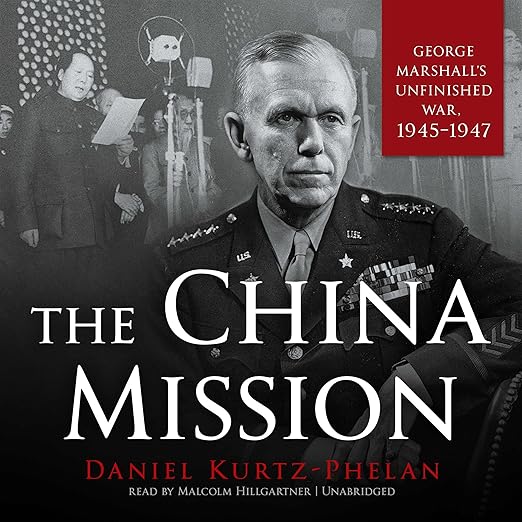
I came to The China Mission having spent several weeks on other books about the early Cold War, and I was expecting something solid but relatively technical. What Daniel Kurtz-Phelan had actually written was something closer to a tragedy in the classical sense: a man of extraordinary competence sent on a mission that was probably impossible from the start, making consequential decisions under pressure that would define the rest of his career and shape the entire Cold War order. I was a third of the way through before I realized I had stopped thinking of it as a history book and started reading it the way I read novels. That is not a common experience with diplomatic history, and it is worth understanding how Kurtz-Phelan achieves it.
The mission at the book’s center is George Marshall’s deployment to China in late 1945, just as the second world war ended. Marshall, who had just been celebrated as the architect of Allied victory in Europe and the Pacific, was asked by President Truman to broker a peace between Chiang Kai-shek’s Nationalists and Mao Zedong’s Communists before their civil war could escalate into something that might draw the United States into a third world war. He was given thirteen months. The mission is, as Kurtz-Phelan frames it, a neglected turning point, a story that explains the entire shape of American foreign policy for the next generation and that most general readers have never encountered in any detail.
Marshall as the Lens for an Impossible Task
Kurtz-Phelan’s central achievement is his portrait of Marshall himself. Marshall is one of those historical figures who can be difficult to make vivid, because the qualities that made him genuinely remarkable, his selflessness, his refusal of credit, his almost total absence of personal vanity, are not the qualities that make for conventional dramatic subjects. Kurtz-Phelan finds the human texture in Marshall’s quiet determination and in the accumulation of pressure he faced from all sides simultaneously: Mao distrusting American motives, Chiang refusing to cede real authority, American domestic politics pushing for simplistic solutions, and all the while the clock running on a narrow window for a negotiated settlement.
The early sections of the mission are genuinely gripping. Marshall’s initial successes in negotiating a ceasefire and the outlines of a political settlement seemed, briefly, miraculous. Reviewers noted correctly that this is a part of history that has received very little popular attention, and Kurtz-Phelan handles the early diplomatic progress with the detail and care it deserves. When it begins to come apart, as it inevitably does, the reader feels the collapse the way you feel the collapse of something you had briefly hoped might succeed.
The Personalities Around the Negotiating Table
One of the particular strengths of this narrative is its treatment of the secondary figures. Zhou Enlai emerges as one of the most compelling presences in the book: charming, linguistically gifted, strategically brilliant, and fundamentally committed to a Communist victory that he never allowed his charm or his negotiations to endanger. Chiang Kai-shek and Soong Mei-ling, his formidable wife, are portrayed with complexity rather than caricature. The card games and cocktails mentioned in the synopsis were real, and Kurtz-Phelan uses these moments of social diplomacy to illuminate the personalities involved in ways that formal treaty analysis cannot. The human texture of the negotiating process, conducted across card tables and through interpreters in heavily guarded compounds, gives the book a dramatic immediacy that most diplomatic histories achieve only in their most vivid passages, and that this one sustains throughout.
The Mao Zedong portrait is somewhat more limited by the available sources, but Kurtz-Phelan is honest about this. The eyewitness accounts he draws on are more numerous and more detailed on the Nationalist side, and the Communist leadership, while present throughout, is somewhat more opaque. This is a function of the historical record rather than an authorial choice, and the author navigates it with appropriate transparency.
McCarthyism and the Question of Who Lost China
The second half of the book, tracing what happened after Marshall returned to the United States in early 1947, is in many ways as important as the mission itself. The question of who lost China, which became a flashpoint for McCarthyite attacks on the State Department and on Marshall personally, is traced with careful analytical precision. Kurtz-Phelan is clear about what the accusations were, what they cost, and why they were wrong without being polemical about it. The connection between Marshall’s China failure and the broader pattern of McCarthyism is one that general readers may not have understood clearly before, and the book makes it illuminating. The China Mission is one of those rare histories that explains not only what happened but why it has been so difficult for Americans to reckon with what happened.
Malcolm Hillgartner and the Scale of the Narrative
Malcolm Hillgartner’s narration is consistently reliable for detailed political and military material, and his performance here is particularly well-suited to this book. The text shifts between intimate biographical detail and large-scale geopolitical analysis, and Hillgartner manages those shifts without losing the thread or the pace. The 14-hour runtime is substantial but feels earned by the material. There is no padding, and no section outstays its welcome.
Who Should Listen, Who Should Skip
The China Mission is the kind of book that rewards listeners who care both about American foreign policy history and about individual human stories within that history. It is not primarily a military history; the fighting in the Chinese civil war is background rather than foreground. But as a work of diplomatic history with genuine narrative drive and serious analytical ambition, it stands with the best of recent American historical writing. Listeners already steeped in Cold War history will find new texture here; listeners coming to the subject fresh will find an unusually accessible entry point into one of the most consequential periods of the twentieth century.
Frequently Asked Questions
Do I need background knowledge of the Chinese Civil War to follow this audiobook?
No prior knowledge is required. Kurtz-Phelan provides enough historical context to orient new readers, and the book is explicitly designed to illuminate a neglected turning point that most general readers do not know well. The narrative momentum pulls you through the context rather than requiring you to have absorbed it first.
How much of the book focuses on Marshall’s later career, including the Marshall Plan, versus the China mission itself?
The primary focus is the thirteen months of the China mission itself. The Marshall Plan and Marshall’s subsequent career as Secretary of State are addressed, particularly in the context of how the China mission shaped his legacy, but they are not treated in the same detail as the events in China.
Does the book take a position on whether Marshall made the right choices during the mission?
Kurtz-Phelan is analytical rather than prescriptive. He presents the choices Marshall faced and the constraints he operated under with evident sympathy for the difficulty of the mandate, while being honest about where the mission failed. The overall framing suggests the mission was probably not achievable given the conditions on the ground, but the author presents the evidence and allows readers to form their own conclusions.
How does this compare to Barbara Tuchman’s Stilwell and the American Experience in China?
Tuchman’s Stilwell is the natural comparison point. Both books cover the American military engagement with wartime and postwar China through the lens of a single senior figure. Kurtz-Phelan is more focused on the diplomatic dimensions and more contemporary in his scholarly apparatus. They complement each other well, with Stilwell covering the wartime period and The China Mission picking up immediately after.