Quick Take
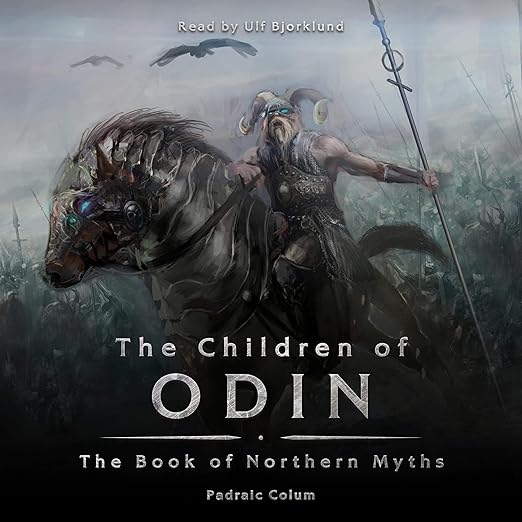
- Narration: Ulf Bjorklund brings Scandinavian cadence to Padraic Colum’s prose retellings, adding an authenticity of register that generic narrators would lack.
- Themes: The Norse mythological cycle from creation to Ragnarok, divine family conflict, fate and heroism
- Mood: Elemental and unhurried, with the rhythmic quality of oral tradition committed to the page
- Verdict: One of the most satisfying audio treatments of Norse mythology available, particularly for listeners who find Neil Gaiman’s version too modern in tone.
I have a long and not entirely rational attachment to Padraic Colum. He is one of those writers who operated in the early twentieth century with genuine reverence for the source materials he was adapting, without the condescension toward mythological tradition that sometimes colored that era’s retellings. His Children of Odin, originally published in 1920, was produced as a serious literary work for young readers but consistently reads as something more than that. I listened to this version over three evenings last autumn, when the light was going early and the quality of the darkness felt appropriate to the material.
Ulf Bjorklund’s narration is worth noting immediately, because the casting decision here is meaningful. A narrator with Scandinavian linguistic roots brings something to Colum’s prose that an anglophone narrator, however capable, would struggle to replicate: the sense that the words Odin, Thor, Freyr, and Skadi land in a mouth that has some relationship to their acoustic origins. Bjorklund reads with the measured gravity the stories require.
Colum’s Method and Its Distance from Gaiman’s
Several listeners have drawn the comparison to Neil Gaiman’s Norse Mythology, published nearly a century after Colum’s original, and the comparison is useful precisely because the two approaches are so different. Gaiman writes as a storyteller who loves the material and wants to make you love it too; his prose is warm, often wry, and consciously contemporary. Colum writes as someone translating a sacred inheritance, preserving the formal dignity of the Eddic sources while making them accessible without modernizing them into something lighter than they are.
Ragnarok, the twilight of the gods, reads differently in Colum than in Gaiman. In Colum it carries the weight of actual doom, the sense that the gods themselves are moving toward their ordained destruction with full knowledge and without the possibility of escape. The Eddic fatalism is present rather than softened. This makes the book more austere but also, for certain readers, more truthful to the mythological tradition it draws on.
The Structure of the Sagas
Colum organizes the Norse myths into a continuous arc that begins before the world’s creation and moves through the major cycles: Odin’s self-sacrifice on Yggdrasil, Thor’s encounters with giants, Loki’s escalating treachery, Baldur’s death and the events that lead toward Ragnarok. The structure imposes more narrative coherence than the original Eddic texts possess, which is appropriate for an audiobook designed to be experienced as a unified work.
The book is categorized as children’s mythology by some libraries and readers, and one reviewer here explicitly identifies it as aimed at children and young people. This is accurate in the sense that Colum designed it to be readable by young audiences, but it is a significant undersell. The language is elevated, the themes genuinely dark in places, and the emotional register more serious than most contemporary children’s publishing would permit. Adult listeners should not be deterred by the classification.
Six Hours with the Norse Pantheon
At six hours and twenty-two minutes, The Children of Odin sits in a comfortable middle range for mythology listening. Long enough to feel complete, short enough to sustain focus across two or three sessions. Bjorklund’s pacing is deliberate without becoming slow; he understands that the rhythm of the sentences needs space to breathe.
The book works particularly well for listeners who are new to Norse mythology and want something more literary than a Wikipedia survey but less scholarly than a translation of the Prose Edda. It also works for experienced readers who want to return to these stories in a version that feels like it was written to be heard. Colum’s prose has a natural oral quality that the audio format rewards.
Listening Contexts and Honest Caveats
This is a book for quiet attention rather than background listening. The formal prose and the mythological density reward engagement. Driving or gym sessions are not the right venue; a walk or an evening at home will serve it better.
The single honest caveat is that listeners expecting a pace or tone comparable to contemporary mythology retellings, whether Gaiman, Rick Riordan, or others, will find Colum’s approach more demanding. The dignity is real but so is the distance. If you want to feel the genuine weight of the Norse mythological tradition rather than a modern approximation of it, that distance is the point.
Frequently Asked Questions
How does this version compare to Neil Gaiman’s Norse Mythology for someone who has already listened to that audiobook?
The two books complement rather than duplicate each other. Gaiman’s version is warmer, more contemporary in voice, and more playful. Colum’s version is more formally literary, more faithful to the Eddic sense of fate and doom, and written with less narrative mediation between the source material and the reader. Listeners who loved Gaiman will find Colum a more demanding but ultimately deeper encounter with the same mythology.
Is The Children of Odin appropriate for adult listeners despite its classification as a children’s book?
Yes, fully. Colum wrote in elevated prose that reads as serious literary work, and the themes, including death, betrayal, cosmic doom, and the mortality of gods, are treated with genuine gravity. Adult listeners are the book’s most natural audience for the audiobook format.
Does Ulf Bjorklund’s Scandinavian narration style affect comprehension for American listeners unfamiliar with the accent?
Bjorklund’s narration is clear and unhurried, and the accent is mild enough that comprehension should not be an issue for any attentive English-language listener. The slight Scandinavian cadence actually enhances the listening experience for most reviewers who mention it.
Does the audiobook cover all the major Norse myths including Ragnarok, or does it end before the final sequence?
The book covers the full mythological arc from creation through Ragnarok. Colum organized the sagas into a continuous narrative sequence, and the ending includes the apocalyptic events that define the Norse cosmological tradition.