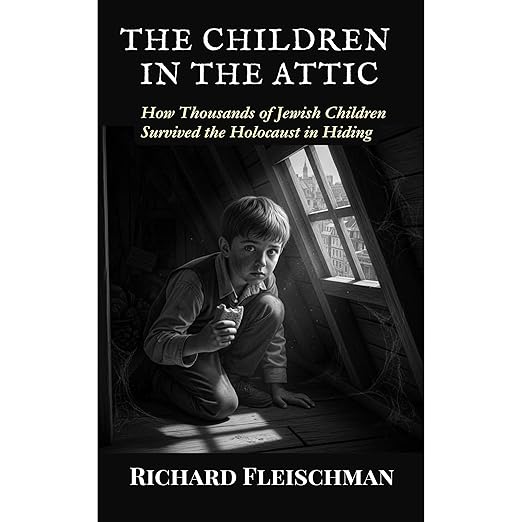
Richard Fleischman's The Children in the Attic arrives as an audiobook with a subject that demands a particular kind of attentiveness from the listener. This is a work of historical nonfiction drawing on survivor testimonies, secret diaries, and archival records to reconstruct the experiences of Jewish children who survived the Nazi occupation by hiding - in attics, cellars, forest bunkers, and under false identities in plain sight. The narrator here is a Virtual Voice rendering, which is worth acknowledging directly: AI-generated narration of Holocaust testimony carries specific limitations, particularly in its inability to convey the emotional register of survivor voices with the authenticity a human narrator could bring. Listeners should understand this going in. What the audiobook offers nonetheless is access to the historical record Fleischman has assembled, across five hours and thirty-three minutes, organized around the variety of hiding places and the moral choices made by those who offered shelter.
Fleischman's research encompasses a remarkable geographic range: from Anne Frank's attic in Amsterdam to forest hideouts in Poland and Hungary, from the village of Le Chambon-sur-Lignon in France - whose Protestant community sheltered thousands of Jewish refugees - to convents, orphanages, and underground resistance networks. The book does not flatten these stories into a single narrative of heroism. It pays attention to the costs of survival - the isolation of children who could not make noise, could not play, could not go to school; the psychological fracturing of those who lived under false identities for years; the lifelong difficulty of reclaiming a self that had to be suppressed to stay alive. This is the book's most valuable contribution: it insists on the full human reality of what survival meant rather than stopping at the fact of it. The Virtual Voice narration handles the descriptive and archival passages adequately, though the testimonial sections lose some of their humanity in the delivery.
A Lyrical Voice That Survives Synthetic Narration
Audio is not always the optimal format for heavily research-based historical nonfiction, but The Children in the Attic benefits from the listening context in specific ways. The book is organized thematically - by type of hiding place, by region, by category of rescuer - rather than as a single biographical narrative, and the audio format allows that structure to build cumulatively without demanding the kind of cross-referencing that a print reader might do. Fleischman's lyrical narrative voice, as the synopsis describes it, is present in the prose, and even a synthetic narration preserves the cadence of that writing. The thematic organization means each chapter functions as a discrete unit, which makes it easier to process emotionally difficult material in segments rather than all at once. This is not an easy listen, and it is not designed to be. The moral weight is appropriate to the subject.
More Ambivalent Than a Redemptive Narrative
The book encompasses both the extraordinary acts of rescue - Le Chambon's organized sheltering operation, the network of convents that provided false identities - and the betrayals that ended many hiding arrangements. Fleischman does not minimize the latter. Listeners who come to WWII history expecting a predominantly redemptive narrative will find this book more ambivalent and more accurate. The sections on the postwar experience of hidden children - the difficulty of returning to communities that had moved on, the lack of psychological support, the silence that many survivors maintained for decades - are among the most significant parts of the book and among the least commonly discussed in popular Holocaust history. The research draws on diaries and testimonies that were often kept secret for years after the war, which gives the book access to perspectives that were historically suppressed. That recovery of suppressed voices is the book's central purpose, and it fulfills it with meticulous care.
Anne Frank's Diary Placed in a Wider Context
This audiobook is suited to listeners with a serious interest in Holocaust history who want to engage with survivor testimony and archival research rather than narrative dramatization. Those familiar with Anne Frank's diary will find this book placing that famous account within a much broader context of hidden children whose names were never known. Listeners who prefer their WWII history in the form of biography or personal narrative will find Fleischman's thematic structure requires a different kind of engagement - less chronological, more cumulative. The Virtual Voice narration makes this a more functional than immersive listening experience; those for whom the quality of narration is a primary factor should be aware of this. The historical scholarship is the primary value here, and it is substantial.
The book's research attention to Le Chambon-sur-Lignon is worth highlighting specifically. The French Protestant village, which sheltered an estimated three to five thousand Jewish refugees during the occupation, represents one of the most documented collective rescue operations of the war, and Fleischman's treatment of it as one node in a much larger network of hidden lives places it appropriately - as extraordinary but not singular, remarkable but not the only remarkable thing happening in the shadows of occupied Europe. For listeners whose Holocaust history knowledge centers primarily on the German-Jewish experience in urban centers, the geographic range of the book - Poland, Hungary, France, the Netherlands - is a meaningful broadening of the standard frame. The archival records and secret diaries Fleischman draws on were in many cases preserved specifically for the purpose of eventual testimony, and treating them with the seriousness the book extends to them is itself an act of historical respect.
The book's research attention to Le Chambon-sur-Lignon is worth highlighting specifically. The French Protestant village, which sheltered an estimated three to five thousand Jewish refugees during the occupation, represents one of the most documented collective rescue operations of the war, and Fleischman's treatment of it as one node in a much larger network of hidden lives places it appropriately - as extraordinary but not singular, remarkable but not the only remarkable thing happening in the shadows of occupied Europe. For listeners whose Holocaust history knowledge centers primarily on the German-Jewish experience in urban centers, the geographic range of the book - Poland, Hungary, France, the Netherlands - is a meaningful broadening of the standard frame. The archival records and secret diaries Fleischman draws on were in many cases preserved specifically for the purpose of eventual testimony, and treating them with the seriousness the book extends to them is itself an act of historical respect.
Before You Listen
Is The Children in the Attic audiobook appropriate for younger listeners interested in WWII history?
The content is suitable for mature teens and adults with an interest in Holocaust history. The book deals with death, betrayal, trauma, and the psychological aftermath of survival in a direct and honest way. It is not graphic in a gratuitous sense but it does not soften the historical reality either. Parents should use their judgment for younger readers.
How does this audiobook differ from other WWII histories focused on Jewish children, such as accounts of Anne Frank?
Anne Frank's diary is one of the most famous examples of a hidden child's experience, and Fleischman places it within a much larger context of tens of thousands of children who were hidden across Europe. The book deliberately covers stories that remained unknown for decades, including regional rescue networks, underground identity systems, and the postwar experience of survivors whose stories were suppressed or forgotten.
Is the audiobook structured as a narrative or as a collection of separate testimonies?
Fleischman organizes the material thematically rather than as a single continuous narrative. Each section focuses on a category of hiding place or a regional rescue network, drawing on multiple testimonies and archival sources. This means listeners can process chapters as discrete units, which is useful given the emotional weight of the subject matter.