Quick Take
- Narration: Michael Carman handles FitzSimons’s kinetic prose with energy and good timing, he suits the adventure-narrative register that this book demands.
- Themes: Irish political imprisonment and resistance, the intersection of Irish, American, British, and Australian colonial history, loyalty and cunning as survival strategies
- Mood: Propulsive and morally clear, a thriller with a historical conscience
- Verdict: One of FitzSimons’s strongest books, and one of the genuinely gripping true stories in Australian historical writing, the slow opening is worth pushing through.
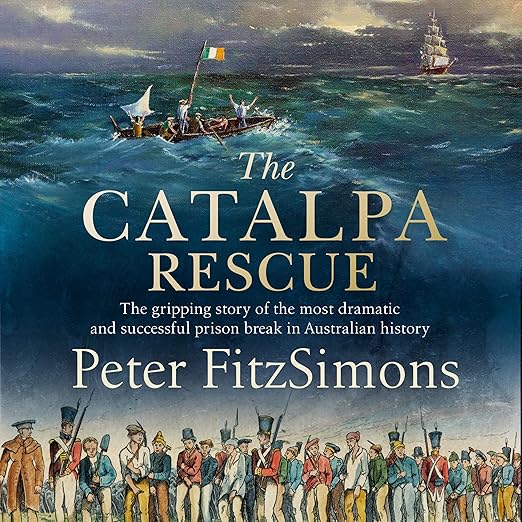
I have a weakness for prison escape stories that have real people in them, and this one is exceptional. The Catalpa rescue, a whaling ship sent from New York to extract six Irish political prisoners from the most remote jail in the British Empire, is the kind of story that sounds invented, and that worked precisely because the British authorities could not quite believe anyone would attempt it. Peter FitzSimons, who has made a career out of recovering buried Australian stories, found in the Catalpa a narrative that splices four national histories together at a single dramatic moment. It earns that framing.
New York, 1874. The Clan-na-Gael, an organization agitating for Irish independence, hatches a plan so audacious that even its own members doubt it: buy a whaling ship, sail it to Western Australia under the cover of a legitimate whale hunt, and extract six Fenian soldiers who have been transported to Fremantle Prison as political prisoners. The plan takes years to execute, involves multiple near-failures, and culminates in a confrontation on the open ocean between the Catalpa and a British government steamer that is as dramatically satisfying as anything in the literary tradition of escape narratives.
Four Nations at a Single Crossroads
What makes FitzSimons’s account more than a straight adventure story is his insistence on what the rescue meant to each of the four nations involved. For Ireland, which had endured 700 years of English occupation, a successful escape was an inspirational call to arms, proof that the empire was not undefeatable. For America, it was an opportunity to humiliate Britain for supporting the Confederacy in the Civil War, a grievance still raw a decade later. For Britain, it was a straight humiliation, the kind that colonial powers find intolerable because it suggests that their authority can be successfully defied. And for young Australia, still uncertain whether it was Great Britain in the South Seas or worthy of being an independent country in its own right, it was proof that the empire’s word was not quite law.
This four-way reading of a single event is one of FitzSimons’s signature moves as a historian, and it is effective here because the event genuinely does carry all four of those meanings. The British authorities’ response to the rescue, outrage, legal threats, diplomatic maneuvering, illustrates exactly why each of these interpretations was accurate.
The Slow Opening That One Review Flags
One reviewer notes that the book starts out a little sluggish before FitzSimons gets into full storytelling mode, and this is honest feedback worth passing on. The opening sections establish the Clan-na-Gael’s internal politics and the mechanics of financing a whaling expedition, which are necessary for the story to make sense but do not have the momentum of the rescue itself. FitzSimons is a thoroughgoing researcher and he does not like to skip the scaffolding. Listeners who commit past the first two hours will find the book accelerates and does not slow down again.
Michael Carman’s narration is well matched to FitzSimons’s style. FitzSimons writes in a muscular, present-tense mode when the action is high, he borrows from cinematic storytelling, and Carman handles those moments with energy. The Irish and American characters are distinguished without caricature, and the pacing in the climactic ocean sequence is excellent.
FitzSimons and the Art of Recovered History
FitzSimons has been accused, not always wrongly, of occasionally privileging narrative excitement over analytic depth. The Catalpa Rescue is one of his books where that tendency is mostly an asset rather than a liability. The story does not need analytical apparatus; it needs a clear narrative line and the patience to let the historical ironies speak for themselves. That is what FitzSimons delivers, and the result is the kind of book that another reviewer described as ripe for a miniseries, not because it is sensationalized, but because the underlying story is that good.
Captain Anthony and the Moral Center of the Story
One figure who deserves mention is Captain Anthony, the American whaler who commanded the Catalpa on its mission. FitzSimons handles Anthony with particular care, because Anthony was not a Fenian sympathizer or an Irish political actor, he was a professional mariner who took a job and then found himself in the middle of an international incident he had not fully anticipated when he signed on. His relationship to the rescue meaning is therefore different from that of the Clan-na-Gael organizers, and FitzSimons is honest about that difference. Anthony decision, when the moment of confrontation came and the British steamer had him outgunned, to hold his course anyway is one of the book best scenes, not because it is heroic in a simple way, but because it is a professional and personal decision made under genuine pressure, with consequences that extended well beyond the immediate situation.
Who Should Listen and Who Should Skip
A strong recommendation for listeners interested in Irish diaspora history, the Pacific colonial world of the 1870s, or simply a true escape story that has been unjustly overlooked. The four-nation framing makes it valuable for anyone interested in how colonial history worked at the intersections between empires. Skip it if you need rigorous academic apparatus, FitzSimons is a narrative historian, and while his research is thorough, his goal is always the story rather than the argument.
Frequently Asked Questions
Who were the six Fenian prisoners that the Catalpa rescued, and are they named in the book?
Yes. FitzSimons identifies and introduces each of the six prisoners individually, giving them biographical context before the rescue narrative begins. They were Irish-born soldiers sentenced to transportation for their role in the Fenian movement.
Does the book cover what happened to the prisoners and the Catalpa crew after the escape?
Yes. FitzSimons tracks the aftermath of the rescue, including the British government’s attempts to recover the prisoners, the diplomatic fallout, and the subsequent lives of the principal figures, both the prisoners and the Clan-na-Gael organizers.
Is The Catalpa Rescue suitable for listeners with no prior knowledge of Irish-Australian history?
Yes. FitzSimons provides the context needed to understand the Fenian movement, the transportation system, and the political dynamics of 1870s Australia. No prior knowledge of this specific history is required.
How does this compare to FitzSimons’s other historical narratives in terms of narrative focus?
The Catalpa Rescue has a tighter narrative focus than some of his larger-scale works, it covers a specific plan and its execution rather than a war or a cultural phenomenon. Reviewers who have read multiple FitzSimons books tend to consider it among his strongest precisely because the story has such a clean dramatic shape.