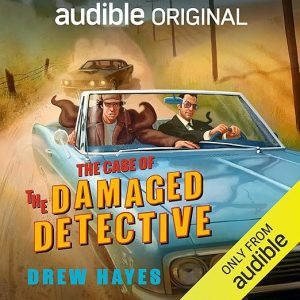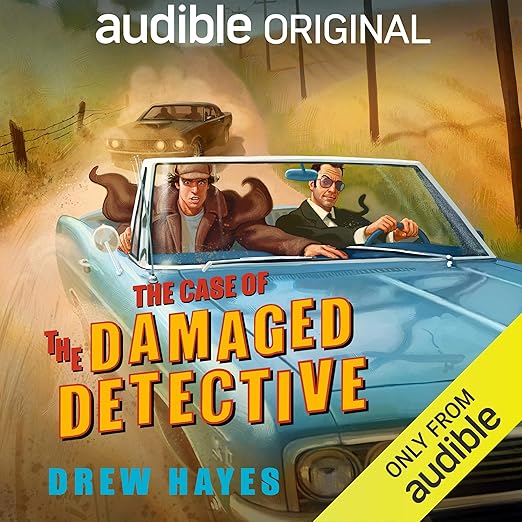
A dance club full of bodies and exactly one survivor, a man raving incoherently in nothing but a deerstalker hat, opens this audiobook, and from that image alone Drew Hayes signals he is going to have fun with his Sherlock Holmes premise rather than reverently recreate it. The Case of the Damaged Detective is book one of the 5-Minute Sherlock series, and the setup, a possibly-brilliant, possibly-broken man code-named after the world's most famous detective, studied by a secret government agency and escorted cross-country by a paranoid, betrayed former agent nicknamed Watson, is exactly the kind of buddy-comedy-meets-mystery hybrid Hayes' fans already know him for.
The Verdict, Briefly
The central gimmick, a man calling himself Sherman Holmes who oscillates between raving lunacy and flashes of genius, is a clever structural solution to a real Sherlock-adaptation problem: how do you make deduction feel fresh again after a century of pastiches. Hayes' answer is to make the deduction itself unreliable and dangerous, Sherman's brilliance is framed as a potential scientific breakthrough locked inside a mind that might be barely functional, which raises the stakes of every insight he offers well above clever observation about a pocket watch.
Watson, or rather the agent using that code name, is doing real emotional work underneath the comedy. The synopsis establishes him as a rising star undone by deadly betrayal, now rebuilding credibility on an assignment nobody wants, and one reviewer specifically praises his character development alongside Sherman's comic energy. That combination, a genuinely wounded straight man anchoring a genuinely unhinged comic lead, is a harder balance than either element alone, and it is the thing that keeps this from being a one-joke premise stretched to eight hours.
The series title itself, 5-Minute Sherlock, is a small joke worth unpacking: it plays on the classic pulp convention of the amateur detective who solves a case through a single brilliant flash of insight, condensed, in theory, into five minutes of actual deduction, surrounded by however many hours of chaos it takes to get there. Naming the series after that compressed moment of clarity rather than after Sherman or Watson themselves signals exactly what Hayes finds funniest about the genre: not the detective, but the absurd gap between genius and the mess required to access it.
The significance the synopsis attaches to Sherman's mind, potentially the greatest scientific breakthrough of the millennium, is deliberately, comically oversized, and Hayes seems fully aware of that. Treating an erratic, hat-wearing club survivor's brain as a hypothetical civilization-altering discovery is exactly the kind of tonal whiplash the book trades in throughout, grounding real government-thriller consequence in a premise this absurd is the joke and the plot engine at the same time, rather than one undercutting the other.
The Best Parts of The Case of the Damaged Detective
Scott Aiello narrates, and one reviewer calls his work superb, specifically praising how he handles this fun, thrilling take on the classic Sherlock Holmes story. A road-trip buddy comedy built on the friction between an unstable genius and an exhausted handler lives or dies on comic timing and voice differentiation, Sherman's manic energy needs to read as genuinely different from Watson's controlled exasperation, and reviewer response suggests Aiello nails that contrast rather than blending the two into generic banter.
The mystery, road trip, buddy comedy, and action adventure blend the synopsis promises works especially well in audio because tonal shifts, a tense action beat sliding into a genuinely funny exchange, land more naturally through vocal performance than they sometimes do on the page, where a reader has to reset their own internal tone. Hayes has a track record here too; he is the author of Second Hand Curses, cited directly in the synopsis, and fans crossing over from that work should recognize the same genre-blending instinct at play.
Modern Sherlock Holmes riffs have become their own crowded subgenre, from prestige television reinventions to straight literary pastiche, and Hayes' approach, treating the Holmes-figure's brilliance as literally, medically unreliable rather than merely eccentric, carves out a genuinely distinct angle within that crowded space. It is a comedic premise, but it also takes seriously a question a straighter adaptation rarely asks: what would it actually look like, physically and psychologically, to have a mind that operates the way fictional detectives are always described as operating.
Points to Consider
More than one reviewer flags editing quality specifically, one notes editing not up to the author's usual standard, worth setting expectations around even though it did not stop that same reviewer from calling the book great overall. This appears to be a production-polish note rather than a story or performance complaint, but it is consistent enough across feedback to mention plainly.
Readers coming in expecting a fairly faithful Holmes riff should note that Sherlock-based characters start to appear as the book progresses, according to one reviewer, suggesting the deeper franchise-parody elements build gradually rather than front-loading immediately in book one. If you want the full genre-parody payoff, patience through the setup chapters is worth it.
This is explicitly the start of a series, 5-Minute Sherlock book one, and while the central mystery, who died at the dance club and why, gets addressed within this entry, the larger Sherman-and-Watson dynamic and the shadowy agency studying him read as ongoing series architecture rather than a fully closed loop. Go in expecting a satisfying single case with bigger threads left open for future books.
At seven hours and forty-nine minutes, the book has room to let its road-trip structure breathe, government facility to cross-country chase to eventual confrontation, without rushing the character work between Sherman and Watson that reviewers single out as the story's real strength. That pacing matters for a book balancing this many tonal registers, comedy, mystery, action, genuine emotional stakes, since a shorter runtime might have forced Hayes to sacrifice one of those threads to serve the others.
Listeners drawn specifically to the mystery-solving mechanics of classic detective fiction should know upfront that this book spends comparatively more time on the road-trip character dynamic between Sherman and Watson than on step-by-step deductive reasoning, the traditional genre's core pleasure. That is a deliberate trade worth knowing about rather than a shortcoming exactly, but it does mean this reads closer to character-driven comic thriller than puzzle-box mystery.
Who Should Listen to The Case of the Damaged Detective
Fans of genre-blending comic mystery, especially anyone who enjoys Sherlock Holmes riffs that play with the format rather than just modernizing the setting, will find a lot to like here. Existing Drew Hayes readers, particularly fans of Second Hand Curses, should consider this a natural next pick, and listeners who want a buddy dynamic with real emotional stakes underneath the jokes will appreciate Watson's arc specifically.
Skip it if inconsistent copyediting genuinely disrupts your listening experience, that specific complaint recurs in reviewer feedback, or if you want a straight, reverent Sherlock Holmes adaptation rather than an irreverent, comedy-forward reinvention of the premise.
In Brief
- Performance: Scott Aiello draws a clean, effective line between Sherman's manic energy and Watson's controlled exhaustion, praised directly by reviewers as superb.
- What it covers: unreliable genius, found partnership under duress, comedy-mystery genre-blending
- Feel: Fast-paced, funny, with real tension underneath the banter
- Our call: A strong start to a genre-blending series for comedy-mystery fans, with editing-polish caveats worth knowing but not dealbreakers.
Before You Listen
Is this audiobook a faithful Sherlock Holmes adaptation?
No, it's an irreverent riff: a man who calls himself Sherman Holmes may be a genius or may be barely functional, and the deeper Holmes-universe references build in gradually rather than being a straight retelling.
Who narrates The Case of the Damaged Detective audiobook?
Scott Aiello, whose performance one reviewer calls superb, specifically for how clearly he differentiates Sherman's unhinged energy from Watson's exhausted control.
Do I need to have read Second Hand Curses before this audiobook?
No, they're unrelated stories by the same author, Drew Hayes, referenced in the synopsis mainly as a signal of his genre-blending style, not as required reading.
Are there editing or quality issues with this audiobook?
A couple of reviewers mention editing not matching the author's usual standard, though it didn't stop them from still rating the story itself highly.