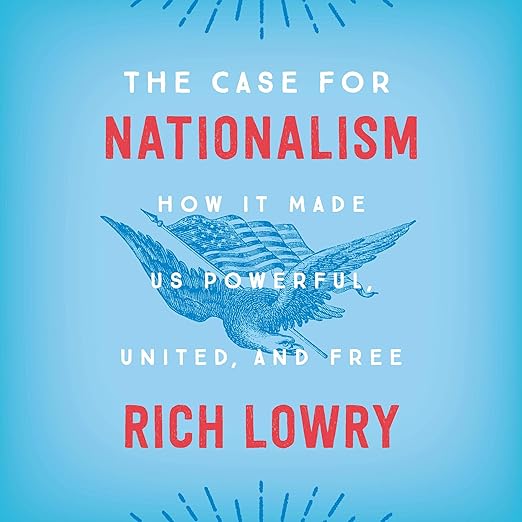
Quick Take
- Narration: Roy Worley delivers a clean, authoritative read that suits the book’s academic-adjacent tone without making it feel dry.
- Themes: American nationalism as historical tradition, sovereignty vs. globalism, cultural identity
- Mood: Deliberate, historically grounded, and politically argued
- Verdict: A carefully researched argument that will engage readers willing to examine the term nationalism outside its contemporary associations, regardless of where they sit politically.
Few political words carry more accumulated freight than nationalism. By the time Rich Lowry published The Case for Nationalism in 2019, the term had been thoroughly colonized by its worst associations in mainstream discourse. Lowry’s project is to excavate the word from that pile and make a serious argument that a properly understood nationalism is not only compatible with liberal democracy but essential to it. That is a genuinely interesting argument to encounter on audio, and Roy Worley’s reading gives it the measured delivery it needs.
I listened to this one over the course of several commutes, which gave me time to sit with Lowry’s argument across multiple sessions rather than absorbing it in one long sitting. That turned out to be the right format for a book that is making a historical and philosophical case rather than a polemical one.
Our Take on The Case for Nationalism
Lowry’s central move is definitional: he separates nationalism from the ethnic supremacism and militaristic imperialism with which it is most commonly associated in contemporary political conversation, and argues instead for what he calls a cultural nationalism. This is a nationalism grounded in civic rituals, shared history, and common identity, the kind he traces through Hamilton, Theodore Roosevelt, Martin Luther King Jr., and Ronald Reagan. Threading those particular figures together into a single nationalist tradition is one of the book’s more provocative arguments, and Lowry supports it with more historical specificity than the cover art might suggest.
One reviewer with a political background found the book helped inform his thinking precisely because it drew distinctions that the current debate tends to collapse. Another noted the argument’s relationship to international cooperation and found that dimension underexplored. That latter critique has merit. Lowry is primarily arguing for what nationalism is and what it has meant in the American tradition; he is less interested in its relationship to multilateral institutions and international frameworks, which is a real lacuna in a book published in the year of Brexit and Trump. A reader looking for a complete theory of how national sovereignty interacts with global governance will not find it here.
Why Listen to The Case for Nationalism
Roy Worley reads the book with steady competence. The material is dense in places, particularly in the historical survey sections, and Worley does not try to inject drama that is not in the text. The result is a performance that serves the argument without getting in its way. At nine hours and twenty-seven minutes, the runtime is appropriate for the scope of the historical argument Lowry is making.
The book was explicitly described by one reviewer as non-partisan, not advocating for left or right. That claim is somewhat aspirational given Lowry’s position as editor of National Review, and readers across the political spectrum will notice that some of his case involves staking positions that align with conservative policy preferences. But the historical argument itself is more balanced than the political context might suggest, and readers on the left who engage with it as an intellectual exercise rather than a tribal text may find more to chew on than they expect.
What to Watch For in The Case for Nationalism
One reviewer described the tone as a bit academic, which is accurate. This is not a polemical book designed to fire up a particular base. It is a deliberate historical and philosophical argument, and it moves at the pace that argument requires. Listeners hoping for political entertainment will be disappointed. Those looking for a serious engagement with what nationalism means and has meant in the American context will be more satisfied.
Who Should Listen to The Case for Nationalism
This audiobook is for listeners with a genuine interest in political theory and American history who want to understand the intellectual case for nationalism on its own terms rather than through the filter of its most extreme manifestations. It rewards patient engagement. Skip it if you want political commentary or red-meat argumentation; this is a different kind of book than its title might suggest to readers used to partisan political titles.
Frequently Asked Questions
Does The Case for Nationalism advocate for the nationalism associated with far-right movements?
No. Lowry explicitly separates his argument from ethnic nationalism and fascist traditions, making a case instead for civic and cultural nationalism rooted in American constitutional and historical traditions.
Is this book appropriate for listeners with liberal or left-leaning political views?
It depends on the listener. The argument is more historically grounded than polemical, and several reviewers from different political perspectives found it informative. Lowry’s conservative editorial position is present but does not dominate the historical analysis.
How does Roy Worley’s narration handle the denser historical sections of the book?
Steadily and without dramatic embellishment. His clean reading suits the book’s academic tone, though it does mean the denser passages require active listening rather than passive absorption.
Does the book address nationalism’s relationship to international cooperation and global institutions?
Not in depth. One reviewer identified this as a significant gap. Lowry is primarily making an affirmative case for nationalism’s role in American history rather than addressing how it interacts with the post-WWII international order.