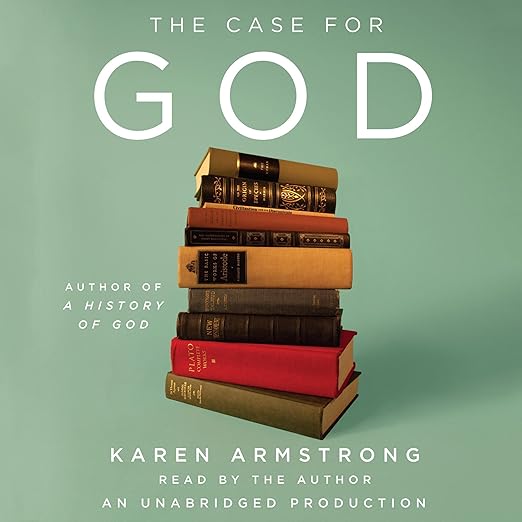
Quick Take
- Narration: Armstrong reading her own work is a revelation: measured, precise, and carrying the unmistakable authority of someone who spent decades living inside these arguments.
- Themes: The evolution of religious understanding, apophatic theology, the limits of literalism
- Mood: Dense and contemplative, demanding but profoundly rewarding
- Verdict: One of the most serious and important treatments of religious history available in audio, not for the impatient but essential for anyone willing to meet it on its own terms.
I started The Case for God on a Sunday morning in late autumn, when the light comes in at that particular low angle that makes everything feel like it deserves more careful attention than usual. That turned out to be the right frame of mind for what Armstrong is attempting here. This is not a book that rewards multitasking. It requires the kind of concentrated listening that most audiobooks never demand, and it offers something in return that most audiobooks cannot deliver: a genuinely revised understanding of a subject you thought you already had opinions about.
Armstrong’s argument spans from the Paleolithic to the present, tracing the ways in which human beings across radically different cultures and centuries have attempted to articulate a relationship with what they variously called God, Brahman, Nirvana, Allah, and Dao. What she is really tracing is the history of a mistake: the gradual slide, accelerating in the modern period, toward treating religious language as if it were making empirical claims, and then judging those claims by scientific standards they were never designed to meet. The result, she argues, is the current stalemate between fundamentalism and atheism, both of which share the same fundamental misreading of what religion is for.
The Apophatic Tradition and Why It Has Been Forgotten
The core of Armstrong’s case rests on the apophatic tradition: the insistence, running from the Cappadocian Fathers through Maimonides and Ibn Arabi to the Cloud of Unknowing, that God is precisely what cannot be captured in positive assertions. To say what God is, in this tradition, is already to misunderstand the project. What the great mystics and theologians understood, Armstrong argues, is that religious practice is not a set of propositions to be believed but a set of disciplines to be undertaken, practices through which the practitioner might be transformed in ways that purely rational analysis cannot achieve.
This is not a comfortable argument for modern readers, trained as we are to expect clarity and testability. Armstrong acknowledges that difficulty directly, and her honesty about why these traditions became inaccessible is one of the book’s great strengths. She traces the shift from mythos to logos not as a betrayal but as an understandable development, while insisting that the colonization of religious language by scientific rationalism has left both domains impoverished. The task of religion, she writes, is not to provide answers within the competence of human reason, but to help us live creatively and peacefully with realities for which there are no easy explanations.
The Scope of the Historical Survey and Its Cost
Covering roughly thirty thousand years of religious development across Christianity, Judaism, Islam, Buddhism, Hinduism, and Chinese spiritualities in sixteen hours requires ruthless selection. One European reviewer objected, with some justice, that Armstrong dispatches entire chapters of Greek philosophy in a few pages. That compression is real. What she sacrifices in granular depth she partly recovers in synthetic scope: few writers can draw lines between Paleolithic cave paintings, Confucian ritual, and Christian mystical theology with the authority that Armstrong brings. The risk is that specialists in any single tradition will find the treatment of their field thin. The reward is that non-specialists encounter a genuinely unified argument rather than a survey course.
Armstrong reading her own work amplifies both the strengths and the demands of the text. Her voice carries the cadence of someone who has lectured this material many times and believes in it completely. The pace is deliberate, which is the right choice for content this dense, but listeners accustomed to more dramatically narrated nonfiction will need to adjust their expectations. This is a scholarly reading, not a performance, and the distinction matters.
Who Should Listen and What to Expect
This free audiobook rewards listeners with some prior familiarity with religious history or philosophy of religion, not because newcomers cannot follow it but because the arguments build on each other and benefit from a framework to hang them on. Armstrong provides that framework generously, but the sheer volume of historical material means that a listener encountering Aquinas or al-Ghazali for the first time will have less traction than someone who arrives with context.
Those who come seeking reassurance that their current religious or secular views are correct will leave disappointed. Armstrong’s project is specifically to disturb both the complacent believer and the confident atheist, to insist that both positions rely on a conception of God that the richest theological traditions would not recognize. Whether you find that argument convincing or maddening, it is impossible to engage with it seriously and emerge unchanged. The reviewer who described this as an eye opener that prompted further exploration is experiencing exactly what Armstrong intends: not conclusions, but the beginning of a different kind of inquiry. The reviewer who described this as an eye opener that prompted further exploration is experiencing exactly what Armstrong intends: not conclusions, but the beginning of a different kind of inquiry into what religion has been and what it might still offer.
The book’s most quietly radical argument is that religion was never designed to provide comfort in the form of certainty. The traditions Armstrong traces were built around the cultivation of wonder, the acknowledgment of mystery, and the development of practical compassion, not around the assertion of propositions. Understanding that history does not require accepting it, but it does require grappling with it, and Armstrong gives you every tool you need to do so across sixteen carefully argued hours.
Frequently Asked Questions
Does Karen Armstrong argue that God exists in a traditional sense, or is her argument more philosophical?
Armstrong is not making a metaphysical argument for God’s existence in the way the title might suggest. She is arguing that the question itself, posed in those terms, reflects a modern misunderstanding of what religious traditions were actually doing. Her case is historical and philosophical rather than theological.
How does Armstrong’s self-narration compare to professional narrator performances in terms of accessibility?
Her delivery is authoritative and precise but not dramatized. It rewards patient listening rather than casual consumption. Listeners who prefer more animated narration may find the pacing slow, but the clarity of her own understanding of the material comes through in every sentence.
Does the audiobook give equal weight to all the traditions it covers, or is it primarily a Christian history?
Armstrong states that she focuses especially on Christianity, though Judaism, Islam, Buddhism, Hinduism, and Chinese traditions all receive substantial attention. The Christian material is most detailed, reflecting both her own background and the Western-centric history of the apophatic tradition she is tracking.
Is this suitable for someone who considers themselves an atheist or agnostic?
Particularly suitable, in fact. Armstrong specifically addresses why modern atheism and modern theism share a common literalist framework that misrepresents the best of both traditions. Atheist listeners are likely to find their position challenged, which is exactly her intent.