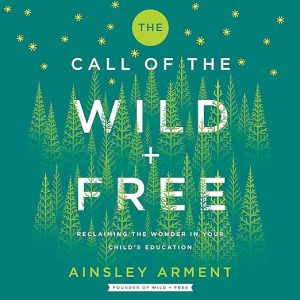
- Performance: Piper Goodeve brings a warm, conversational delivery that matches the book's community-of-mothers voice; she makes the nine-hour runtime feel like a long, encouraging conversation rather than a lecture.
- What it covers: Child-led learning, nature immersion, prolonging childhood wonder
- Feel: Encouraging and expansive
- Our call: Ainsley Arment makes the Wild and Free philosophy feel genuinely achievable rather than aspirational, and the audiobook format extends the sense of being supported by a community of likeminded parents.
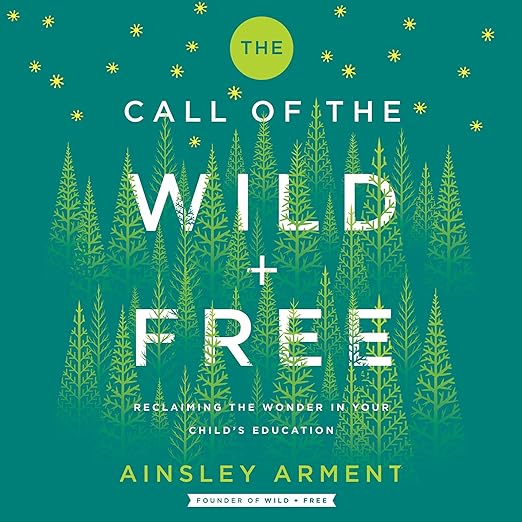
Among the questions parents most commonly carry without voicing them aloud, the one about whether the education they are giving their children is adequate, or the right kind, or missing something essential, is one of the most persistent and least answered by conventional sources. The Call of the Wild and Free, the audiobook from Ainsley Arment, founder of the Wild and Free movement, does something useful and relatively rare in the homeschooling genre: it answers that question not with a curriculum or a rigid methodology but with a philosophy and a community. Arment's movement, built around the Thoreau-inflected idea that the best things are wild and free, has grown precisely because it names something many parents feel but cannot articulate clearly enough to act on.
Dismantling the Old Image of Homeschooling
Arment's framing directly addresses one of the most significant obstacles potential homeschoolers face: the image of what homeschooling looks like. The old model, conservative clothes, socially isolated children, a classroom replicated in the living room, is a real deterrent for parents who loved school themselves but question whether the institutional form of education is what they want for their children. Arment dismantles that image by describing an approach that centers nature, great literature, intellectual curiosity, and the extension of childhood wonder rather than the acceleration of it toward standardized benchmarks. This is a book that gives parents permission to make the entire world a classroom without needing to justify that choice against a predetermined rubric of academic achievement.
The book's target audience is genuinely broad. Arment writes for parents actively considering homeschooling, parents already doing it who need renewed inspiration, and parents whose children remain in traditional schooling but who want supplementary frameworks for enriching their education at home. This range of intended readers means the audiobook does not assume a single starting point or level of commitment, which is both a strength and a potential limitation: listeners already deep into homeschooling may find the earlier chapters too focused on persuasion they no longer need, while complete newcomers may wish the later chapters on practical implementation went deeper into specific day-to-day application of the Wild and Free approach.
Goodeve's Warm Narration Grounded in Real Community
Piper Goodeve's narration is a strong match for the material throughout the nine-hour runtime. Arment's writing voice is warm and community-minded, and Goodeve captures that register without becoming cloying or saccharine. Nine hours of homeschooling philosophy and practical advice could easily feel like a lecture in the wrong narrator's hands; Goodeve makes it feel like the kind of conversation you might have with a more experienced parent who has navigated the territory you are just entering and wants to make it less daunting than it appeared from the outside. Reviewers describe the print edition as moving them to tears at various points, which is a strong signal that the emotional resonance of the content transfers well, and Goodeve's audio delivery preserves that quality throughout.
The Wild and Free movement's grounding in community is one of the details the audiobook captures effectively. Arment built an online community of families before she wrote this book, and the content reflects that: she is not working from theory alone but from the accumulated experience of a large network of parents who have implemented these ideas with real children in real households with varying resources and constraints. The specificity of that foundation shows in the practical sections, which avoid the vagueness of purely philosophical homeschooling writing. The concept of making the entire world a classroom draws on the kinds of learning opportunities that present themselves outside any formal curriculum and that the Wild and Free philosophy is explicitly designed to help parents recognize and use rather than ignore in favor of artificial lesson structures.
Outdoor Access Matters More Than a Curriculum
The Wild and Free approach is a philosophy and an ethos, not a step-by-step curriculum with grade levels and subject-specific resource lists. Listeners expecting a structured, year-by-year homeschooling plan will find the audiobook illuminating on values but will need additional resources for detailed implementation. Arment's approach is explicitly child-led and curiosity-centered, which is a powerful educational philosophy but one that requires the parent to do significant interpretive work in applying it to their own family's specific situation, temperament, and available time. The audiobook is most useful as an orientation and a renewable source of encouragement rather than as a practical manual with actionable steps that transfer directly from page to daily schedule.
The Thoreau-inflected naturalism at the heart of the Wild and Free philosophy works most naturally for families with meaningful access to outdoor space and the structural flexibility to organize their days around discovery rather than fixed schedule. Urban families and those with significant constraints on outdoor time or schedule flexibility will find the philosophy inspiring but may need to adapt its implementations considerably. The audiobook does not address these practical access questions in depth, which is worth noting for listeners whose circumstances differ from the rural or semi-rural households that seem most naturally aligned with the Wild and Free approach as described and practiced by Arment and the broader community she founded.
Renewed Inspiration for Parents Already Homeschooling
Parents currently wrestling with whether to homeschool, and particularly those drawn to the idea but held back by the old image of what homeschooling requires and looks like, will find this audiobook genuinely transformative in terms of how they imagine the possibility. Parents already homeschooling who need renewed inspiration and a reminder of the philosophy behind their daily decisions will benefit significantly from returning to the foundational arguments Arment makes here. Teachers and caregivers looking for frameworks to enrich a child's education beyond school hours will find the Wild and Free philosophy generative and adaptable even without committing to full homeschooling. Those looking for a structured, subject-by-subject curriculum guide with specific resource lists will need to look beyond this audiobook for that level of practical specificity in daily implementation.
A Few Questions About The Call of the Wild and Free
Is The Call of the Wild and Free audiobook aimed only at committed homeschoolers, or does it have value for parents whose children attend traditional schools?
Arment explicitly addresses three groups: those considering homeschooling, those currently doing it, and parents who want to enrich their children's traditional schooling at home. The Wild and Free philosophy has applications across all three contexts, so the audiobook is not limited to committed homeschoolers with children already out of the traditional system.
Does this audiobook provide a specific curriculum or is it more of a philosophy and inspiration guide?
It is primarily a philosophy guide and source of encouragement rather than a step-by-step curriculum. Arment describes the values and ethos of the Wild and Free approach with practical examples but does not offer a grade-level subject plan. Families will need additional resources for specific curriculum implementation.
How does Piper Goodeve's narration affect the listening experience over nine hours of educational content?
Goodeve's warm, conversational delivery makes the nine-hour runtime feel like an extended encouraging conversation rather than a lecture. Reviewers of the print edition describe being moved to tears by the content, and the audio delivery preserves that emotional quality. The narration is well-paced and well-matched to the genre.
Does The Call of the Wild and Free audiobook work for urban families, or is it primarily designed for families with access to rural outdoor space?
The philosophy centers nature and outdoor learning, which is most naturally implemented in rural or suburban settings with outdoor access. Urban families can find value in the core philosophy and adapt its applications to their environment, but the audiobook does not deeply address the practical challenges of implementing a nature-centered approach in dense urban contexts.