Quick Take
- Narration: James Adams brings controlled, journalistic gravity to Weiss’s account, exactly the register this material requires, neither sensationalizing nor distancing.
- Themes: Ethnic conflict, UN accountability, wartime impunity
- Mood: Harrowing, precise, morally urgent
- Verdict: Gordon Weiss’s insider account of the Sri Lankan civil war’s final days is essential for anyone who wants to understand how international institutions fail civilian populations in real time.
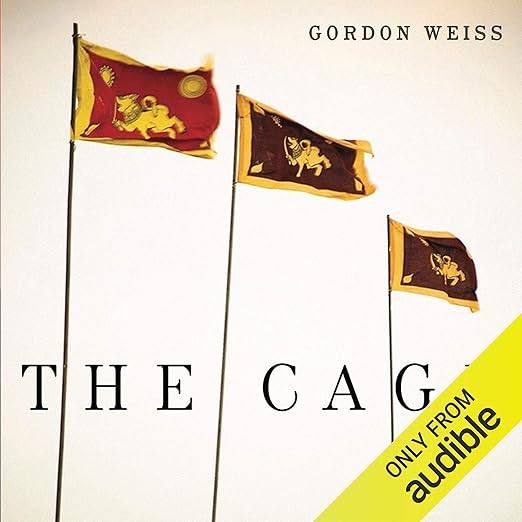
I started listening to The Cage on a flight, which felt appropriate in a grim way, the physical remove of altitude giving me just enough distance from the material to sit with it. Gordon Weiss was the UN spokesperson in Sri Lanka during the final years of the civil war. He was inside the machinery of international response as the government forces closed in on the last Tamil Tiger rebels on a tiny sand spit the military called “The Cage.” The UN estimated that tens of thousands of civilians died in those final weeks. This is his account of what he saw, what he couldn’t say while employed by the UN, and what the official record left out.
That combination, intimate institutional knowledge plus the willingness to challenge the official narrative from inside it, is what makes this book different from the many other accounts of ethnic conflict that occupy adjacent shelf space. Weiss is not an outside journalist parachuting in. He is someone who spent over twelve years with the United Nations, worked in Bosnia, Afghanistan, Darfur, Pakistan, Congo, and Haiti before Sri Lanka, and who understands exactly how the machinery of international response operates and where it systematically fails. The Cage is both a detailed account of a specific atrocity and an anatomy of that failure.
Thirty Years of Conflict in Thirteen Hours
One of the things Weiss does well is establish the historical depth of the ethnic conflict before he brings you to 2009. The book traces the convergence of forces that produced the final crisis: British colonial policies that reshuffled Tamil and Sinhalese populations and their institutional access, the radicalization of Sinhalese Buddhism as a political force, the Tamil Tigers’ own brutality including child soldier recruitment and assassination campaigns, and the international power dynamics that gave the Sri Lankan government cover for its final offensive. A reviewer described the book as not taking sides, which is accurate in the sense that Weiss doesn’t romanticize the Tamil Tigers, but taking sides is not the right frame. Weiss is interested in accountability, and accountability doesn’t require sides to be equivalent.
The structural decision to trace foreign influence alongside the domestic conflict is one of the book’s strongest choices. The role of China, India, Pakistan, and Western nations in either enabling or failing to constrain the government’s conduct in those final months is laid out with the specificity you’d expect from someone who was watching it happen from inside a UN office. That specificity is what separates The Cage from more abstract accounts of international failure.
The Institution and the Limits of Bearing Witness
Weiss is also honest about the limitations of his own position during the conflict. As UN spokesperson, he was operating within institutional constraints that limited what he could publicly say about what he knew. The book is, in part, a reckoning with those constraints, with what it means to be a voice for international law inside an organization that depends on the cooperation of the governments it is meant to hold accountable. That tension is not resolved, because it cannot be resolved. It is a structural feature of how international institutions work, and Weiss renders it with the clarity of someone who has lived it across multiple conflict zones.
The section detailing what happened inside The Cage itself, the concentration of civilians on a shrinking sand spit, the hospitals shelled, the casualty estimates that the Sri Lankan government worked to suppress, is harrowing in the specific way that credible witness testimony is harrowing. There is no dramatization in Weiss’s prose. He is a journalist and analyst by training, and his register is documentary. James Adams’s narration serves this perfectly: measured, authoritative, never reaching for emotional effect that the material itself supplies without help.
Why This Book Still Matters
The Sri Lankan civil war’s end received limited sustained coverage in Western media at the time, and the scale of civilian casualties in those final months has still not been fully accounted for. Weiss is currently a founding advisor to the International Crimes Evidence Project, which is investigating war crimes arising from the conflict. The book exists within an ongoing accountability effort, not a closed historical chapter. That context changes how you read it, or listen to it. This is not retrospective reconstruction. It is documentation compiled while the legal and political reckoning is still unresolved.
At thirteen hours, The Cage is a substantial commitment, but the density is earned. The combination of historical depth, institutional insider perspective, and specific evidentiary detail makes it one of the more important pieces of conflict journalism available in audio format. The 153 ratings at a 4.2 average reflect an audience that came for serious material and found it.
For Human Rights Readers and Those Who Prefer Distance
This is essential listening for anyone with an interest in human rights, international law, or the specific history of South Asian ethnic conflict. It’s also valuable for anyone who wants to understand how international institutions process, and fail to process, mass atrocity in real time.
Skip this if you’re looking for comprehensive political history of Sri Lanka from independence forward, Weiss’s focus is the final phase of the war and the international response to it, not a complete survey of the conflict. For that broader foundation, you’d want to supplement with dedicated works on Sri Lankan postcolonial history.
Frequently Asked Questions
Does Weiss take a political position on the Tamil Tigers versus the Sri Lankan government?
Not in a partisan sense. Weiss documents Tamil Tiger atrocities including child soldier recruitment and political assassination alongside government war crimes. His focus is on accountability, specifically on how the Sri Lankan government escaped meaningful international consequences for its conduct during the final offensive, and on the UN’s institutional failure to apply sufficient pressure.
How current is the information in this book, does it cover post-war Sri Lanka?
The book focuses primarily on the history of the conflict and the events of 2008-2009. Weiss is now a founding advisor to the International Crimes Evidence Project investigating war crimes from the conflict, which suggests the accountability questions the book raises remain live. Readers should note that political developments in Sri Lanka since publication may add context, but the core testimony and analysis remain accurate.
Is this audiobook accessible to listeners unfamiliar with Sri Lankan history?
Yes. Weiss builds the historical and political context before reaching the events of 2009, covering the origins of Tamil-Sinhalese ethnic tension, the role of British colonialism in reshaping population dynamics, and the development of the Tamil Tigers as a movement. A reviewer specifically noted discovering this book as an entry point without prior knowledge of the conflict and finding the historical grounding sufficient.
How does James Adams’s narration handle the emotionally intense material?
Adams maintains a controlled, documentary register throughout, appropriate for a book written by a journalist and UN official. The narration doesn’t reach for emotional amplification, which serves the material well. The horror in the content is sufficient on its own, and a restrained delivery allows the specific factual details to land with their full weight.