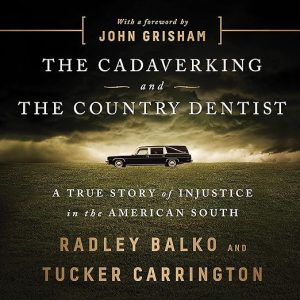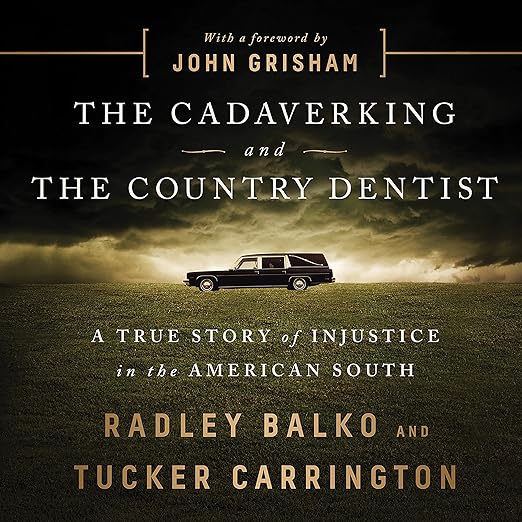
Kennedy Brewer and Levon Brooks spent a combined thirty years in prison for crimes they did not commit. The real killer of two three-year-old girls in rural Mississippi remained free throughout. Radley Balko and Tucker Carrington reconstruct how this happened in The Cadaver King and the Country Dentist, narrated by Robert Fass in an audiobook that runs fourteen hours and forty-five minutes. Built from exhaustive investigative reporting, it is one of the most substantive accounts of how forensic fraud and systemic failure can operate simultaneously inside a system that presents itself as the administration of justice.
What We Made of It
What distinguishes this book from standard wrongful conviction accounts is its structural ambition. Balko and Carrington are not simply reconstructing what happened to Brewer and Brooks, though they do that with precision and weight. They are making an argument about the machinery that produced these outcomes: two expert witnesses, Dr. Steven Hayne and Dr. Michael West, who built successful careers inside a broken system; a death investigation infrastructure that reviewer Ryan Young accurately describes as a relic of the Jim Crow era; and a network of prosecutors, judges, and defense attorneys who failed to challenge credentials that should never have withstood scrutiny.
Dr. Hayne, a medical examiner, performed the vast majority of Mississippi's autopsies during the relevant period at a volume that any forensic pathology professional would recognize as incompatible with genuine quality control. Dr. West, a local dentist who had positioned himself as a forensic jack-of-all-trades specializing in bite mark analysis, provided the kind of testimony that prosecutors could reliably deploy and that courts failed to challenge. Together they became the go-to experts for a generation of Mississippi prosecutions. Reviewer Dan described this as a monumental work of investigative storytelling about how junk science polluted justice for a generation in one state. That assessment is accurate. What makes it more than a Mississippi story is the authors' insistence that the structural conditions they describe are not unique to one state but present in degree across the American criminal justice system.
What Makes The Cadaver King and the Country Dentist Worth Hearing
Robert Fass's narration is precisely calibrated for this material. He reads Balko and Carrington's prose with controlled gravity, never pushing the emotional temperature above what the facts themselves generate. When the book describes Brewer and Brooks in prison, and it does so in sufficient detail to make their decades of incarceration concrete rather than abstract, Fass holds steady and lets the weight land without theatrical emphasis. The fourteen-hour runtime allows the investigative argument to build fully, and Fass maintains consistent pace across sections that cover the forensic science critique, the legal history, and the eventual unraveling of the convictions.
Balko brings genuine expertise to the forensic science critique, having covered criminal justice and forensic evidence reliability for major national outlets over many years. Carrington brings deep knowledge of Mississippi's legal landscape. That specific combination produces a book that is neither polemic nor simple true crime narrative but something more uncomfortable: a structural analysis of institutional failure that implicates many actors beyond the two named in the title. The account of how the convictions eventually began to fall apart involves the work of lawyers, journalists, and advocacy organizations, and this section shifts the narrative energy considerably. The dismantling of these cases was slow, expensive, and contingent on individuals who chose to keep pushing when the institutional response was indifference.
What Might Not Land
The book makes a sustained argument about the Jim Crow origins of Mississippi's death investigation system, and it does not let that argument stay in the historical background. Balko and Carrington connect the relic infrastructure directly to contemporary outcomes, which means the book operates simultaneously as a true crime account, a forensic science critique, and a structural analysis of how racism persists in institutional form. Listeners who want to engage only with one of those threads will find the book consistently pulling them back to the others. This is by design, and it is what gives the audiobook its analytical weight beyond the case narrative.
The bite mark analysis critique in particular deserves attention. West's testimony relied on a forensic discipline that has since been substantially discredited by the broader scientific community. Balko and Carrington explain the methodological problems accessibly without requiring prior forensic science knowledge, and their treatment of how this discredited evidence continued to be accepted by courts despite its lack of scientific foundation is one of the more sobering passages in the book. The contrast between the ease with which wrong convictions were built and the difficulty of undoing them is the book's sharpest structural observation, and Fass holds that contrast in appropriate tension throughout the full runtime.
The Right Listener for The Cadaver King and the Country Dentist
This audiobook is essential listening for anyone with a serious interest in forensic science, wrongful convictions, or the structural dynamics of racial inequality in the American criminal justice system. It rewards listeners who come with some background in the broader debate about forensic evidence reliability, because Balko and Carrington's critique lands with more force when you understand the landscape they are critiquing. It is also valuable for listeners who primarily approach this as true crime and want analytical depth that goes well beyond the case narrative. Those who prefer their true crime without heavy systemic analysis may find the structural chapters demanding, but they are also the chapters that give the book its lasting relevance beyond the specific Mississippi cases.