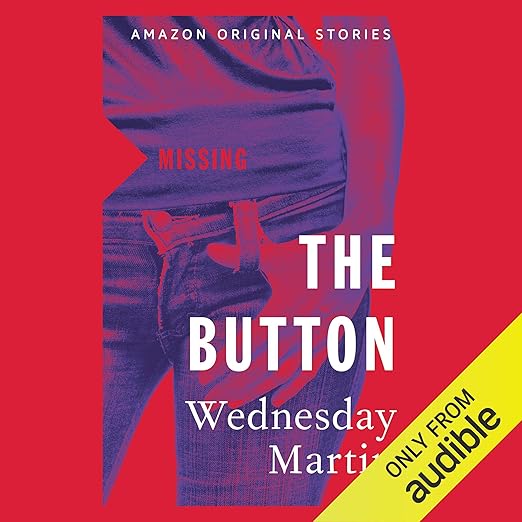
Quick Take
- Narration: Wednesday Martin reads her own work with the dry wit and authority of someone who has spent years making academic research compelling for general audiences, perfectly cast.
- Themes: Female anatomy and cultural erasure, history of medicine and misrepresentation, feminist reclamation
- Mood: Brisk and punchy, with a sharp comedic edge underneath genuine outrage
- Verdict: A one-hour listen that manages to be genuinely educational, politically pointed, and frequently funny, remarkable for its brevity.
At just over an hour, The Button is something of an anomaly in my listening habits. I rarely reach for short-form audio essays the way I do novels or long-form narrative nonfiction, but this one came up in a conversation about Amazon Original Stories and sounded strange enough to warrant a lunchtime listen. I finished it before my soup cooled down, and I spent the next ten minutes slightly stunned by what I had just heard.
Wednesday Martin, best known for Primates of Park Avenue, brings her anthropological lens to the history of the clitoris: its systematic excision from medical texts, its misrepresentation across centuries of European medicine, and the ongoing movement, which the book calls the cliteracy movement, to restore accurate understanding of female anatomy. The thesis is that the most sensitive structure in the human body has been deliberately obscured by medical and cultural institutions for millennia, and that this is not accidental.
Our Take on The Button
The essay travels from ancient Greece through medieval Europe to the Costa Rican rainforest, which sounds like an improbable itinerary for a one-hour piece and yet Martin makes it work. She is a genuinely skilled essayist, and her ability to move between modes, scholarly citation, personal anecdote, anthropological observation, outright comedy, without losing the thread is on full display here. The book manages to be simultaneously educational and outraged without becoming preachy, which is a narrow path and she walks it with care.
One reviewer who worked in the medical field for their entire adult career wrote that they learned things they felt they should already have known, which captures something essential about the book’s impact. Martin is not writing for readers who have never wondered about this topic. She is writing to demonstrate that the absence of accurate information is itself a cultural product, manufactured and maintained.
Why Listen to The Button
The author-read format is ideal here. Martin’s timing is impeccable, and the dry humor she brings to some of the more absurd historical details, medieval medical theories, in particular, lands exactly as intended. A professional narrator would likely have delivered this material more smoothly but with less personality. The slight roughness in Martin’s performance is part of what makes it feel like an urgent conversation rather than a polished lecture.
It is also worth noting that The Button is part of the Missing collection, a series of six Amazon Original Stories about finding, restoring, or accepting loss. Knowing the collection’s theme adds a layer of resonance to Martin’s central argument: that something significant has been missing from our cultural understanding of female anatomy, and that the absence was chosen rather than accidental.
What to Watch For in The Button
The brevity that is the book’s greatest asset is also its limitation. Martin moves fast, and there are threads she raises, particularly around the anthropological evidence from primate research, that could sustain a much longer treatment. Listeners who want deep dives into the history of medicine or feminist theory will finish this wanting more, which is a reasonable criticism even if it is also a kind of compliment.
The rating of 3.9 is slightly lower than the content warrants, and browsing the reviews suggests that some listeners came in without knowing what the essay was about and found the subject matter unexpected. Martin herself acknowledges in the text that the topic is one that our culture has been conditioned to treat as uncomfortable, which is precisely the point. If you know what you are signing up for, the essay delivers exactly what it promises.
Who Should Listen to The Button
Anyone curious about the intersection of medical history, feminist scholarship, and popular anthropology will find this a rewarding listen. It functions well as an introduction to Martin’s voice for listeners who have not yet read Primates of Park Avenue, and it works as a self-contained essay for those with no existing interest in her work. One hour is not a significant commitment, and the return on that hour is unusually high. Skip it only if you find the subject matter genuinely uncomfortable, and even then, the discomfort may be worth examining.
Frequently Asked Questions
How explicit is the content in The Button, and is it appropriate for all listeners?
The essay deals directly with female anatomy and sexuality in an academic and anthropological register rather than a graphic one. It is frank and sometimes blunt but not gratuitous. The Audible listing notes mature themes. Listeners who are uncomfortable with candid discussions of female sexuality may want to skip it, but the tone is closer to a science lecture than to explicit content.
Do I need to listen to the other Missing collection stories to understand The Button?
No. Each story in the Missing collection stands completely alone. The Button works as a self-contained essay and requires no knowledge of the other five installments. The loose thematic link is the concept of something that has been missing or lost, which Martin applies to cultural and anatomical knowledge.
Is Wednesday Martin’s narration of her own work effective, or would a professional narrator have been better?
Martin’s self-narration is one of the essay’s genuine strengths. Her timing and dry wit translate exactly as intended, and the personal investment in the material is audible throughout. The performance is not technically polished in the way a studio narrator’s might be, but for this particular content, that informality serves the work well.
At just over an hour, does The Button cover enough ground to be genuinely informative?
Yes, within the constraints of the format. Martin covers the anatomical history, the cultural context, the medical erasure, and the contemporary reclamation movement in a way that is genuinely informative rather than superficial. Listeners who want deeper treatment of any single strand will need to follow up with dedicated reading, but as an introduction to the topic, an hour is enough to be substantively changed.