Quick Take
- Narration: Sean Patrick Hopkins delivers the academic business content with clarity and appropriate authority, suitable for a strategy text aimed at business and management audiences.
- Themes: Platform strategy, digital competition, innovation and power in the tech economy
- Mood: Analytical and precise, academic rigour without being inaccessible
- Verdict: A serious academic treatment of platform business strategy from MIT Sloan researchers, the English-language audiobook narrated by Hopkins is well suited to business listeners who want rigour over hype.
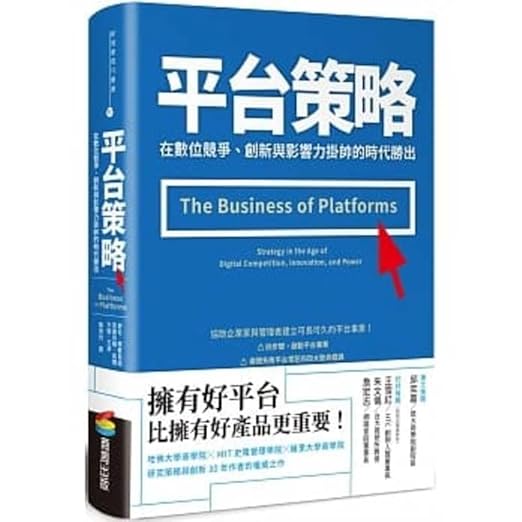
I want to flag something before going further: the product data associated with this listing reflects the Traditional Chinese print edition of The Business of Platforms, but the audiobook available via the linked Audible page is the English-language production narrated by Sean Patrick Hopkins. This review addresses the English audiobook, which is the format relevant to AudiobookDaily readers.
The Business of Platforms by Michael A. Cusumano, Annabelle Gawer, and David B. Yoffie is a serious academic text about platform strategy in the digital economy. Cusumano and his co-authors are MIT Sloan and Imperial College researchers who spent years studying how platform businesses, Amazon, Google, Apple, Facebook, Uber, Airbnb, and their peers, build competitive advantage, scale, and pricing power in ways that conventional product-and-service businesses cannot. The book is not a cheerleading exercise for tech companies. It is an analytical examination of what platform strategy actually is, when it works, and crucially, when it fails.
Our Take on The Business of Platforms
The central argument the authors develop is that not every business should be a platform, and that the platform model generates enormous risks alongside its rewards. This is a contrarian position in business literature, which tends to treat platform dominance as an unambiguous triumph. Cusumano et al. document platform failures alongside platform successes, using cases like Myspace, eBay’s struggles with Amazon, and various enterprise platforms that collapsed despite early momentum. The analytical framework they develop, examining how platforms manage innovation, competition, trust, and regulation, is robust enough to apply beyond the headline cases.
For audiobook listeners, the format presents some inherent challenges. This is a business strategy text built around detailed case studies, data tables, and analytical frameworks that the authors originally designed to be read rather than heard. Hopkins’s narration handles the material professionally, but listeners accustomed to narrative-driven business books like those from Malcolm Gladwell or Michael Lewis will find this a different kind of engagement. There are no characters. There is no dramatic arc. There is an argument, rigorously developed, with evidence marshaled in careful sequence.
Why Listen to The Business of Platforms
The value of listening rather than reading here is primarily practical: the material is dense enough that listening at moderate speed on a commute, where you cannot pause to take notes on a diagram, forces a kind of high-level absorption that can actually be useful for strategic thinking. You may not retain every case study detail, but the analytical vocabulary, how to distinguish an innovation platform from a transaction platform, how to think about pricing both sides of a market, how to anticipate regulatory exposure, is transferable and worth having in your working mental model.
Sean Patrick Hopkins’s delivery is clear and appropriately paced. He treats the material with the seriousness it demands without adding artificial drama to what is fundamentally academic analysis. For business audiobooks in this register, that is exactly right, you want the argument to come through, not the narrator’s interpretation of it.
What to Watch For in The Business of Platforms
This book assumes a degree of familiarity with technology business history and basic economics. Readers who have not previously engaged with concepts like network effects, two-sided markets, or switching costs will find the early chapters challenging. The authors define their terms, but they move quickly. This is not an introduction to platform economics for the uninitiated, it is a strategic analysis for practitioners and advanced students.
No listener reviews are available for this audiobook edition specifically, which limits how precisely I can assess the audio production relative to reader expectations. The print edition has a strong academic reputation, and the narration is professionally executed, but listeners should be aware they are entering territory with fewer navigational aids than a well-reviewed audiobook usually provides.
Who Should Listen to The Business of Platforms
Business strategists, product managers, entrepreneurs considering platform models, and MBA students will find this the most useful. It is also worthwhile for anyone trying to understand how digital giants built their competitive positions, from a rigorous rather than celebratory angle. Skip it if you want narrative business storytelling or if you are new to digital economics; the analytical density requires prior foundation.
Frequently Asked Questions
Is the audiobook edition of The Business of Platforms in English or Chinese?
The audiobook narrated by Sean Patrick Hopkins is in English. The Chinese-language data in the product listing reflects the Traditional Chinese print edition, a separate publication. The Audible audiobook is the English-language version.
Who are the authors of The Business of Platforms and what are their credentials?
The book is authored by Michael A. Cusumano of MIT Sloan, Annabelle Gawer of Imperial College London, and David B. Yoffie of Harvard Business School, three researchers with decades of combined work on technology strategy, platform economics, and competitive dynamics in digital markets.
Is The Business of Platforms optimistic about platform business models, or critical?
Balanced and analytical, leaning toward caution. The authors document both platform successes and failures, and they argue explicitly that the platform model is not appropriate for every business. The book is a rigorous examination, not a promotional case for platform strategy.
How does this compare to other platform strategy books like Platform Revolution or The Platform Economy?
The Business of Platforms is more academically rigorous and less prescriptive than Platform Revolution by Parker, Van Alstyne, and Choudary. Where Platform Revolution leans toward practical playbooks, Cusumano and co-authors prioritize analytical frameworks grounded in extensive case study research, including failed platforms that the more optimistic literature tends to underreport.