Quick Take
- Narration: Peter Hessler reading his own work is a particular pleasure; his voice carries the quiet precision of a journalist who knows exactly which detail to linger on.
- Themes: Living between ancient and modern, the Arab Spring from the inside, outsider observation
- Mood: Contemplative and humane, unhurried in the best sense
- Verdict: One of the most intelligent works of literary journalism about Egypt in the modern era, and Hessler narrating himself elevates it further.
I was partway through a late evening walk when Peter Hessler’s account of his neighborhood garbage collector, Sayyid, stopped me mid-stride. Hessler had been describing how an illiterate man’s access to the trash of Cairo constituted its own form of archaeological excavation, a way of reading the city that no formal education could replicate. The image is so exact, so entirely Hessler, that I stood on the sidewalk replaying it before continuing. This is the kind of book that does that to you: stops you in place and holds you there until you have properly received what it is offering.
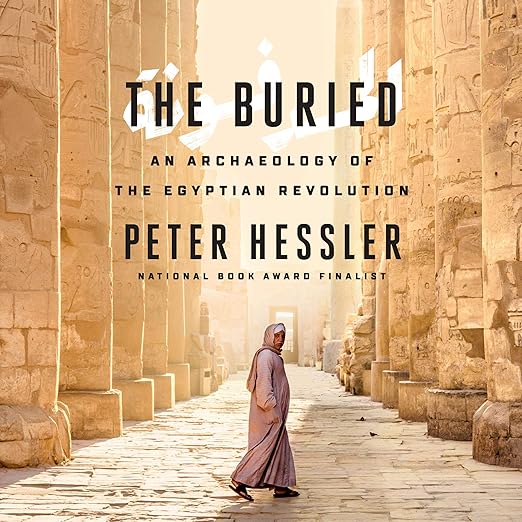
Hessler came to Egypt in 2011, just as the Arab Spring was breaking. He was hoping for something quieter than the decade he had spent covering China for The New Yorker, and he got the opposite. What he produced over his years in Cairo is a National Book Critics Circle Award finalist, and listening to him read it himself across nearly 17 hours is one of the more complete audio experiences I have had with literary journalism in recent years.
The People Who Become the Story
Hessler’s method, developed across his China trilogy, is to embed himself in ordinary life and let relationships accumulate slowly enough that real understanding becomes possible. In Cairo, this means Sayyid the garbage collector, whose street-level knowledge of the city shames most formal analysis of urban life. It means his Arabic instructor, a cynical political sophisticate who helps Hessler and his wife navigate the language and the revolution simultaneously. It means his translator, a gay man navigating Egypt’s homophobic culture in ways that Hessler describes with sensitivity and without the condescension that sometimes infects Western accounts of similar subjects. And it means a family of Chinese small-business owners in the lingerie trade, whose presence in Upper Egypt becomes one of the book’s most surprising and illuminating narrative threads.
One Egyptian reviewer, clearly delighted to encounter their own country described with this level of precision, wrote that Hessler is a marvelous storyteller with a sharp mind that is always working. That sharpness is evident in how he handles the revolution: not as an event to be explained from the outside but as a texture that pervades daily life, a backdrop against which ordinary people make decisions that are neither purely political nor purely personal, because in Egypt at that moment the two categories had collapsed into each other entirely.
What al-Madfuna Means for the Book’s Structure
The title comes from the Arabic term locals use for the archaeological landscape of Upper Egypt, where people live beside the tombs of kings and courtiers. Hessler travels to digs at Amarna and Abydos throughout the book, and these visits function not as separate documentary sections but as counterpoint to his Cairo life, a way of asking what persistence means in a civilization where empires and regimes have risen and collapsed for five thousand years. The juxtaposition between ancient burial sites and a contemporary society in revolutionary upheaval gives the book a philosophical depth that a straightforwardly political account could not achieve.
One reviewer noted that the book is too long. This is a fair point that others have raised as well, and it is worth acknowledging honestly. At nearly 17 hours, Hessler’s accretion of detail is magnificent but occasionally repetitive, particularly in the middle sections where the revolutionary timeline circles back through familiar territory. For readers who want a tighter, more propulsive account, there will be moments of friction. For those willing to settle into Hessler’s pace, the accumulated texture pays off substantially in the final third.
Why the Author-Narrator Choice Matters Here
Hessler reading himself is not a given with author narrations. Some writers are not performers, and their readings can feel flat or self-conscious. Hessler avoids both traps. His delivery is low-key and precise, carrying the same quality of quiet attention that defines his prose. There is a moment in the opening chapters where he describes moving his young family to Cairo just as the revolution began, and the understatement in his delivery, this sense of someone who understood the absurdity and the risk but committed anyway, communicates something about his character that a hired narrator could only approximate. The Wall Street Journal described him as a superb literary archaeologist, and his narration has that same quality of careful excavation applied to language itself.
Readers Who Will Get the Most From This Audiobook
Listeners drawn to literary journalism in the tradition of Rebecca West or Bruce Chatwin, both name-checked in the editorial praise for the book, will find exactly what they are looking for here. Those who came to Hessler through his China work will find the same methodological patience applied to a radically different cultural context, with an added political urgency that the China books did not have. Readers expecting a chronological account of the Arab Spring as a news event should look elsewhere; this is a portrait of ordinary lives, not a political timeline. At 16 hours and 44 minutes, it rewards an unhurried listening pace and pays back that investment generously for the listener willing to move at Hessler’s speed. The Wall Street Journal’s description of him as a superb literary archaeologist could not be more apt: he handles every conversation, every ruin, every piece of trash with the same precise curiosity, and that curiosity is contagious across the full length of the audiobook. Rarely does a single work of literary journalism manage to make a reader understand a country more completely by looking at it entirely through the lives of ordinary people rather than through the events that make the front page.
Frequently Asked Questions
Does The Buried require prior familiarity with Hessler’s China books like River Town or Oracle Bones?
No. The Buried stands completely on its own and covers a different country and period. Knowledge of his China work gives useful context for understanding his method and the comparisons he draws, but the Egyptian narrative is fully self-contained and accessible to newcomers.
How much of The Buried covers the Arab Spring as a political event versus everyday Egyptian life?
Hessler is explicitly not writing political history. The revolution appears as ambient context and a pressure on his subjects’ lives rather than as a chronological account of events. The book is primarily a portrait of individual Egyptians across class, literacy, religion, and sexuality, seen from the ground up.
Is Peter Hessler an effective narrator of his own work?
Very much so. His delivery is understated and precise, consistent with the voice of the prose itself. He does not perform the material but inhabits it quietly, and that restraint suits the book’s contemplative intelligence. Several reviewers specifically mention the reading as adding to the experience rather than being merely adequate.
What is the significance of the Chinese lingerie merchants Hessler describes in Upper Egypt?
They represent one of the book’s most unexpected angles on globalization and cultural encounter. Hessler uses the Chinese entrepreneurs as a counterpoint to Western development workers and aid narratives, suggesting that the most effective economic actors in rural Egypt were operating outside the frameworks most international observers were using. It is one of the book’s most quoted sections.