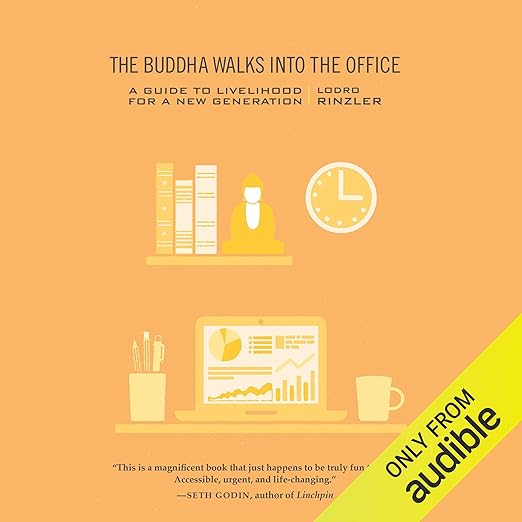
Quick Take
- Narration: Rinzler self-narrates with a calm, unhurried delivery that matches the material, the voice suggests practice rather than performance.
- Themes: Buddhist ethics in professional life, finding meaning in work, compassion as workplace tool
- Mood: Gently pragmatic and occasionally funny, never preachy
- Verdict: A practical dharma guide for anyone who has ever felt their job and their values pulling in opposite directions, most effective when Rinzler simply teaches rather than laboring the office analogies.
I listened to most of this one during a particularly difficult stretch at work, not a dramatic crisis, just the slow accumulation of meetings that should have been emails and colleagues operating from a place of stress that had started to feel contagious. I was not looking for a productivity system. I was looking for a way to be less reactive between nine and five. The Buddha Walks into the Office did not solve that problem, but it gave me a vocabulary for thinking about it differently, which is almost more useful.
Lodro Rinzler is a Buddhist teacher who writes for audiences with no assumed background in the tradition. He is also young and funny and clearly aware that most people who pick up a book about Buddhism and the workplace are not monks. The title is disarming by design. It signals that this is not a solemn text, and Rinzler mostly follows through on that promise. The audiobook is organized in three parts: deciding what you want to do with your life in a broader sense, how to be of genuine benefit to the people around you, and how to treat the hardest workplace situations as opportunities rather than obstacles.
Our Take on The Buddha Walks into the Office
What Rinzler does well is translate specific Buddhist concepts, leaning into fear, open presence, the practice of loving-kindness, into contexts that are neither trivial nor forced. The section on difficult people at work is genuinely useful. Rather than offering the usual advice about managing your reaction to a difficult colleague, Rinzler asks you to consider what is happening in that person’s experience, which is a different and more demanding question. It is not guaranteed to make the situation easier, but it changes how you inhabit it.
The self-narration is the right choice for this material. Rinzler does not sound like a person performing wisdom at you, he sounds like a teacher who has thought carefully about these questions and is sharing what he has found. There is a difference in register that matters a great deal in the Buddhism-and-self-help space, where a great deal of content sounds like a very confident person telling you how to be enlightened. Rinzler is quieter than that.
Why Listen to The Buddha Walks into the Office
One reviewer read this while losing a twenty-year job and found the sections on leaning into fear and present-moment awareness specifically useful in that context, not as consolation, but as a practice that allowed them to remain functional and open during real crisis. That is the test for this kind of book. The material is easy enough to absorb during comfortable times; what matters is whether it holds up under pressure. Based on that testimony and the consistency of positive responses, Rinzler has constructed something genuinely applicable rather than merely inspiring.
At five hours and forty-three minutes it is a manageable listen. The three-part structure means it works well in segments, you can listen to Part One, think about it for a few days, and return without losing continuity. The audiobook does not demand sustained attention in the way that narrative nonfiction does; it rewards pausing and sitting with what Rinzler has just said.
What to Watch For in The Buddha Walks into the Office
The honest limitation is the one reviewer who noted that mapping Buddhist concepts onto office scenarios can feel contrived. There are moments, particularly in passages that try to address very specific workplace situations, where the application feels stretched. The dharma holds; the analogy wobbles. Rinzler is at his best when he is teaching the concepts directly and trusting listeners to make their own connections, rather than walking through a scripted office scenario and asking you to find yourself in it.
This is explicitly targeted at Generation Y, which dates the framing slightly, the concerns about uncertain career paths and the search for meaningful livelihood that animate the book are less specific to that cohort now than they were when it was published in 2014. But the underlying Buddhist teaching is older than any generational anxieties and holds up regardless of when you encounter it.
Who Should Listen to The Buddha Walks into the Office
This is for anyone who has ever felt a gap between who they are at work and who they want to be, regardless of whether they have any prior interest in Buddhism. It is accessible enough to work as a first encounter with the tradition and practical enough to be useful to longtime practitioners who want to think about livelihood more carefully. Listeners who want quick tactical advice for navigating office politics will find the pace too reflective. Listeners who can sit with a slower, more contemplative approach will find it genuinely rewarding.
Frequently Asked Questions
Do I need any background in Buddhism to get value from this audiobook?
No background is required. Rinzler introduces concepts as they appear and explains them in plain language. The book works as a first encounter with Buddhist ideas and as a refresher for practitioners.
Is this a self-help book, a spirituality book, or something else?
It sits at the intersection of both. The structure is practical and the advice is actionable, but the foundation is Buddhist teaching rather than productivity research. Think of it as applied dharma for professional life.
How does Rinzler’s self-narration compare to a professional narrator for this kind of content?
It is a genuine advantage here. Rinzler sounds like a teacher rather than a narrator, and his calm delivery reinforces the content. The audiobook benefits from hearing the author’s own voice and pacing.
Is The Buddha Walks into the Office useful if I am currently unhappy at my job or considering a career change?
The first section directly addresses decisions about livelihood and what you want your work to mean. Reviewers dealing with job loss and professional uncertainty specifically cited it as helpful during those transitions.