Quick Take
- Narration: Edoardo Ballerini brings a composed, unhurried reverence to the anthology format that suits the meditative purpose of the selections.
- Themes: Impermanence and suffering, the universality of Dharma teaching, compassion as practice rather than sentiment
- Mood: Gentle and contemplative; ideal for early mornings or slow evenings
- Verdict: Jack Kornfield’s anthology of contemporary Buddhist teachers is a genuine resource for practice, and Ballerini’s narration makes it as suitable for listening as for reading.
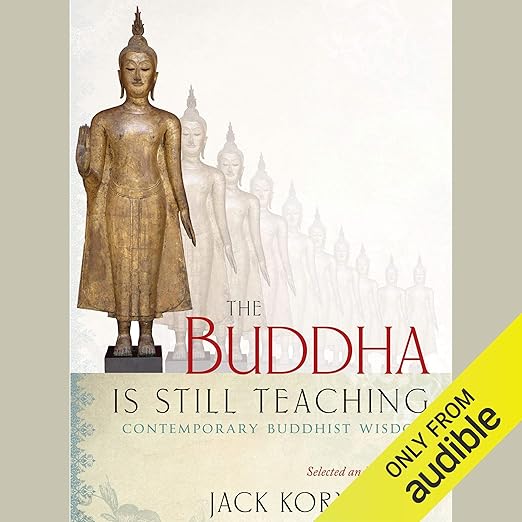
I listened to most of The Buddha Is Still Teaching in fragments across a week: a passage on a walk, a selection before sleep, a few minutes while making coffee before the workday began. That is exactly how the book is designed to work, and discovering that the listening experience rewarded that non-linear approach was one of the more pleasant surprises in a long while. Jack Kornfield, one of the primary figures responsible for bringing Theravada Buddhism to a Western audience in accessible form, has assembled an anthology of contemporary Buddhist teachers that is built for exactly this kind of repeated, unhurried engagement.
The contributors list is remarkable in its range and depth: Tara Brach, Pema Chodron, the Dalai Lama, Thich Nhat Hanh, Sharon Salzberg, Ram Dass, Joseph Goldstein, Suzuki Roshi, Robert Thurman, and nearly two dozen others. These are not minor or peripheral voices in contemporary Buddhist thought. They represent genuinely different lineages and approaches. Edoardo Ballerini reads the selections with the kind of unhurried clarity that the material requires, treating each passage as something to be received rather than simply transmitted at pace.
Our Take on The Buddha Is Still Teaching
The anthology format has an inherent limitation that Kornfield acknowledges honestly through his curation: not every selection will resonate equally with every listener at every moment. One reviewer noted this with candor, describing some passages as more meaningful than others while affirming that all held some value. This is the honest experience of a compilation built from many voices and many traditions: breadth comes at the cost of sustained depth in any individual piece. What Kornfield has done, with considerable editorial skill, is sequence the selections so that they speak to each other across lineages and centuries rather than simply sitting in isolated parallel. The audio format makes this sequencing more apparent than it might be when reading the physical book and choosing your own path through it.
Why Listen to The Buddha Is Still Teaching
The four-hour runtime makes this a genuinely usable audiobook for daily contemplative practice. Multiple reviewers describe using it specifically in meditation groups: someone reads a passage aloud, the group sits with it for some time, then discusses what arose. That application translates naturally to audio: Ballerini’s pace leaves breathing room around each selection, and the passages are brief enough to hold in mind during a sitting without effort. If you are building or maintaining a meditation practice and want something to anchor it to wisdom that extends across traditions beyond your own teacher’s lineage, this compilation provides unusual breadth without diluting any individual teacher’s voice significantly.
What to Watch For in The Buddha Is Still Teaching
This is not an introduction to Buddhism and is not structured as one. The selections assume a listener who already has some personal relationship with Buddhist concepts, even if that relationship is new and tentative. Listeners seeking a systematic philosophical overview of Buddhist thought from the ground up would be better served by an introductory text before arriving here. Additionally, the brief duration of individual passages means that no single teacher’s thought is developed at any length within this anthology; it is specifically an invitation to encounter rather than a substitute for reading those teachers in their own full-length works.
Who Should Listen to The Buddha Is Still Teaching
Practitioners who want a portable anthology for daily reflection are the natural primary audience. But the book also works as a thoughtful gift for someone beginning to explore contemplative practice, and as a resource for experienced meditators who want measured exposure to teachers outside their primary tradition. Ballerini’s narration makes the audio version a complete and independent experience rather than a lesser substitute for the print edition. If you are already familiar with any of the contributing teachers and want a compressed window into the range of contemporary Buddhist thought across lineages, this compilation earns its place on the shelf.
Frequently Asked Questions
Is this audiobook appropriate for someone who has never studied Buddhism before?
It is better suited to listeners with at least some passing familiarity with basic Buddhist concepts. The selections are not written for complete beginners, and the anthology format does not provide the explanatory scaffolding an introductory text would. Jack Kornfield’s own A Path With Heart is a gentler starting point.
How does Edoardo Ballerini’s narration handle the shift between so many different contributing authors?
Ballerini reads all selections in his own voice rather than attempting to differentiate stylistically between contributors. This creates continuity across the anthology, which serves the meditative purpose of the compilation well. The trade-off is that the individual voices of the teachers are somewhat unified through his reading.
Can this audiobook be used effectively in a group meditation context?
Yes. Multiple reviewers specifically describe using it in exactly this way, with someone reading a passage aloud and the group sitting with it before discussing implications for practice. The brief length of individual passages makes them easy to integrate into a meditation session without dominating the sitting.
Does the selection represent the full range of Buddhist traditions, or does it lean toward a particular school?
The compilation leans toward Theravada-influenced Western teachers, which reflects Kornfield’s own formation, but includes Tibetan voices like the Dalai Lama and Dilgo Khyentse, and the Vietnamese tradition of Thich Nhat Hanh. Listeners interested specifically in Zen or Pure Land traditions may find those lineages less fully represented.