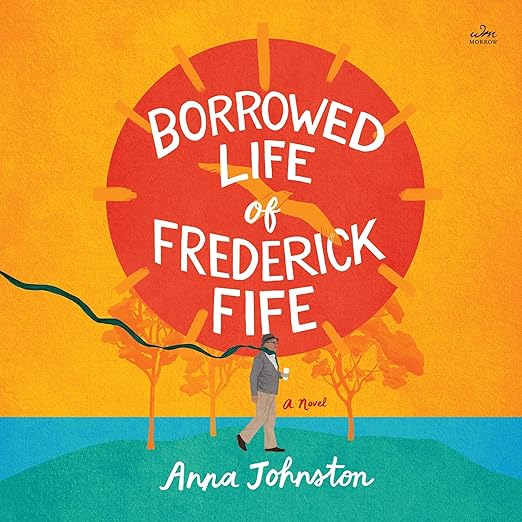
Quick Take
- Narration: Tim Carroll brings Frederick to life with a gentle, unhurried warmth that perfectly matches the novel’s pace, his elderly-man register is never a caricature.
- Themes: Found family and late-life reinvention, kindness as radical act, identity and impersonation
- Mood: Warm and bittersweet, funny in a way that accumulates rather than detonates
- Verdict: A genuinely kind novel in the tradition of A Man Called Ove, elevated by a narrator whose restraint makes the emotional moments land harder than they would in more performative hands.
I finished The Borrowed Life of Frederick Fife on a Sunday evening with a cup of tea that had gone cold, in that particular reading-induced fugue state where you are not quite back in your own life yet. The novel had been keeping me company for two days, I had rationed it, which is something I almost never do, and when it ended I felt the specific sadness of leaving a place and its people behind. Anna Johnston’s debut for adult readers has been compared to A Man Called Ove, and that comparison is not wrong. But it also has something Backman’s novel occasionally lacks: genuine comedic timing in the service of character rather than sentiment.
Frederick Fife is eighty-two, broke, on the verge of eviction, and in possession of what the synopsis correctly identifies as an extra helping of kindness. He is the sort of man who returns borrowed cars washed and full of gas. When he is mistaken for a missing nursing home resident named Bernard Greer, he makes a decision that is foolish, desperate, and entirely in character: he takes Bernard’s place. The deception plot is the engine. But the heart of the novel is in what happens when Fred starts walking in Bernard’s shoes and leaves, as the synopsis puts it, a trail of kindness behind him.
Tim Carroll and the Weight of Eighty-Two Years
Carroll’s performance is the version of this audiobook that will stay with you. He never plays Fred as a type, the kindly old man, the rogue senior, the stock comedy figure. He plays him as someone with history, with a particular internal rhythm, with the specific relationship to time that comes from being near the end of a life rather than the middle of it. The warmth is there, but so is something more elusive: the sense that Fred knows things the younger characters around him do not, and is patient about waiting for them to figure it out. That quality takes an actor, not just a voice.
Denise’s Half of the Story
Johnston is careful to give the caregiver Denise equal narrative weight. Her marriage is failing, her daughter is unwell, and she has made a reasonable if painful decision to stop trusting men who deceive her. Fred’s presence in the facility sets her on a collision course with her own suspicions, she knows something is wrong about Bernard Greer, and she keeps looking. The push-pull of a woman who is drawn to a person she has every reason to distrust is one of the novel’s more quietly sophisticated elements. Johnston does not resolve this by making Fred’s deception morally simple. He is kind, and he is also lying. Both things are true, and the book holds them together honestly.
Where the Comedy Lives
The novel is billed as hilarious, and that word is a scale problem, what reviewers mean by it is that there are genuine, earned laughs throughout, not that this is a broad comedy. The humor comes from Fred’s unfailing politeness in situations that would break a more ordinary person, from his chess-match perspective on adversity, and from the gap between how he sees the world and how the world sees him. One reviewer noted laughter followed by tears followed by joy, and that arc is real. Johnston earns the emotional material by not rushing it, and the humor is what keeps the novel from collapsing under the weight of themes that include grief and redemption alongside the lighter elements.
Who Will Love This and Who Will Not
Readers who loved Fredrik Backman’s A Man Called Ove or Shelby Van Pelt’s Remarkably Bright Creatures, the Library Journal comparison is well-chosen, will feel immediately at home. This is feel-good fiction in the best sense: not saccharine, not dishonest about pain, but fundamentally optimistic about human capacity for reinvention. Listeners who prefer their fiction more ambivalent about morality, or who find elderly-protagonist novels too gentle by default, will find this confirms rather than challenges their preferences.
Frequently Asked Questions
Is The Borrowed Life of Frederick Fife a standalone novel or the beginning of a series?
It is a complete, standalone novel. There is no sequel and the story resolves fully within this book. It is the kind of narrative that benefits from its contained scope, everything it sets up, it pays off.
How accurately does the A Man Called Ove comparison hold up, is this the same emotional register?
The comparison is fair in broad terms: both feature older, cantankerous-adjacent protagonists whose fundamental decency is revealed through unexpected circumstances, and both have emotional payoffs that creep up on you. Johnston’s novel is perhaps funnier in a more consistently comedic way and less focused on grief as a primary motor. Readers who loved Ove will be comfortable here, though this is its own thing.
Does the novel address the ethical dimension of Frederick’s impersonation seriously, or does it hand-wave it in favor of comfort?
It addresses it honestly. Denise’s suspicion and the novel’s eventual revelation are not played for easy resolution. The book acknowledges that Fred’s deception, however motivated by necessity and kindness, is a deception. Its conclusion is generous rather than exculpatory, which is a meaningful distinction.
Is Tim Carroll’s narration differentiated enough to distinguish between the large cast of nursing home residents and staff?
Yes. Carroll maintains clear character differentiation throughout, with enough tonal and pacing variation to keep the supporting cast legible. Given that much of the novel is set in a facility with a large ensemble, this is not a trivial achievement.