Quick Take
- Narration: Paul Tuttle reads with appropriate solemnity and never overperforms the mystical material, which is the right instinct for texts that are meant to be absorbed rather than dramatized.
- Themes: Angelic hierarchies and the fall of the Watchers, prophetic cosmology, the intersection of Jewish mysticism and proto-Gnostic thought
- Mood: Reverent, atmospheric, and genuinely strange in the best sense
- Verdict: For listeners drawn to ancient apocrypha and esoteric religious history, this guided edition offers real scholarly framing alongside the texts themselves.
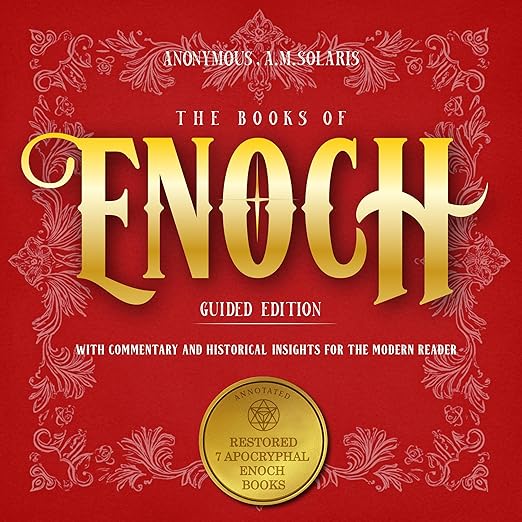
I came to the Books of Enoch sideways, the way most people do, through a footnote in something else. I was listening to a lecture series on Second Temple Judaism and kept hitting references to Enochian literature as a missing context for understanding early Christian angelology, apocalyptic writing, and the figure of the Son of Man. The texts themselves are not difficult to find, but finding them with coherent scholarly framing attached is another matter. This guided edition by A. M. Solaris, narrated by Paul Tuttle, attempts exactly that: not just the ancient texts but a layer of commentary that makes them navigable for listeners who are approaching from outside theological scholarship.
The Books of Enoch is a loose designation covering a set of ancient Jewish religious works attributed to Enoch, the great-grandfather of Noah, who in the Genesis account walked with God and was taken without dying. The First Book of Enoch, the most significant and extensive, was preserved in full only in the Ethiopian Orthodox canon; other parts survived in fragments. They were rejected from the Hebrew Bible and eventually from Christian scripture, but they circulated widely and shaped apocalyptic literature, the figure of the fallen angels, and the mythology of the Nephilim in ways that echo across centuries of subsequent religious and literary tradition.
Our Take on The Books of Enoch (Guided Edition)
What makes this guided edition worth attention is not just the assembly of texts, the seven books covering the Watchers, the fallen angels, the Nephilim, the Book of Parables, the Luminaries, the Book of Dreams, and a postscript, but the commentary framework A. M. Solaris provides around each section. The introductions connect Enoch’s cosmology to early Jewish mysticism, Hermetic tradition, Gnostic thought, and Kabbalistic interpretation, and they do so without flattening the distinctions between those traditions. Listeners who know something about any of these frameworks will find the cross-references genuinely illuminating; the glossary of Enochian and Hermetic terminology is a useful anchor for those approaching without prior background. This is not a devotional edition in the sense of being designed for liturgical use; it is more accurately a scholar-adjacent popular edition, aimed at the intellectually curious reader who wants historical context alongside revelation.
Why Listen to The Books of Enoch in Audio
Apocryphal and pseudepigraphical texts have a particular quality in audio that they do not quite have in print: the oral tradition dimension. These texts were transmitted orally for generations before they were written down, and listening to them read aloud reconnects them to that origin in a way that reading from a screen does not. Paul Tuttle’s narration is well-suited to this function. He reads with steadiness and gravity, letting the material’s strangeness emerge naturally rather than underlining it. The Book of the Watchers, which narrates the descent of two hundred angels who take human women as wives and teach forbidden knowledge to humanity, is one of the more cosmologically wild texts in the ancient Near Eastern canon, and Tuttle reads it without sensationalism. That restraint is the right call; the content earns its own weight.
What to Watch For in the Commentary
The Solaris commentary is the variable element in this edition. It is knowledgeable and contextually rich, but listeners with serious academic backgrounds in Jewish studies or early Christianity will notice that it pitches to a popular audience and occasionally synthesizes traditions in ways that specialists might find imprecise. That is not a disqualifying critique, this is a popular edition, not a critical scholarly text, but listeners who want rigorous academic commentary should also consult the work of scholars like George Nickelsburg, whose translations and critical apparatus are the standard reference in the field. As an introduction and orientation, the Solaris commentary does what it sets out to do.
Who Should Listen to The Books of Enoch (Guided Edition)
Ideal for listeners with an interest in biblical apocrypha, esoteric religious history, or the history of angelology and demonology. It functions well as both an introductory text and a companion to more specialized reading. Skip it if you want strict academic apparatus, this is a popular edition with scholarly sensibility, not a critical text. For listeners who have encountered Enoch through references in Milton, Dante, or contemporary fantasy and want to go to the source, this edition is a thoughtful starting point.
Frequently Asked Questions
Is prior knowledge of the Bible or Jewish scripture required to follow these texts?
Not required, but helpful. The Solaris commentary provides context for listeners approaching from outside religious scholarship, and the glossary covers key terminology. Familiarity with Genesis, particularly the brief Enoch references in chapters 5 and 6, adds resonance but is not a prerequisite.
How does the guided commentary by A. M. Solaris relate to the ancient texts? Is it integrated or separate?
Each of the seven books is preceded by an introductory section from Solaris that provides historical background, theological context, and cross-references to related traditions. The ancient text itself then follows. The structure alternates between scholarly framing and source material throughout the ten-hour runtime.
Are these the same texts referenced in mentions of the Nephilim and the Watchers in popular culture?
Yes. The Watchers narrative and the Nephilim account originate in the First Book of Enoch, and this edition includes both. Much of the mythology around fallen angels in Western culture traces back to this source material.
Is Paul Tuttle’s narration suitable for extended listening sessions, or does it become fatiguing?
Tuttle’s register is measured and consistent rather than dramatically varied, which suits texts that reward contemplative listening. Some listeners may find the ten-hour runtime dense in extended sessions; listening in shorter segments allows more time to absorb the commentary alongside the ancient material.