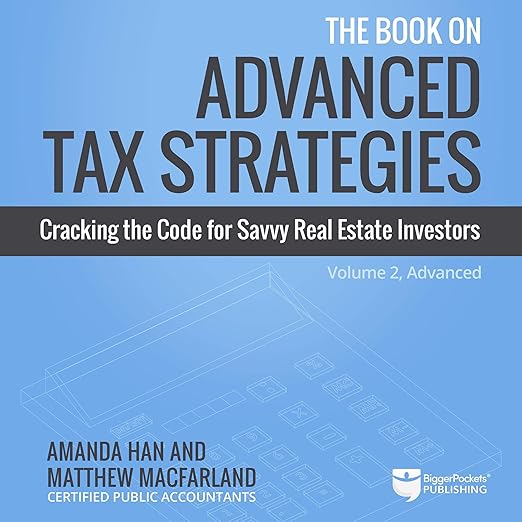
Tax strategy books occupy a strange position in the personal finance audiobook space: the good ones are genuinely useful, the mediocre ones are padding dressed in authority, and even the good ones require you to bring your own situation to the material or they slide past without sticking. I came to The Book on Advanced Tax Strategies after hearing it recommended specifically for real estate investors who feel their CPA is not as proactive as they ought to be. That framing turned out to be exactly right, and it shaped how I listened to the entire thing.
Amanda Han and Matthew MacFarland are CPAs who specialize in real estate investing, and this is their second book for BiggerPockets, functioning as a sequel to their original Book on Tax Strategies. That earlier volume appears frequently in reader reviews as the stronger standalone read, and the sequencing matters: this one is explicitly designed for investors who have absorbed the foundational material and are ready to work with more sophisticated structures. Jumping in here without that background is not impossible, but you will feel the gaps.
One reviewer was precise about this: the strategies in this book are genuinely advanced, and many of them cannot be implemented independently without a CPA or tax attorney to execute the transactions properly. Han and MacFarland are transparent about that limitation throughout. The book's practical utility is primarily in raising the investor's awareness of what is legally possible, so that when they sit across from their tax professional they can ask informed questions and push back on passive advice.
This framing is itself one of the book's most valuable contributions. The reviewer who saved thousands of dollars by raising specific strategies with their CPA, who confirmed those approaches would work but had not volunteered them, illustrates exactly how the book is designed to function. It is not a do-it-yourself tax guide. It is an education in what questions to ask of the people you pay to know these things. For investors who have spent years with CPAs who treat them as passive clients, this can be genuinely transformative.
Ponder's Clear Delivery Through 1031 Exchange Mechanics
The audiobook works through opportunity zone tax benefits, 1031 exchange mechanics including how to take cash out without triggering taxes, self-directed retirement account strategies, and cost segregation analysis for existing properties. It also addresses the tax reform provisions that affect real estate deals and the specific traps around retirement account investing in real estate. These topics arrive with concrete examples rather than abstract principle, which is where the tutorial-style approach that one reviewer praised becomes most visible and most useful.
Clifford Ponder's narration is a strong match for this content. He maintains clarity through sections that could easily become numbing in the hands of a narrator who over-dramatizes or under-inflects technical material. Acronyms and tax code references land crisply. The accompanying PDF, available in the Audible library with purchase, carries charts and structural information that the audio references but cannot fully convey, and listeners serious about implementing any of these strategies should download it before beginning.
Advanced Strategies for Investors Past the Basics
A newer investor with limited tax sophistication will get something from this book, but the subtitle is accurate: these are advanced strategies for investors who already have some portfolio complexity. The investor thinking about cost segregation on existing properties, wondering how to access equity from a 1031 exchange without paying tax on it, or trying to understand whether a spouse might qualify for real estate professional status will find specific, actionable frameworks. Someone wondering whether to open a real estate LLC for a first property needs the first book, not this one.
Listeners who are established investors managing multiple properties, who have been paying taxes they might have legally deferred, who have a CPA who does not proactively surface these conversations, will find genuine traction here. The book does not pad its running time with motivation or lifestyle content. It moves through strategy with the efficiency you would expect from working CPAs who have more clients than time, which Han and MacFarland are.
Numbers From 2020 Worth Rechecking With a CPA
Tax law changes, and some of the specific provisions discussed here, particularly around opportunity zones and tax reform benefits, are calibrated to the legislative landscape as of the book's 2020 release date. Listeners should treat the conceptual strategies as durable and the specific rules and thresholds as starting points requiring verification with a current tax professional. The categories of optimization the book identifies are stable across most legislative cycles. The exact numbers, deadlines, and qualifying requirements are not. At just under eight hours, this is a focused listen that rewards note-taking. Use it with the companion PDF, and bring what you find to your next CPA meeting ready to ask specific questions rather than waiting to be told what you might have done differently.
Questions Listeners Ask
Is this audiobook useful for someone just starting to invest in real estate?
It provides issue-spotting value for newer investors, but many of the strategies require enough investment activity and complexity to justify their cost of implementation. Newer investors will benefit more from the first book in the series, then return to this one as their portfolio grows.
How does Clifford Ponder handle the technical tax terminology in the narration?
Ponder delivers the material with professional clarity. Tax code terms, IRS designations, and financial structure vocabulary come through without distortion. This is not performative narration, which is appropriate: the content is the point, and Ponder does not get in the way of it.
Is the tax information in this 2020 book still accurate?
The strategic frameworks for opportunity zones, 1031 exchanges, and self-directed retirement accounts remain conceptually sound. However, specific thresholds, deadlines, and legislative details should be verified with a current CPA, as tax law has continued to evolve since the book's publication.