The Short Version
- Performance: Paul Selig narrates his own channeled text, and the effect is genuinely unusual. His voice carries the rhythm of received dictation, slower and more deliberate than conventional narration, which either deepens the experience or makes it feel ceremonial depending on your orientation.
- What it covers: relational mirrors, divine unity, forgiveness as liberation
- Feel: Contemplative and cumulative, demanding patience
- Our call: For listeners already in Selig's world, The Book of Truth is essential in audio form. For newcomers, start with I Am the Word before committing to eleven hours of channeled instruction.
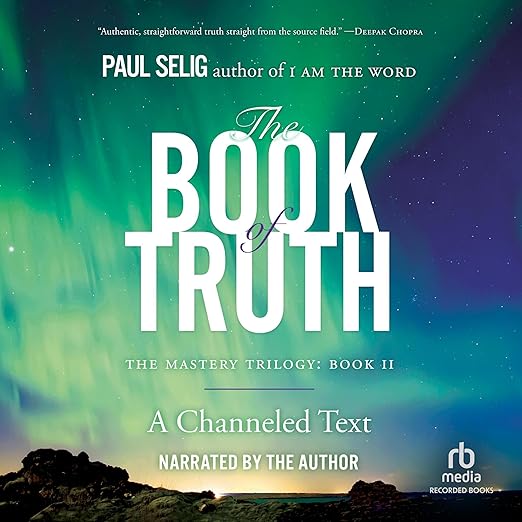
Paul Selig's voice on this recording is not quite like any other narrator in the audiobook world, and understanding why requires knowing what kind of text The Book of Truth actually is. Selig is a channeler who receives clairaudient dictation from what he calls the Guides, and this audiobook, the second installment in his Mastery Trilogy, is the transcribed result of those sessions read by the man who originally spoke them. The experience of listening is accordingly different from listening to an author read an essay or a novel. Something in the pace and register carries the quality of material that was received rather than composed, and that quality is either the book's greatest asset or its most difficult demand, depending on what you bring to it.
The Verdict, Briefly
Selig's previous trilogy, which began with I Am the Word and continued through The Book of Love and Creation and The Book of Knowing and Worth, established a dedicated following for his channeled work. The Mastery Trilogy continues that project with an intensified focus on what the Guides call the simple truths behind the seeming complexities of your relationships. The core teaching here is that the people around you, including those who have hurt you, function as mirrors for your own interior state, and that the path through relational pain runs through recognition and forgiveness rather than separation or defense. This is not an unfamiliar spiritual principle, but Selig's framing is more radical than most: the claim is not merely that forgiveness is healthy, but that the distinction between self and other dissolves at the level of what the book calls Divine Essence.
Reviewer S. Dares noted that the audiobook feels fresh on each relisten, which is a meaningful observation for a spiritual text. The Guides' instruction is circular and cumulative in a way that resists being summarized but builds over repeated exposure. Reviewer lindab described the experience as finally remembering information she had been waiting for, which is the kind of response this material tends to generate in listeners who find themselves inside its wavelength. The 11-hour and 29-minute runtime is not accidental; the teaching requires sustained immersion rather than casual sampling.
Why The Book of Truth Works as an Audiobook
The argument for the audio format here is stronger than for almost any other book in this genre. Selig's self-narration carries an energy that transcription alone cannot fully convey. He is not performing the text in a conventional sense; he is re-inhabiting the receiving mode, and the result has a quality of presence that listeners accustomed to more polished productions may find disorienting before they find it compelling. Reviewer S. Dares said explicitly that listening rather than reading was the mode that unlocked the material, which is a recommendation worth taking seriously.
The book is organized around teachings rather than chapters in the conventional sense. Each section builds on the relational themes established in The Book of Mastery, adding layers of specificity about how the process of forgiveness and recognition operates in daily life. The Guides address the listener directly throughout, which makes the audio experience particularly charged. Being addressed by a voice speaking directly to your own resistance, your own tendency to protect injury rather than release it, is more immediate in sound than on the page.
What Might Not Land
This is the second book in a trilogy, and Selig has described his entire catalog as interconnected. Listeners new to his work will not be completely lost, but they will miss the scaffolding that The Book of Mastery provides. If you are new to Selig, starting with I Am the Word, the first entry in his original trilogy, gives you the foundational language the Guides use throughout the Mastery series. Beginning with The Book of Truth cold risks a sense of confusion about why certain phrases and formulations keep repeating, which is not a stylistic tic but a deliberate pedagogical structure.
The channeled loop format, in which certain phrases and instructions recur with variation, is also worth preparing for. It is a feature of how Selig's source material operates, not a sign of poor editorial judgment. Listeners who find repetition frustrating rather than deepening will find the style difficult to sustain for eleven hours. Listeners who work with meditation, contemplative prayer, or other practices built on returning to core formulations tend to find the rhythm natural rather than tedious.
It is also worth noting that The Book of Truth addresses relationships in a way that can feel unsettling before it feels liberating. The Guides' claim that your enemies are mirrors of your interior state is not offered as a metaphor but as a literal description of how consciousness operates. For listeners who are in the middle of active conflict or injury, that framing can feel like victim-blaming before the full context of the teaching becomes clear. Selig acknowledges this resistance in the text and addresses it directly, but patience with the early chapters is required before the framework resolves into something that feels genuinely compassionate rather than demanding.
Who Should Pick Up The Book of Truth
Listeners who have already read or heard I Am the Word or The Book of Mastery are the natural audience, and for them this audiobook is a meaningful continuation of a project they are already invested in. Listeners drawn to channeled literature, particularly those familiar with A Course in Miracles, will find Selig's work in the same tradition but with a more relational and psychologically immediate focus. The 4.9 rating across nearly 600 reviews reflects a deeply committed readership for whom the material is transformative rather than merely interesting.
Approach with caution if you are new to Selig, or begin with an earlier volume first. Skip this audiobook entirely if channeled texts feel intellectually unsatisfying or if you require empirical grounding for spiritual claims. The book makes no attempt to verify its origins or argue for their plausibility; it simply proceeds from the premise that the teaching is real and that the listener is ready to receive it.
Good to Know
Do I need to have read The Book of Mastery before listening to this audiobook?
The Book of Truth is the second volume in Selig's Mastery Trilogy, and the teachings build directly on the first. New listeners are strongly advised to start with The Book of Mastery, or at minimum with I Am the Word, to have the foundational language and concepts the Guides use throughout this recording.
Is the audiobook of The Book of Truth worth choosing over the print edition?
Several listeners explicitly noted that audio is the preferred format for Selig's work. His self-narration carries the quality of the original channeling sessions in a way that the printed transcript cannot fully replicate, and the Guides' direct-address format gains particular intensity when delivered as sound.
How does The Book of Truth compare to A Course in Miracles for listeners familiar with channeled literature?
Selig's work has been described as the most important channeled literature since A Course in Miracles rose to prominence. The relational focus of The Book of Truth is more psychologically specific than ACIM, and the Guides address contemporary interpersonal dynamics with a directness that distinguishes this series.
At 11 hours, how should I pace my listening to The Book of Truth audiobook?
Reviewer S. Dares described finding the material fresh on each relisten, which suggests this is not a book to absorb once and move on from. Sustained immersion in shorter daily sessions tends to work better than marathon listening. The cumulative, circular structure is designed to build over time.