Quick Take
- Narration: Sean Crisden brings a reverent, measured delivery to a 25-hour text that demands sustained commitment; his pacing is calibrated for devotional listening as much as narrative.
- Themes: Prophetic covenant across generations, the relationship between faith and record-keeping, spiritual testimony as historical document
- Mood: Devotional and meditative, with the formal cadences of ancient scripture rendered in Anglicized prose
- Verdict: This audiobook serves its intended audience well: Latter-Day Saint listeners seeking a production-quality reading of their central sacred text, and scholars wanting to encounter the work in audio form.
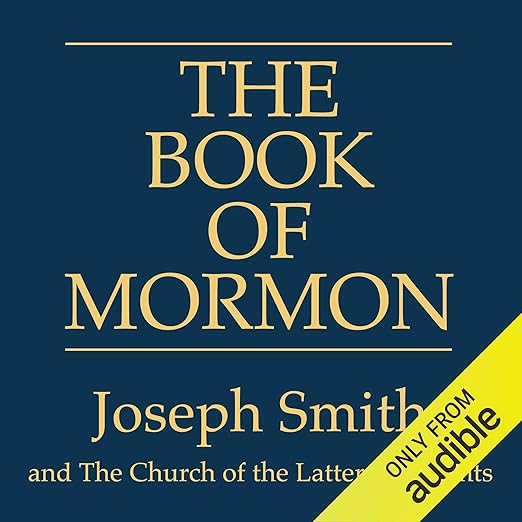
Reviewing a sacred text as an audiobook requires a particular kind of honesty: the categories that apply to fiction or even to religious nonfiction are not quite right here, and any assessment that ignores what the text is and who it is for will miss the point entirely. The Book of Mormon, translated by Joseph Smith Jr. from what Latter-Day Saint theology holds to be ancient records on golden plates, is the foundational scripture of the Latter-Day Saint movement. It is listened to by millions of adherents as an act of devotion, studied by religious scholars as a text of significant cultural and historical importance, and encountered by curious outsiders as one of the most widely distributed religious documents in American history. Sean Crisden’s Audible edition, running twenty-five hours and nineteen minutes, is a serious audio production of a text that deserves serious treatment regardless of one’s theological position on its origins.
I want to be clear about my position in writing this: I am reviewing this audiobook from the perspective of a literary critic and audiobook listener, not from inside the faith tradition. That means I can assess the production quality, the narration, and the listening experience with some consistency. What I cannot assess is the spiritual experience that adherents bring to this text, which is by definition the primary context in which most listeners will encounter it, and which the production is ultimately designed to support.
What the Text Actually Is and Is Not
The Book of Mormon presents itself as an abridgment of ancient records kept by prophets on the American continent from approximately 2200 B.C. to A.D. 421, compiled by a figure named Mormon and his son Moroni, and translated by Joseph Smith in the late 1820s. The text includes narrative accounts, prophetic discourse, doctrinal exposition, and passages of poetry, all rendered in a formal prose style strongly influenced by the King James Bible. The parallels to biblical style are intentional and functional: the language carries the formal weight appropriate to scripture, and the cadences are designed for oral proclamation as much as private reading, which makes the audio format a particularly appropriate medium for encountering this material.
The synopsis for this edition describes it as a fascinating listen for religious scholars and denominational adherents alike, which is accurate as far as it goes. Scholars of American religious history will find the text essential: the Book of Mormon is not only a theological document but an artifact of nineteenth-century American religious culture with significant implications for understanding millenarianism, primitivism, and the relationship between textual authority and new religious movements. Adherents will find here what they find in their personal copies: scripture whose meaning deepens through repeated encounter and whose narrative threads reward close attention across the full twenty-five hours.
Sean Crisden and Twenty-Five Hours of Sacred Text
Narrating twenty-five hours of scripture is a task without many parallels in audiobook production. Sean Crisden approaches it with the kind of considered formality that the text’s register demands. His voice is clear and unhurried, with a measured reverence that suits devotional listening. He does not perform the text in the sense of differentiating characters through theatrical voice acting, which would feel incongruous with scripture’s formal mode; instead he reads with a consistency of tone that allows the text itself to carry the weight of its claims.
For adherents who want a production they can listen to during personal scripture study or family reading time, Crisden’s narration is well-suited to that purpose. For scholars listening for content and structure, his pace, slightly slower than a typical audiobook narrator, allows for note-taking and reflection. For purely secular listeners exploring the text out of cultural curiosity, the runtime and the formal register require patience, but the production does not create additional barriers beyond those the text itself imposes on the uninitiated reader.
The Reviews and What They Tell a Prospective Listener
The audiobook’s review section reveals something interesting about the audience for this edition. Several reviewers are clearly assessing a physical print edition rather than the audio production, discussing font size and paper quality in ways that suggest they received a print copy rather than listened to the audiobook. This confusion appears to stem from the title listing structure on retail platforms and should not concern audio listeners evaluating the narrated version. The reviews that engage with the audio edition specifically speak to the experience of hearing scripture read aloud with appropriate care and production quality, and those assessments are consistently positive.
One reviewer offered an extended personal testimony about how the Book of Mormon has shaped his understanding of faith across decades of devotional reading, describing how the text has helped him appreciate what he believes is the Savior’s love for him. That kind of testimony is the primary context for this audiobook’s existence. Many of those testimony-focused reviews are written by people who have engaged with the text for decades as a devotional practice, and their relationship to what they are describing is categorically different from a conventional audiobook consumer assessment. A 4.2 rating that includes several clearly misdirected print-edition reviews should be read with the awareness that the actual audio audience evaluating the production on its own terms reports a different and more consistently positive experience. The Book of Mormon in audio form serves its intended community well, and that community’s relationship to this text is the most important context any prospective listener can bring to their decision about whether to begin.
Frequently Asked Questions
Is this audiobook of The Book of Mormon the same as the Broadway musical of the same name?
No. This is an audio production of the actual Latter-Day Saint scripture, translated by Joseph Smith Jr. It has nothing to do with the Broadway musical. They share a name but are entirely different works.
Does Sean Crisden’s narration differentiate between the different prophets and narrative voices within the text?
He maintains a consistent formal tone throughout rather than adopting distinct voices for different narrative voices or prophets. This suits the scripture’s devotional register, where the text’s authority comes from consistency of presentation rather than dramatic interpretation.
Is the audio edition organized the same way as the standard print edition?
Yes. The audio production follows the text’s standard organization from 1 Nephi through Moroni, in the same order as the print editions used by Latter-Day Saint congregations. The twenty-five-hour runtime covers the complete text.
Is The Book of Mormon audiobook accessible to non-Latter-Day Saint listeners who are curious about the text?
It is accessible in the sense that no prior knowledge is required. The text includes its own introduction explaining its origins and theological claims. Secular or non-member listeners who approach it with genuine curiosity and patience for formal scripture prose will be able to engage with the material throughout.