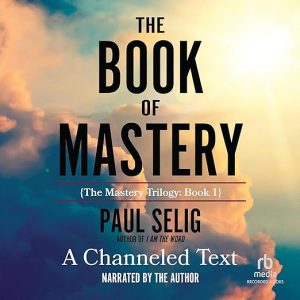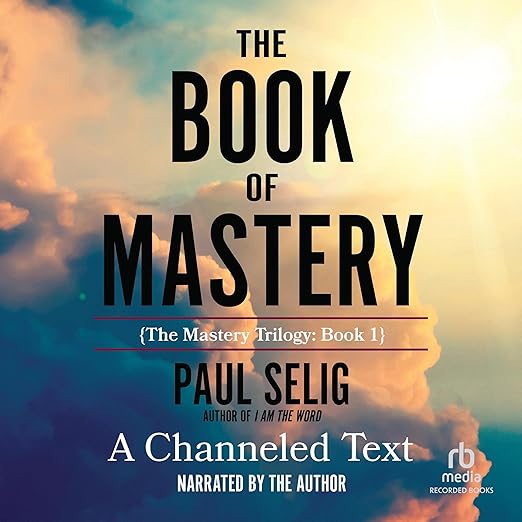
Paul Selig opens The Book of Mastery in the register of transmission rather than instruction: these words are given, not composed, and that distinction matters to how the audiobook is meant to be received. Selig, who works as a clairaudient channel for what he calls the Guides, narrates his own material throughout the ten hours and thirty-one minutes, and his delivery carries a quality distinct from produced audiobook narration. This is the first volume of the Mastery Trilogy, itself positioned as a new phase in Selig's widely followed channeled literature project, which began with I Am the Word and has since built one of the most substantial audiences in contemporary spiritual publishing.
Where This One Lands
The context matters for new listeners: Selig's three previous books, I Am the Word, The Book of Love and Creation, and The Book of Knowing and Worth, have built a substantial following grounded in what his publisher describes as the most important channeled work since A Course in Miracles rose to prominence in the 1970s. That is a significant claim, and the listener's comfort with it determines whether this audiobook functions as a deepening practice or as a fascinating document of a contemporary spiritual phenomenon. The Guides' opening statement, that no one who reads these books will be left unchanged, and that the physical realm is about to go back to the stone ages unless you all get it together, sets the stakes immediately. This is not a gentle wellness offering; it is an urgent one with planetary scope.
Reviewer S. Dares described The Book of Mastery as speaking of the passage from ego, from the personality self that has identified with a co-created realm, toward a restoration of divinity, and that framing is accurate to the content. The Guides' teaching methodology is cumulative rather than sequential: ideas introduced early in the audiobook are returned to at deeper levels as the runtime progresses. Listener Iris flagged the channeled material's challenge around radical honesty with oneself as the moment that caught her full attention, specifically the question of whether she truly aligned to truth in her daily life. That kind of specific personal entry point is characteristic of how Selig's work finds its audience: the material is constructed to create moments of direct recognition rather than intellectual approval.
Selig's self-narration is inseparable from the material's effect. He has described the channeling process as receiving clairaudient dictation, and his vocal delivery in the audiobook carries the quality of live reception: the pace is not the pace of a rehearsed performance but of someone tracking a transmission in real time. For listeners who accept the frame, that quality creates a sense of direct access to the source material that a produced, actorly narration would interrupt. For listeners approaching from outside the tradition, it is worth knowing that this is what you are encountering: a genuine spiritual practice rendered in audio form, not a self-help product with spiritual branding.
The practical dimension of the Guides' teaching is real and extends well beyond individual transformation. Reviewer J.J. Michael described a sustained personal transformation that brought them through Selig's first book before arriving at this one, and noted that The Book of Mastery represents a direct continuation and deepening of that developmental arc. The Mastery teachings go further than personal excellence, extending to improving life for others and, ultimately, for global humanity, which distinguishes this volume from purely inward-focused personal-development content. That distinction, from individual cultivation to collective responsibility, is what marks the Mastery Trilogy as a distinct phase in Selig's project.
Weak Spots in The Book of Mastery
The vocabulary of the Guides is specific and consistent across the Selig catalog. Terms like the Word, the Knowing, and the distinction between the personality self and the higher self appear throughout, and they carry precise meanings within the Selig cosmology that are assumed rather than re-explained in this volume. New listeners unfamiliar with the earlier books will benefit from starting with I Am the Word to acquire that vocabulary before arriving here. This is not a standalone entry point into the work, and the accumulated context from the prior three books deepens the Mastery Trilogy's opening volume considerably.
The content makes explicit claims about physical-world consequences, not merely personal transformation, and the scope of those claims is one of the features that distinguishes Selig's work from more inward-focused channeling traditions. The Guides are urgent about collective humanity's situation, and The Book of Mastery is framed as a practical response to that urgency. Listeners who engage with the material on its own terms will find it substantive and structurally coherent. Listeners arriving with strong prior commitments to secular rationalism will find the frame incompatible, and the audiobook does not attempt to bridge that gap.
Recommended For
Established Selig readers who have completed the first three books are the clearest audience and will get the most from this as the opening of a new trilogy. Listeners who have worked through A Course in Miracles or similar channeled spiritual texts and want contemporary comparative material will find Selig's work substantive and clearly structured. Newcomers to channeling literature are strongly encouraged to start with I Am the Word rather than here. Listeners who require empirical grounding for spiritual claims will find the frame in The Book of Mastery fully incompatible with that requirement.