At a Glance
- Narration: Paul Selig reading his own channeled text creates an unusual intimacy; his voice carries the material's repetition with patience rather than monotony.
- Themes: Divine Self, surrender and acquiescence, identity beyond the ego
- Mood: Meditative and cumulative, demanding active participation from the listener
- Verdict: Readers already committed to the Mastery Trilogy will find this third volume the most ambitious of the three; newcomers should start with I Am the Word to calibrate expectations.
I first encountered Paul Selig's work through a friend who described it as the kind of thing that either lands completely or makes no impression at all. She had been working through the entire series for two years and called The Book of Freedom the most demanding. I finally sat with it on a series of long walks last autumn, letting it move at its own pace, which is the only pace it seems to accept.
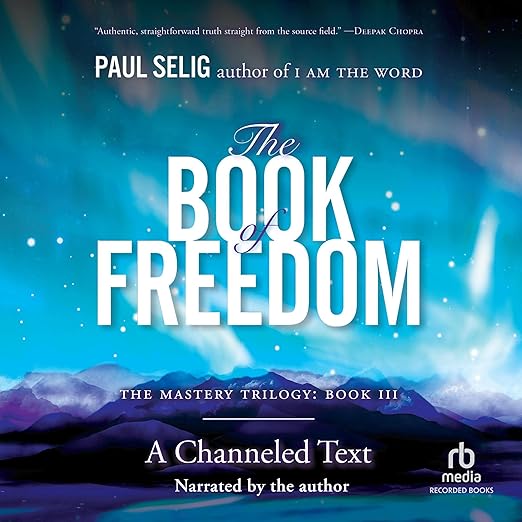
Selig occupies a specific category of contemporary spiritual writing: channeled literature, in which the author receives dictation from what he calls the Guides, unseen intellects whose transmissions form the substance of his books. Whether you approach this framing as metaphor, as literal fact, or with the careful neutrality of, as one reviewer put it, a former scientist trained at a national lab, the material itself is coherent and internally consistent. The Book of Freedom is the concluding volume of Selig's Mastery Trilogy, following The Book of Mastery and The Book of Truth, and it addresses what the Guides call full expression as the Divine Self.
What Paul Selig Delivers
Understanding how to listen to this audiobook requires understanding how the text was written. The Guides do not make arguments in the conventional sense. They make declarations, return to central claims from multiple angles, and invite the listener into what feels like an ongoing conversation rather than a lecture. The repetition is structural, not accidental. One reviewer described needing to be in the correct frame of mind and at the right vibrational level to engage with it properly, and while that language will make skeptical readers roll their eyes, the observation contains something true: this is participatory listening, not passive reception.
Selig reading his own work is the correct choice for this material. His voice has a kind of plainness that serves as contrast to the density of the content. He does not perform the transmissions. He delivers them steadily, which allows the ideas to carry whatever weight they carry without rhetorical amplification. At nearly eleven hours, this is a long listen, and that delivery style is what makes the duration manageable. A more theatrical narrator would have been exhausting over that runtime, turning something meant to be absorbed into something performed at the listener.
The Book of Freedom's central argument, if one can call it that, is that freedom arrives through surrender rather than assertion. The Divine Self that the Guides describe is not achieved through discipline or accumulation of spiritual practice but through what they call acquiescence to the true nature of one's being. For readers trained in Western self-help traditions, this is a counter-intuitive framing: the effort is not toward becoming something but toward recognizing what already is.
One reviewer who called herself a former scientist found this empirically verifiable, though she was deliberately cautious about how she described her experience. Another simply noted that Paul Selig is just a pure channel of truth. These testimonials cannot be evaluated externally, nor is that the right frame for them. What I can say is that the logic within the system is consistent, and that The Book of Freedom extends the Mastery Trilogy's central concerns with philosophical specificity rather than mere repetition of earlier material. Readers who found the middle volume, The Book of Truth, too abstract have reported this final installment more grounded.
Where Paul Selig Loses Some Ground
Multiple reviewers note that this is the best of the Mastery Trilogy, and some go further to say it is the strongest of all of Selig's books. I am less certain about that superlative, partly because the earlier books in the longer series, particularly I Am the Word, provide conceptual scaffolding that makes The Book of Freedom's specific arguments more legible. Arriving here without that foundation is not impossible, but the accumulated context of the Guides' teaching across multiple volumes gives this final installment its full resonance.
Selig's series has been compared to A Course in Miracles in terms of cultural reach within contemporary channeling literature, and the comparison is instructive. Both require the listener to engage not as a consumer of information but as someone willing to be changed by prolonged exposure to the material. Whether that change happens, and what it looks like, is not something any review can predict. What the review can confirm is that the material is serious, the internal logic is durable, and Paul Selig's plainspoken narration serves it better than any other approach could.
Who Should Pick Up The Book of Freedom
If you have already moved through the Mastery Trilogy and are wondering whether the third volume justifies the commitment, the consistent testimony of the readership is that it does. Multiple reviewers identify it as the strongest entry, and Selig's clarity in articulating the concept of surrender as it relates to the Divine Self is genuinely sharper here than in the preceding two books.
If you have never encountered Selig's work, beginning with The Book of Freedom is not the most productive entry point. Start with I Am the Word, allow the Guides' voice to become familiar, and come to this one when the earlier vocabulary is already part of your listening. This is not background audio. It is something closer to a practice, one that rewards returning to sections rather than consuming them linearly, and Selig's own voice makes that kind of recursive listening feel natural rather than demanding.
Common Questions
How is Paul Selig reading his own channeled material different from a professional narrator delivering the same text?
Selig's delivery is plain and deliberate rather than performative. Because he was present for the original transmissions, there is an earned familiarity in his reading that a third-party narrator could not replicate. Several reviewers specifically value this intimacy, treating it as evidence of authenticity.
How should a listener approach the repetition in the Guides' teaching style?
The repetition is intentional and structural. Selig's own framing suggests the Guides return to central claims from multiple angles because the point is absorption rather than comprehension alone. Active listening, rather than treating it as background audio, is how reviewers describe getting the most from it.