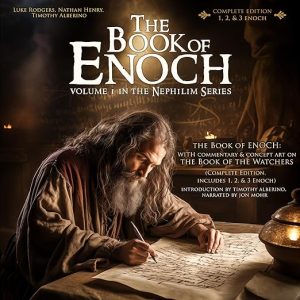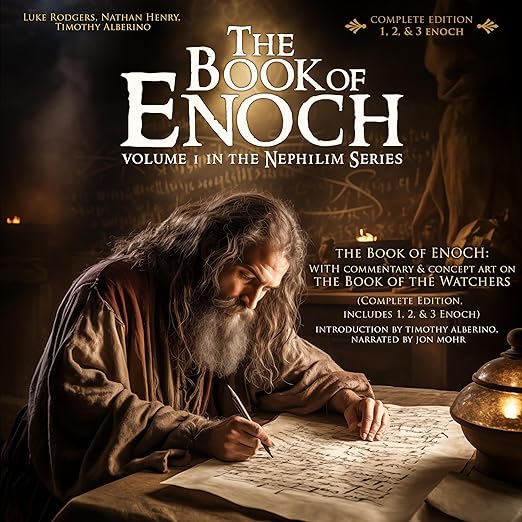
Enoch walks through the entire canonical tradition of ancient Israel and barely leaves a footprint. The seventh patriarch from Adam is treated in the Hebrew scriptures with a kind of conspicuous silence: present, briefly noted, and then gone, caught up into something the text declines to describe. That silence is exactly what Timothy Alberino's edition of the Book of Enoch fills, and this audiobook - narrated by professional voice actor Jon Mohr with commentary and conceptual scenes by Alberino himself - is the most layered audio treatment of the R. H. Charles translation currently available. At 9 hours and 24 minutes, it earns that density.
This is not a casual listen. Alberino positions this production as a scholarly guide to 1 Enoch chapters 1 through 36, the section known as the Book of the Watchers, supplemented by an introduction, extensive running commentary, and conceptual narrative scenes that attempt to bring the ancient account to life. If you come to this title expecting a simple reading of the text, you will find significantly more - and need to be ready for it. If you come expecting a production that genuinely treats the apocryphal tradition as a serious intellectual subject rather than fringe curiosity, you will not be disappointed.
Where This One Lands
The production's central achievement is the way Alberino uses his research background to situate the Book of Enoch within the broader canonical tradition. For listeners who have puzzled over passages in Genesis 6, or the mysterious references to the Nephilim scattered through the Old Testament, or the way certain Dead Sea Scrolls fragments treat Enoch as a prophetic authority, this commentary provides genuine connective tissue. Alberino's framing is not dry academic hedging. He is clearly convinced that this text has been unjustly sidelined, and that conviction drives the presentation with energy that keeps the 9-hour runtime from feeling static.
The approach is unconventional and that is the point. Alberino writes conceptual scenes, dramatized moments that attempt to render the ancient narrative in more immediate terms. This is either the production's greatest asset or its most divisive quality, depending on what you want from the material. Listeners who value pure textual analysis may find the dramatic inserts jarring. Those who find the raw text opaque without interpretive scaffolding will likely find the scenes extremely helpful. The R. H. Charles translation underpinning the whole is rigorous, and Alberino's insertion of his own voice into the material is consistently disclosed rather than blended invisibly with the source, which is the honest way to do it.
Why Listen to The Book of Enoch
Jon Mohr's narration is the stable center of a production with several moving parts. His voice is clean and authoritative without projecting false urgency, and he navigates the archaic registers of the Charles translation without sounding either bored or affected. The text moves between genealogical catalogues, visionary passages, angelic dialogues, and cosmological descriptions - each with different tonal requirements - and Mohr handles the transitions with more consistency than many narrators manage in less formally demanding material. The production also includes a PDF companion with concept art referenced in the title, and while the visual component cannot be fully appreciated in pure audio mode, the narration functions independently without significant loss.
One reviewer described this edition as providing "depth and clarity" to a text known for both its richness and its obscurity, and that is a fair assessment. The Book of Watchers section covers the descent of the Watchers, their corrupting influence on humanity, the births of the Nephilim, Enoch's role as intercessor, and his subsequent journeys through the heavens and the earth. All of it is loaded with interpretive history and Alberino treats none of it casually. Listeners who have worked through other commentary traditions on this text will encounter a perspective that is willing to challenge conventional scholarly readings.
What Gives Us Pause
The most substantive passages in this production are those where Alberino draws direct connections between the Enochic tradition and New Testament texts. His argument that the Book of Enoch was not merely known to but actively shaped by the writers of the New Testament is one of the more contested claims in apocryphal studies, and the way he builds that case across the commentary is worth tracking as you listen. Whether you find his conclusions persuasive or not, the trail of textual evidence he assembles is detailed enough to engage seriously. The sections on the Semikhazah and Azazel traditions within the Watcher narrative are particularly dense and particularly rewarding.
It is also worth paying attention to the framing of Enoch as a scribe and prophet, the two roles the Hebrew canon assigns him tacitly without ever letting him speak. Alberino's thesis is that the silence in canonical scripture points toward a deliberate exclusion, and the Dead Sea Scrolls material provides his most compelling evidence. Listeners interested in the history of the biblical canon and the political processes that shaped which texts were included will find this thread running through the entire production.
The Right Listener for The Book of Enoch
Listeners with an existing interest in biblical apocrypha, early Jewish cosmology, or the history of the canon will get the most from this audiobook. It also works well for those who have encountered the Nephilim and Watcher mythology through other channels - popular history, biblical studies courses, or books like Laurence Gardner's work - and want a more rigorous audio treatment. This is not a production suited to general spirituality listeners looking for devotional content. The PDF companion is genuinely useful and worth downloading. Complete newcomers to 1 Enoch should expect a significant learning curve in the first hour.
Quick Take
- Narrator: Jon Mohr is a professional voice actor whose read is measured and deliberate, handling the archaic cadences of R. H. Charles's translation with care; the conceptual scene narration by Alberino adds a second distinct voice layer that some will find enriching and others will find breaks the textual flow.
- Subjects: Antediluvian mythology, fallen angels and the Nephilim, biblical apocrypha and canonical gaps
- Tone: Dense and atmospheric, like attending a rigorous lecture inside a cathedral library
- Bottom line: A serious scholarly audio edition that rewards patient listeners interested in the cosmology of ancient Israel, though the accompanying PDF is essential for full value.
Common Questions
Do I need the PDF to get full value from this audiobook?
The narration stands on its own and the commentary is fully intelligible without viewing the concept art. However, Alberino's visual references are part of the production's design, and the accompanying PDF - available in your library with purchase - enriches the experience noticeably. Treat it as a parallel resource rather than a requirement.
Is this audiobook an academic production or more of a popular-audience treatment?
It sits between the two. The R. H. Charles translation is the standard scholarly edition, and Alberino's commentary draws on serious apocryphal research. But the conceptual scenes and the overall framing are designed for engaged general listeners rather than academic specialists. Listeners with some prior exposure to biblical studies will feel most comfortable.
Does this audiobook cover the entire Book of Enoch or only part of it?
This production focuses specifically on the Book of the Watchers, which is 1 Enoch chapters 1 through 36. The full text of 1 Enoch (R. H. Charles translation) is included, but the extensive commentary and conceptual scenes are concentrated on this first section. Listeners looking for equally deep treatment of the later sections, such as the Book of Parables or the Astronomical Book, will need to supplement with other resources.