Quick Take
- Narration: David Llewelyn reads with quiet authority that matches the text’s contemplative register, never overreaching into the performative spiritual cadence that can mar this genre.
- Themes: dharma as a decision-making system, the inner kingdom, wisdom traditions for contemporary life
- Mood: Measured and illuminating, with a scholarly warmth
- Verdict: An accessible introduction to dharmic principles for Western listeners who want substance rather than surface-level inspiration.
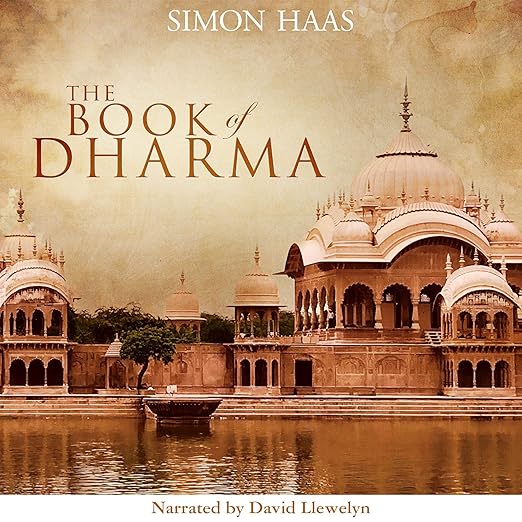
I came to The Book of Dharma during a stretch of weeks when I was reading heavily in the adjacent territory of Stoic philosophy and found myself wondering what the Indian wisdom traditions had to say about similar territory. Simon Haas had spent sixteen years apprenticed to an elderly master in the Bhakti tradition, and the result of that apprenticeship, framed as an excavation of what he calls the dharma code, seemed worth the five and a half hours it required.
Haas sets up his argument through a comparison that immediately earns attention. Sun Tzu’s The Art of War and Machiavelli’s The Prince were composed for rulers, he notes, and both have since become cultural touchstones far beyond their original contexts. The strategic literature of ancient India, developed for the same governing class, remains largely unknown in the West. Haas’s project is to make those teachings accessible without diluting them, translating not just the language but the conceptual architecture into terms a contemporary Western listener can actually use.
Our Take on The Book of Dharma: Making Enlightened Choices
What Haas delivers is more rigorous than most books in the personal transformation category, and also more honest about its sources. He is not manufacturing a wellness product or assembling cherry-picked aphorisms. The 16-year apprenticeship with his master is present throughout as a grounding structure, lending the material a lineage that distinguishes it from the usual self-help re-packaging of ancient texts. The central insight, that all knowledge, happiness, abundance, and compassion already exist within the individual and that the practice is one of recognition rather than acquisition, is familiar from multiple traditions but is articulated here with particular clarity.
The comparison to the teachings for kings is substantive rather than decorative. Haas traces the system’s structure, which he organizes around a model of personal sovereignty, clarifying what it means to govern oneself before attempting to act in the world. This is not merely metaphorical territory. The practical applications he draws from Bhakti tradition teaching address the kind of difficult decisions, the ones made under pressure, in uncertainty, with incomplete information, that most readers actually face.
Why Listen to The Book of Dharma: Making Enlightened Choices
David Llewelyn’s narration is an asset. He reads with the calm of someone who has absorbed the material rather than simply processed it. The Sanskrit terms and proper names are handled with precision and consistency, which matters in a text where the terminology carries weight. There is no performative mysticism in his delivery, no attempt to conjure an atmosphere of Eastern exoticism. He treats the material as serious intellectual content, which is exactly what it is.
At under six hours, the audiobook is well-proportioned. Haas does not pad his argument, and the runtime reflects a discipline that mirrors the content. Reviewers who came from yoga and meditation backgrounds found the text illuminating in ways that more practice-focused books had not been, and I understand that response. The Book of Dharma addresses the cognitive and philosophical architecture beneath the practices rather than the practices themselves.
What to Watch For in The Book of Dharma: Making Enlightened Choices
Listeners with significant existing exposure to Vedic literature or the Bhakti tradition may find the entry-level framing of some sections slower than they need. The book is positioned for Western readers unfamiliar with the Sanskrit textual tradition, and that positioning is appropriate for its primary audience but may occasionally feel introductory to those already versed in the material.
It is also worth being clear about what kind of book this is. It is not a workbook, a step-by-step system, or a collection of exercises. It is a conceptual introduction to a coherent philosophical framework. If you come looking for immediate practical techniques you can apply this week, you may find the register more abstract than you hoped. The value is in the framework itself, and frameworks require time and reflection to integrate.
Who Should Listen to The Book of Dharma: Making Enlightened Choices
This audiobook suits listeners who find most Western self-help too thin and want engagement with a genuinely developed philosophical tradition. It will reward readers with backgrounds in yoga, meditation, or comparative religion who want the intellectual scaffolding beneath those practices. It is also well-suited for anyone drawn to the Stoic or Epicurean literature of classical antiquity who wants to understand what parallel traditions were developing in India during the same period. Those seeking immediate prescriptive advice or a structured program will find the tone too contemplative. But for listeners who trust that understanding the principles deeply is itself the practice, this is a worthwhile five and a half hours.
Frequently Asked Questions
Do I need any prior knowledge of Hinduism or Vedic texts to benefit from this audiobook?
No. Haas wrote The Book of Dharma specifically for Western listeners unfamiliar with the Sanskrit tradition. He contextualizes the source material and explains terminology as it arises. Some reviewers with no background in Vedic literature found it among the most accessible introductions they had encountered.
How does The Book of Dharma differ from other books on Eastern philosophy available in English?
Haas draws on a specific lineage, a 16-year apprenticeship in the Bhakti tradition, rather than surveying multiple schools or synthesizing popular conceptions of Eastern philosophy. The focus on the dharma code as a system for decision-making and personal sovereignty gives it a more practical frame than most comparative philosophy texts.
Is this primarily a spiritual book or a practical decision-making guide?
It functions as both, though the integration may frustrate listeners who want one cleanly separated from the other. The philosophical and practical are treated as inseparable in the dharmic framework, so the book’s approach to decision-making is grounded in its understanding of the self and one’s nature, not in purely strategic terms.
How does David Llewelyn handle the Sanskrit terminology and Indian proper names in narration?
Llewelyn handles the terminology with consistency and care. The pronunciation is stable across the runtime, which matters considerably in a text where returning to specific Sanskrit concepts is part of the pedagogical method. There is no affectation in his delivery of the non-English material.