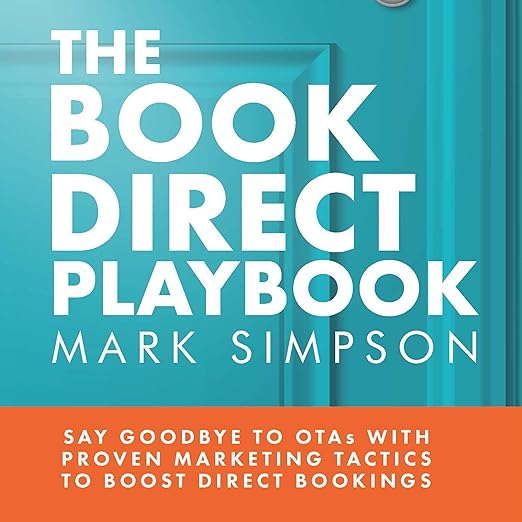
- Voice: Mark Simpson narrates his own book with the energy and directness of someone who has delivered this material to live audiences, conversational, occasionally soccer-metaphor-heavy, and completely persuaded by his own argument.
- Big ideas: short-term rental independence from OTA platforms, direct marketing and guest relationship building, brand identity for property owners
- Atmosphere: Practical and motivating, structured like a workshop rather than a manifesto
- Worth it?: A focused, actionable guide for STR hosts who are serious about building a direct booking channel, one of the more practically useful property management audiobooks in the category.
I do not run short-term rental properties. I mention this because transparency about listener position matters for this kind of prescriptive business audiobook, and I want to be clear about how I engaged with The Book Direct Playbook, not as a practitioner checking the advice against my own experience, but as a reader of business writing evaluating whether the ideas are clear, the structure is sound, and the specific knowledge claims feel credible. On all three counts, Mark Simpson delivers.
The book's argument is simple and structurally sound: property owners who rely exclusively on Airbnb, Booking.com, and similar online travel agencies (OTAs) are ceding a percentage of their revenue and a significant portion of their guest relationship to intermediaries who have no loyalty to them. The solution Simpson proposes is a direct booking infrastructure, a proper website, a customer management system, a social media strategy, that allows hosts to convert OTA bookings into direct ones and attract new guests without paying platform fees. This is not a new idea in hospitality, but Simpson's version of it is specific and operational in ways that generic advice often is not.
From Platform Gratitude to Platform Disillusionment
The book's origin story, Simpson's family short-stay accommodation business going online, his initial gratitude for platforms, his eventual disillusionment when he realized "business owners are just a number to them", is a useful frame. It positions the advice as earned through experience rather than theorized from outside the industry. The pivot he describes, from platform dependence to direct booking infrastructure, mirrors the experience many hosts have at a certain scale of operation when the platform's percentage of revenue stops feeling like a fair exchange for the distribution they provide.
The "customer avatar" concept he builds from, identifying the ideal guest with specificity and structuring all marketing decisions around that profile, is sound digital marketing practice applied with appropriate specificity to short-term rentals. The Boostly company that Simpson founded won a Best Use of Social Media award at The Shortyz, which provides external validation for the social strategy chapter. These credentialing details matter in a business book where the author's primary qualification is his own success story.
Simpson Narrates With Sports Metaphors and Checklists
Simpson narrating his own book is a natural choice for material this conversational. He writes and speaks in the register of someone who has explained these concepts many times in workshops and podcasts, direct, sometimes funny, occasionally prone to sports metaphors that may or may not land depending on your enthusiasm for soccer analogies. One reviewer who met Simpson at a VRBO summit in London noted that "he was the only one there I trusted because he wasn't trying to sell me something." The book has that quality: it is selling the method rather than the man, and the action items it provides throughout are concrete enough to function as a checklist rather than as aspiration.
At just over four hours, the runtime is well-calibrated. This is a book you can listen to in a day and emerge from with a clear list of things to do. One reviewer described it as "filled with 'get it done' action items," which is the right framing. The supplemental companion materials and the Boostly ecosystem surrounding the book provide ongoing resources beyond what the audio alone can deliver.
2022 Tactics Aging, Strategy Holding Steady
The book was published in early 2022, and the digital marketing and social media landscape shifts quickly enough that some specific tactical advice may have aged since publication. The underlying strategic framework, build direct relationships, own your guest data, create a brand identity that exists independently of platform profiles, is durable. The specific platforms, tools, and algorithms he references may require updating. Listeners who plan to implement the advice should cross-reference current best practices in areas like social media advertising and website SEO, where the specifics change faster than the principles.
The book is also more useful for hosts who already have an established operation than for those who are just starting. The direct booking infrastructure Simpson describes requires an existing guest base to convert from OTA to direct, a marketing budget, and operational systems that pure beginners may not yet have.
Premature for Hosts With Just One Unit
This book is for property owners who are frustrated with OTA dependency and ready to invest in their own marketing infrastructure. It is particularly useful for hosts who are running multiple properties or scaling toward that level, where platform fees represent a significant enough revenue share to justify the investment the book's strategy requires. First-time hosts starting with a single property may find the book inspirational but premature, the direct booking channel it describes makes most sense once you have a track record and a guest pool to work with.
A Few Questions About The Book Direct Playbook
Is the advice in this book still current given that it was published in 2022?
The strategic framework, building a direct booking channel, creating a customer avatar, owning your guest relationships, is durable and remains sound. Specific tactical advice around social media platforms, advertising tools, and SEO strategies should be cross-referenced with current sources, as these areas evolve quickly. The core argument for direct booking independence has only become more relevant as platform fees and policy changes have continued since publication.
Does the book assume I am already running a short-term rental, or does it also work as a starting guide?
The book assumes an existing operation. Simpson's advice on converting OTA bookings to direct, building a returning guest list, and structuring social media around an established brand presupposes that you have guests to convert and a track record to reference. Listeners who are still deciding whether to enter the STR market will find the strategic thinking useful, but the implementation advice is pitched at people with properties already live.