Quick Take
- Narration: Justin Earley reading his own words creates an intimate confessional quality, the anxiety he describes in the book is audible in the voice, which is a feature rather than a flaw.
- Themes: Body-soul integration, habit formation as spiritual practice, recovery from burnout through physical attention
- Mood: Warm, vulnerably personal, and practically grounded, less preachy than the genre average
- Verdict: One of the more grounded Christian wellness books in recent years, offering practical habits embedded in genuine theology rather than self-help language with scripture bolted on.
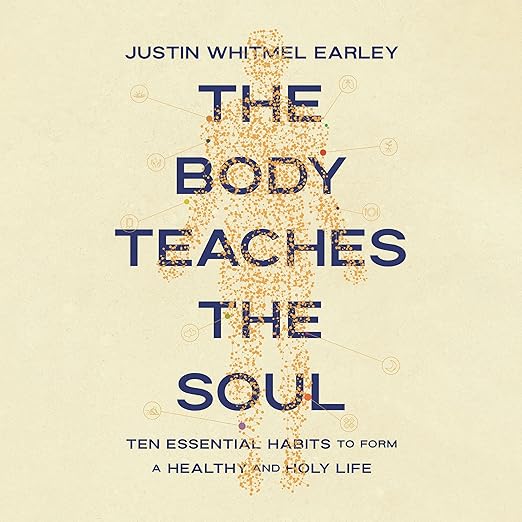
I’ll admit I came to Justin Whitmel Earley’s work without having read his earlier books, The Common Rule or Habits of the Household. A colleague who had described him as someone who takes physical health seriously without reducing the spiritual to mere wellness language mentioned The Body Teaches the Soul, and I was curious about the framing. That framing turns out to be the book’s most interesting offering: the argument isn’t that body and spirit are separate things that can be integrated with sufficient effort, but that they were never separable in the first place, and that the contemporary Christian tendency to treat physical life as spiritually neutral is itself a theological error.
Earley arrives at this argument through personal catastrophe. As a young lawyer, he collapsed into anxiety and insomnia that nearly destroyed his life. That biographical grounding is not incidental to the book’s argument, it’s the engine of it. He’s not writing from a position of arrived wellness but from the experience of someone who learned, through breaking down, what the body was trying to tell him. That posture is audible in the narration, which Earley provides himself.
Our Take on The Body Teaches the Soul
The book’s central move is to take practices that contemporary culture treats as purely physical, eating, exercise, sleep, rhythms of rest, and show them as having a specifically theological character. This is not the prosperity gospel version of body-spirit integration, where God rewards physical discipline with material blessing. It’s closer to the ancient Christian idea that the body is the site where spiritual formation actually happens, not merely the vessel that carries the soul around.
The ten habits Earley offers range from eating and sleep rhythms to exercise as service to others rather than vanity project. One reviewer compared the ambition to “Atomic Habits for Christian literature,” and that comparison is instructive: Earley is doing what James Clear does, but with a theological anthropology underneath it. The habits aren’t arbitrary productivity tools; they’re grounded in a view of what human beings are for.
Why Listen to The Body Teaches the Soul
Author narration is particularly meaningful here. Earley’s voice carries the history of what he’s describing, the anxiety attacks, the insomnia, the gradual recognition that neglecting the body was a spiritual failure and not just a scheduling problem. One reviewer noted being moved to near-tears by the personal sections, and I think that response is partly about the voice itself. When Earley describes the experience of collapse, you’re not hearing an actor performing vulnerability; you’re hearing the person it happened to.
At under 7 hours, the book is unusually compact for a Christian wellness title. Zondervan produced it cleanly, and the companion PDF that accompanies the audiobook version covers visual references that the text sometimes assumes. The note about the PDF in the listing is worth attending to before you start listening.
What to Watch For in The Body Teaches the Soul
Readers who come expecting devotional content primarily will find this book more practically and physiologically grounded than expected. Earley draws on neuroscience and behavioral research alongside scripture, and some chapters spend more time in the biological mechanics of habit formation than in explicitly theological territory. The integration is genuine, the research and the theology support each other, but listeners who want a primarily scripture-centered wellness book may find the balance different from what they anticipated.
There’s also a question of scope. Earley covers ten habits across eating, sleep, exercise, and rest, which means each gets proportionally limited space in a 7-hour audiobook. The habits are introduced clearly enough, but the depth of engagement with any single area is relatively bounded. Listeners with specific struggles in one domain (severe insomnia, chronic illness, disordered eating) may find the relevant sections useful as an orientation but insufficient as a complete resource.
Who Should Listen to The Body Teaches the Soul
This is well-matched to Christians who have experienced the split that Earley is writing about, who know intellectually that the body is a temple but have lived as if daily physical choices are spiritually neutral. The book does the work of reconnecting those two things in a way that doesn’t feel like guilt-tripping but like genuine reclamation.
Listeners who are not practicing Christians will find the theological framework integral rather than decorative, this isn’t a secular wellness book with scripture added. The habits themselves are evidence-based and non-sectarian in their mechanics, but the frame is explicitly Christian. Earley is honest about that, and the book is better for the honesty.
Frequently Asked Questions
Do I need to have read The Common Rule or Habits of the Household before listening to The Body Teaches the Soul?
No. The Body Teaches the Soul stands completely independently. Prior Earley readers will recognize his voice and some recurring themes around household rhythms, but the book makes its argument from the ground up without requiring prior context.
The listing mentions a companion PDF, is the audiobook meaningfully incomplete without it?
The PDF contains visual references and materials that the text sometimes assumes. The audio itself covers the argument coherently, but some of the habit charts and reference materials are in the PDF only. It’s included with the Audible purchase and worth downloading before you start.
Is this book primarily devotional or primarily practical in its approach to the ten habits?
More practical than devotional in tone. Earley draws on neuroscience and behavioral research alongside theology, and the chapters on specific habits are structured as actionable guidance rather than reflection prompts. The theological foundation is real but the delivery is grounded and concrete.
Several reviewers mention Earley’s personal mental health crisis, how central is that biographical thread to the book’s argument?
It’s the book’s grounding. Earley’s collapse into anxiety and insomnia as a young lawyer is not background detail but the lived argument for why the body-soul split is dangerous. He’s not writing from theoretical authority but from personal experience of what happens when you ignore what the body is communicating.