Quick Take
- Narration: Virtual Voice narration delivers the content cleanly enough for a short, practical guide, though the synthetic delivery lacks the warmth a human narrator would bring to the personal trading anecdotes.
- Themes: Trading psychology, risk management, price action strategy
- Mood: Direct and no-nonsense, with an undercurrent of hard-won experience
- Verdict: A stripped-back Forex primer that earns its brevity, useful for beginners willing to act on simple systems rather than wait for a perfect strategy.
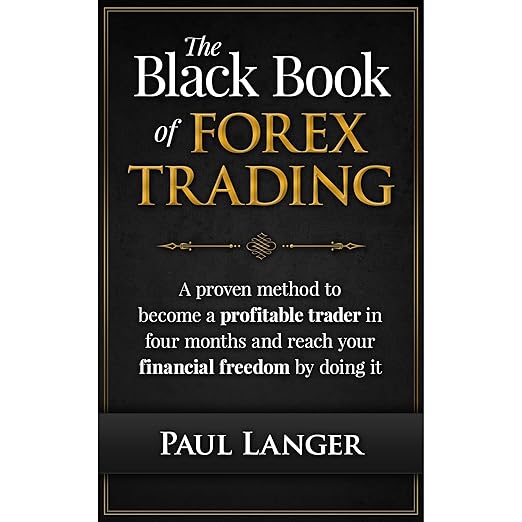
I came to this one on a Tuesday afternoon, sandwiched between two denser finance titles I had been working through for weeks. At one hour and forty minutes, The Black Book of Forex Trading felt almost shockingly compact by comparison, and that brevity, I discovered, is both its chief virtue and its most honest statement about what the book is actually trying to do. Paul Langer is not attempting to write the definitive encyclopedia of currency markets. He is trying to hand someone who is bleeding money a tourniquet, and get them back on their feet before they quit entirely.
The book opens with a question that doubles as self-diagnosis: are you consistently losing, watching the markets without the confidence to enter, or throwing money at third-party systems that deliver nothing? Langer’s framing is refreshingly honest. He lost most of his life savings to bad trading before developing the approach he describes here, and that personal history gives the material a grounding that most trading books, written from a position of retrospective authority, tend to skip over. The vulnerability is the point.
Three Strategies, One Philosophy
The core of the book is built around three trading approaches, day trading, swing trading, and position trading, each presented as an adaptation of the same underlying logic rather than three separate systems. Langer’s philosophy is pure price action: no indicator spaghetti, no black-box signals, just reading what the chart is actually showing you. For a genre that often drowns beginners in oscillators and moving average crossovers, the restraint here is notable. Reviewer zzrose, who described having studied price action across multiple markets for thirty years, called this book’s commitment to simplicity "the mark of art", and that’s not an overstatement. The difficulty isn’t finding a complex system; it’s trusting a simple one.
What the book adds on top of strategy is a money management framework and, perhaps more usefully, a section on emotional control. Langer argues, correctly, in my view, that most Forex losses come not from bad strategy but from traders overriding their own rules under pressure. He offers a short blueprint for the months after you finish reading: a structured plan to track progress, review decisions, and hold yourself accountable. It’s the kind of material that sounds obvious until you realize how rarely it’s presented in practical, actionable terms rather than motivational generalities.
What the Reviews Are Actually Telling You
Reader responses to this book split predictably along one fault line: experience level. Reviewer Niki Wilson noted the book contains "many surprising typos for a published book" and felt it was pitched above true beginners, while Amazon customer Andres G. found it an ideal primer for newcomers. That contradiction resolves once you understand the book’s actual target: traders with a few months of activity who have already learned what a pip is but haven’t found a repeatable system. If you have zero context for currency markets, you may need to do some foundational reading first. If you’ve been trading inconsistently for six to twelve months and can’t articulate why you enter or exit a position, this is almost certainly the right book for this moment.
The Virtual Voice narration is worth addressing directly. Synthetic narration has improved considerably, and for a technical, instruction-heavy text with no extended narrative passages, it performs adequately. You will not get the inflection shifts or the sense of a human personality coming through the material, but the content is delivered intelligibly. For a book this short, it functions.
The Blueprint at the End
One detail that distinguishes this from similar short trading guides is the structured action plan Langer includes toward the close. Rather than ending on a motivational note and leaving readers to figure out implementation, he provides a framework for the next several months of practice: how to paper trade, how to review, when to scale, and how to assess whether a strategy is failing or whether you are. For beginner-to-intermediate traders, this section may be the most practically valuable part of the entire audiobook. It converts the ideas from theory into a daily practice.
The book’s claim that listeners "will be able to notice a difference within 24 hours" should be read as marketing energy rather than literal promise. What’s realistic is that the core principle, keep it simple, manage risk, control your psychology, can shift how you approach a trade session immediately, even if consistent profitability takes considerably longer. Langer does not oversell the timeline elsewhere in the book, so the back-cover language feels slightly out of step with the more honest tone of the content itself.
Right for Your Stage, Wrong for Others
Listen if you have some exposure to Forex markets and are losing money without understanding why, if you want a clear and uncommercial framework for price action trading, or if you find yourself endlessly researching and never committing to a single approach. Skip if you are a complete beginner with no context for currency markets, if you require human narration for focus, or if you want a comprehensive academic treatment of quantitative trading methods. This is a practical tool, not a scholarly text, and it works best for readers willing to apply what they hear immediately rather than absorb it passively.
Frequently Asked Questions
Is The Black Book of Forex Trading suitable for someone who has never traded at all?
The book describes itself as aimed at beginner-to-intermediate traders, but several reviewers note it assumes some baseline familiarity with Forex concepts. Complete beginners may want to pair it with a more foundational resource covering terminology and how currency pairs work before starting here.
Does the Virtual Voice narration work for a technical trading book?
For a short, instruction-focused text without extended storytelling, the synthetic narration is adequate. The content is delivered clearly. If you find synthetic voices difficult to sustain attention with over longer listens, the 100-minute runtime limits the exposure.
What are the three trading strategies Langer covers?
Langer outlines day trading, swing trading, and position trading, each adapted from the same price action philosophy. The idea is that you choose the style that fits your schedule and temperament rather than treating each as a separate, incompatible system.
Does the book include anything on trading psychology or just strategies?
Yes, emotional control is one of the three main pillars alongside strategy and money management. Langer specifically addresses how traders override their own rules under pressure, and includes a structured action plan for the months following the book to help build consistent habits.