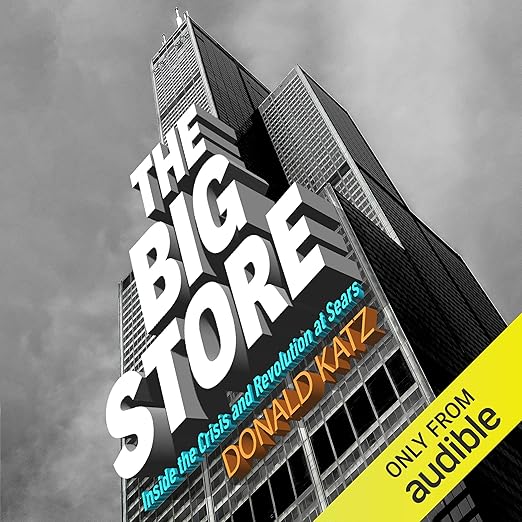
Quick Take
- Narration: Brian Sutherland handles a complex, densely populated corporate narrative with consistent clarity across a 30-hour runtime.
- Themes: Corporate turnaround, American retail history, leadership under pressure
- Mood: Detailed and immersive, with a slow-burn tension for those who know how the Sears story ends
- Verdict: An essential listen for anyone interested in American retail or corporate leadership history, though its appeal thins considerably for listeners without existing investment in the subject.
I finished the last few hours of The Big Store on a Sunday afternoon with a particular kind of melancholy that good business history can produce. Donald Katz wrote this book in 1987, at the peak of the Sears revival he was chronicling, a moment when Edward Telling’s turnaround of the company seemed like one of the great corporate resurrections in American history. The reader in 2024 knows, of course, that Sears eventually collapsed in 2018. Katz could not have known that. And yet the seeds of what went wrong are all visible in the pages of a book written to celebrate what went right.
That irony, the gap between what the story meant when it was written and what it means now, is what makes this audiobook genuinely worth your attention if you have any interest in American business history. It is a thirty-hour commitment, and the densely named cast of Sears executives will test your memory at times, but the payoff is real.
Our Take on The Big Store
Katz had extraordinary access. Unrestricted entry to meetings, records, and executives is not the norm in corporate journalism, and he used it well. The result is a narrative that feels genuinely from the inside, not a hagiography, but not a hit piece either. Telling’s leadership is portrayed with nuance: a hard, sometimes brutal man who happened to have the right combination of vision and stubbornness for a particular historical moment. The internal power struggles at Sears in the late 1970s and early 1980s are rendered in granular detail, and Katz does not shy away from the dysfunction that coexisted with the success.
The updated introduction, written and narrated by Katz himself, is worth noting. It adds a layer of retrospective awareness that the original book obviously lacks, and hearing Katz’s own voice, particularly given that he is the founder and CEO of Audible, gives the listening experience a slightly recursive quality that longtime audiobook listeners will appreciate.
Why Listen to The Big Store
The Sears story is not just retail history. It is a case study in what happens when a company’s culture calcifies around past success in a way that prevents adaptation to present conditions. The corporate culture Katz documents, the internal fiefdoms, the resistance to centralization, the staggering arrogance of a company that once accounted for more than one percent of the US gross national product, maps onto patterns that have recurred in American business again and again. Reading this after Amazon’s rise, or after any number of subsequent retail collapses, illuminates those later stories in useful ways.
Brian Sutherland’s narration handles the complexity of this material steadily. With a cast of dozens of Sears executives moving through thirty hours of corporate history, a narrator’s ability to keep the listener oriented is critical, and Sutherland delivers. He does not make the listening experience glamorous, but he makes it navigable, which is what a book like this needs.
What to Watch For in The Big Store
The book was written before Sears’s second act of decline and eventual bankruptcy, which means the triumphalism of the final chapters reads strangely today. Katz was writing a success story, and the narrative arc reflects that. For listeners who know the full arc, this creates a bittersweet reading experience; for those who do not know much about Sears’s later history, the ending may feel too tidy.
The sheer volume of named executives and internal organizational detail will also challenge listeners who prefer narrative driven by character rather than institutional analysis. Several reviewers noted that a personal connection to Sears, as a former employee or as someone who studied it in a business program, significantly increases the book’s appeal. Without that anchor, the density can feel like work.
Who Should Listen to The Big Store
Business history enthusiasts, retail professionals, and anyone studying corporate turnaround strategy will find this essential listening. It is also excellent for MBA students or anyone exploring leadership under organizational crisis. General listeners without particular interest in Sears or retail history may find the thirty-hour runtime and dense cast difficult to sustain without a personal reason to care. One reviewer finishing their MBA described it as the story of the company that should have been Amazon, a framing that captures both the book’s appeal and its melancholy.
Frequently Asked Questions
Does The Big Store cover Sears’s eventual bankruptcy and collapse?
No. The book was originally written in 1987, documenting the Sears turnaround under Edward Telling through the early 1980s. The updated introduction by author Donald Katz adds some retrospective context, but the book does not cover Sears’s later decline or its 2018 bankruptcy filing.
Why does it matter that Donald Katz is the founder of Audible?
Katz founded Audible, the platform where this audiobook is available, which gives the listening experience a slightly recursive quality. He also narrates the updated introduction himself, so listeners hear the author’s own voice reflecting on the book decades after writing it.
Is The Big Store accessible without any background in retail or business history?
It is readable without prior knowledge of Sears specifically, but the thirty-hour runtime and large cast of executives will test listeners who do not have a pre-existing reason to care about the company. Reviewers with personal connections to Sears, former employees, business students, consistently rate it more highly than general listeners.
How does Brian Sutherland handle the large cast of named executives across 30 hours?
Sutherland reads with consistent clarity and does not attempt to differentiate characters through voice work, which is the right call for a work of non-fiction corporate history. His even delivery keeps the listener oriented through what would otherwise be a confusing volume of names and organizational titles.