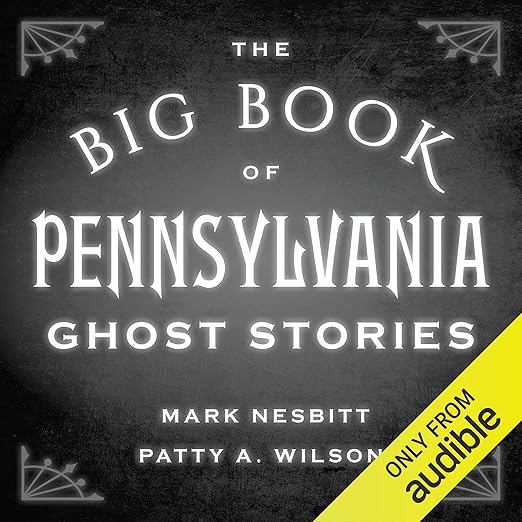
Valley Forge at night, the residual cold of Continental soldiers who did not survive the winter. Dormitories at Gettysburg College where children's footsteps have been heard for generations. Pennsylvania's landscape carries layers of violent history that make its ghost stories feel less like entertainment and more like the land's way of accounting for what happened here. Patty A. Wilson and Mark Nesbitt's The Big Book of Pennsylvania Ghost Stories arrives as an audiobook of just under 12 hours, narrated by Terry Briscoe, and its organizing principle, regional geography as the frame for paranormal anthology, is one that works considerably better in audio than most ghost story collections manage.
Wilson and Nesbitt are not newcomers to this territory. Nesbitt in particular has spent decades documenting the paranormal history of Gettysburg and surrounding Pennsylvania, and that accumulated expertise shows in how the book handles its material. These are not campfire stories stripped of context. Each account is preceded by historical background on the location in question, and that context is where the audiobook finds its genuine distinction from the crowded shelf of regional ghost collections. Reviewer Kindle Customer observed that the authors also taught Pennsylvania History in small bits, which greatly enhanced the stories and their historical origins and made them more than mere spooky tales. That integration of history and haunting is the collection's real and consistent strength.
What We Made of It
The location that stays with you is Valley Forge. The history is so thoroughly documented, the suffering so well attested in primary sources, that the apparitions of fires and struggling soldiers the book describes feel less like supernatural invention and more like a landscape's refusal to let the past fully recede. That quality, the sense that these hauntings are tied to specific, historically documented traumas rather than floating free of context, runs through the best material in this collection. Pennsylvania's history is sufficiently layered, with Revolutionary War battles, Civil War engagements, industrial disasters, and institutional histories all leaving their marks on specific physical locations, that the paranormal accounts have genuine historical texture to work against.
Terry Briscoe's narration sustains this without tipping into theatrical excess. Ghost story anthologies present a particular challenge for narrators: the accounts need atmosphere but not performance, gravitas but not solemnity, and the balance between storytelling and reporting is a narrow register to maintain across nearly 12 hours of material. Briscoe largely achieves it, keeping his voice consistent enough that the historical sections and the paranormal accounts carry equal weight rather than one undermining the other. Reviewer Admiralu specifically noted that the audiobook has great narration of the stories, which confirms that the production choice served rather than undermined the material.
The regional organization is a genuine asset in audio. Wilson and Nesbitt structure the collection by geographic area rather than thematically, which means listeners who know Pennsylvania or who are planning visits to specific locations, from Philadelphia through the central counties to the western regions, can use the audiobook as a kind of annotated companion to the physical landscape. Reviewer Auralia Whiting noted that the book covers a wide range of stories and areas with great depth, which is accurate: the collection is genuinely comprehensive across the state's geography rather than concentrating exclusively on the famous sites that anchor most Pennsylvania ghost tourism.
At nearly 12 hours, this is a substantial collection with real variety in the accounts. Some involve Revolutionary War and Civil War sites where the historical record is thick and the paranormal accounts have centuries of local testimony behind them. Others concern more recent institutional buildings, roadways, and private homes where the historical background is thinner and the paranormal account carries more of the weight on its own merits. The variation in historical density across different sections gives the audiobook a texture that a more uniform collection would lack, even if it means some sections land with more weight than others.
Weak Spots in The Big Book of Pennsylvania Ghost Stories
Listeners expecting original investigation or firsthand encounter accounts will find this is primarily an anthological and historical compilation rather than a field investigation record. Wilson and Nesbitt are curators and historians of the paranormal rather than investigators in the contemporary ghost-hunting documentary tradition, and the audiobook reflects that orientation entirely. The accounts are drawn from historical records, local testimony, and established regional lore rather than from original on-site research. If you came from the world of paranormal investigation documentaries expecting that register, you will need to recalibrate your expectations toward the library and archive rather than the EMF detector.
The collection's length also means that tonal variation across nearly 12 hours is unavoidable. Some sections, particularly those covering locations with thinner historical backgrounds, rely more on the formula of historical context followed by paranormal account than on genuinely distinctive material. The strongest sections are consistently those tied to the most historically specific settings, particularly the Revolutionary and Civil War sites where the weight of documented human suffering gives the hauntings their grounding in something larger than local legend.
Best Suited For
This audiobook is for history readers who want their Pennsylvania history with a paranormal dimension, for ghost story enthusiasts who want regional specificity rather than generic accounts, and for listeners planning travel through the state who want to know what lurks beneath the surface of the landmarks they will visit. Briscoe's narration makes it a genuinely listenable 12 hours rather than a slog. Skip it if you want contemporary ghost investigation content or firsthand field accounts in the tradition of paranormal documentary series. This is historical anthology rather than active investigation, and its pleasures are those of accumulated regional knowledge and the particular chill of knowing exactly where a soldier fell before hearing what was seen there afterward.
Is Terry Briscoe's narration suited to this kind of paranormal anthology audiobook?
Briscoe maintains the balance between storytelling and historical reporting that this format requires, avoiding both campiness and flatness. At nearly 12 hours, consistent tonal control is essential, and reviewers specifically noted the narration enhanced the material rather than working against it.
How is the audiobook organized, and can you listen to specific regional sections without starting from the beginning?
The collection is organized by Pennsylvania region rather than thematically, which means listeners with interest in specific areas, Philadelphia, Gettysburg, or western Pennsylvania, can navigate to those sections. The regional structure makes it useful as an annotated companion for travel through the state.