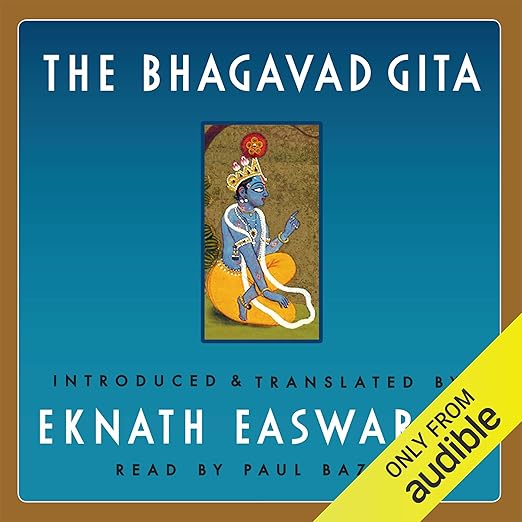
There is no neutral way to encounter the Bhagavad Gita. It arrives with two and a half millennia of interpretation behind it, and every translation is an argument about what the text actually means. Eknath Easwaran knew this as well as anyone, he grew up within the Hindu tradition in India, studied Sanskrit from childhood, spent years as a professor of English literature before coming to the West on a Fulbright scholarship, and brought all of that to his translation work. I read his Bhagavad Gita for the first time on a Sunday morning when I was looking for something that would hold still while everything else in my week felt like it was moving too fast. It held still. It's been on my shelf since.
The audio edition published by Naxos AudioBooks runs two hours and forty-seven minutes, which, for a text that contains 700 verses plus extensive introductory and chapter material from Easwaran, is genuinely compact. This is not a slow, ceremonial presentation. It's a focused one. Sagar Arya narrates with an attentiveness that suits the material, and the production includes Yann Stoneman's music as a measured accompaniment. What you're receiving here is Easwaran's scholarly apparatus, the introduction that places the Gita in historical context, the chapter introductions that clarify key concepts, the glossary of Sanskrit terms, alongside the text itself.
Easwaran's central interpretive move is one that new readers of the Gita need to understand early: the battlefield at Kurukshetra is simultaneously literal and metaphorical. Arjuna's paralysis in the opening chapter, his refusal to fight when he sees his relatives arrayed against him, is the condition of every human being facing an impossible decision that requires them to act anyway. Krishna's 700 verses of response are not tactical advice. They are a complete philosophical account of how to live, and by extension, how to die.
One reviewer describes a verse they first encountered through a comedian's podcast as their entry point: "It is better to be an honest street sweeper than a dishonest king." That's not a precise translation of any single verse but it captures something real about the Gita's concern with right action over status. Another reviewer invokes the Library of Alexandria, suggesting that if everything else were lost and the Gita remained, all that was lost could be reconstructed from it. That's the kind of claim the text inspires in serious readers. Easwaran is careful not to make this kind of claim himself; instead, he demonstrates the text's relevance through patient explication, connecting Arjuna's situation to the experiences of contemporary readers struggling to figure out what they're supposed to do with their lives.
Easwaran's Apparatus Makes Sanskrit Concepts Accessible
For listeners coming to the Gita without prior grounding in Hindu philosophy or Sanskrit terms, Easwaran's apparatus is invaluable. The chapter introductions are not perfunctory. They establish what each section of Krishna's teaching is concerned with, they identify the key Sanskrit concepts that will appear, and they connect the abstract philosophical content to the practical ethical questions a Western reader is most likely to bring to the text. One reviewer specifically praises these introductions for being "both direct and indirect" in their approach, which is an accurate description of how Easwaran writes about difficult philosophical terrain.
The glossary of Sanskrit terms included in the audio edition is a practical resource rather than a scholarly display. Easwaran was, before anything else, a teacher, and his translation work carries the marks of someone who has spent decades helping students encounter this text for the first time. The audio version captures that pedagogical care without making it feel like a course.
Arjuna's Crisis Still Refuses to Resolve Easily
One of the things that makes the Bhagavad Gita permanently relevant rather than historically interesting is that its central crisis, a person of good faith who cannot figure out what the right action is in a terrible situation, does not become obsolete. Arjuna is not paralyzed by cowardice. He is paralyzed by genuine ethical conflict, and Krishna's response does not resolve that conflict by pretending it's simple. The Gita's teaching about duty, about non-attachment to results, about the nature of the self that acts but is not consumed by its actions, all of this is addressed to real difficulty, not manufactured difficulty.
Easwaran's translation keeps this difficulty intact. He does not smooth the Gita into something palatable. He makes it accessible without making it easy, which is the harder and more honest work.
Under Three Hours, Built to Be Replayed
For a first encounter with the Bhagavad Gita, Easwaran's translation is one of the strongest entry points available in English. For listeners who have read other translations and are curious about how Easwaran's interpretive choices compare, the extended introduction and chapter material make the audio edition a useful point of comparison. For those already familiar with Easwaran's work in print, the audio edition offers a different quality of attention, the voice slows you down in ways that are productive with philosophical text. At under three hours, it is also a genuinely repeatable listen, and the Gita is one of the texts that rewards being heard again from a different vantage point in your life.
Common Questions
At under three hours, does this audio edition cover the full Bhagavad Gita text or only selections?
The edition covers the full text of Easwaran's translation along with his introductory and chapter materials. The Gita itself is 700 verses, and Easwaran's translation is complete rather than abridged, though the compact runtime reflects the text's actual length.
Is this audiobook appropriate for someone in personal crisis or grief looking for spiritual guidance?
Many readers describe encountering the Gita during periods of difficulty and finding it genuinely useful. The text's central concern, what to do when the right action is unclear and inaction feels impossible, addresses real human situations. Easwaran's edition is a thoughtful and respectful entry point for that kind of seeking.