Quick Take
- Narration: Lomakayu reads with unhurried gravity that suits the meditative register of Gandhi’s commentaries without flattening their intellectual urgency.
- Themes: Selfless action and renunciation, spiritual life as practical ethics, the Gita made accessible for ordinary people
- Mood: Contemplative and grounding, slow-paced but purposeful
- Verdict: An essential document for anyone interested in Gandhi’s thought or the Gita’s application to modern life, with narration that respects the weight of the material.
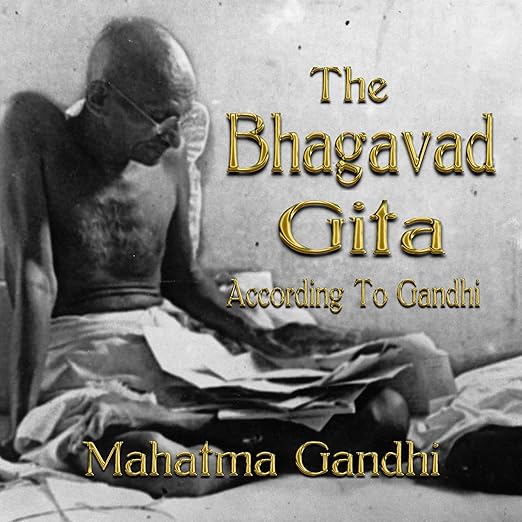
I approach religious texts as a literary critic before anything else, which means I’m less interested in whether I agree with a text’s premises than in how it constructs its argument and whether it holds together as a piece of intellectual and spiritual work. By that measure, The Bhagavad Gita According to Gandhi is a remarkable document. Gandhi wrote his commentary on the Gita while imprisoned, which gives it a specific gravity that no other circumstance could quite replicate. These are the reflections of a man working out his philosophy under conditions of enforced stillness, presenting them over nine months in 1926 to his disciples at prayer meetings. Lomakayu reads the nearly ten-hour audiobook with the pace the material requires, unhurried and considered.
The framing is important. This is not Gandhi simply translating the Gita. Mahadev Desai handled the English translation from Gujarati and contributed a substantial commentary of his own. What we get is a layered document: Gandhi’s spiritual and ethical reading of the ancient text, filtered through Desai’s translation and contextualizing apparatus. For a Western listener coming to this without deep familiarity with Sanskrit tradition, that layering is actually an advantage. The text is building its own interpretive scaffolding as it goes.
The Gospel of Selfless Action in Practice
Gandhi’s central interpretive lens is nishkama karma, action without attachment to its fruits, which he calls The Gospel of Selfless Action in his own subtitle for the commentary. This sounds abstractly philosophical until Gandhi ties it to the specific conditions of his life and his political work. The clarity he achieves in explaining why he advocates for spinning wheels and cleaning latrines as spiritual practices is striking. He’s not being eccentric or performatively humble. He’s working out a theology of embodied service that the Gita supports and that his political circumstances demand.
One reviewer who compared multiple editions of the Gita According to Gandhi noted that the question-and-answer structure of the companion material makes the content particularly accessible. That format works well in audio. The dialogue structure keeps the listener active rather than passive, and Lomakayu navigates the shifts between commentary, verse, and interpretive discussion without losing the thread.
What Gandhi Addresses That Other Commentaries Avoid
Several readers flagged Gandhi’s willingness to engage directly with the aspects of the Gita that create difficulty for modern readers: the apparent sanctioning of warfare, the caste implications of certain passages, the tension between renunciation and political engagement. Gandhi doesn’t resolve these tensions so much as hold them honestly. His own political life was full of them. A man who preached nonviolence was also organizing political resistance. His commentary on the Gita doesn’t pretend that the text is simple or that its ethics are straightforward to apply. He treats his disciples, and by extension his listeners, as capable of sitting with complexity.
One reviewer noted that Gandhi simplifies the meaning of difficult verses in today’s age, which is true, but simplification here doesn’t mean reduction. He makes the Gita legible without making it shallow. That’s a genuine pedagogical achievement, and it’s part of why Gandhi’s commentary is regarded in India as among the most important of the century.
Approaching This as a Slow Listen
The nine hours and thirty-six minutes is substantial, and this is not a listen you can half-attend. It rewards full engagement and periodic pausing. Treat it as a slow read rather than a commute listen. If you approach it that way, what you get is a free audiobook that amounts to a course in Gandhi’s practical philosophy, anchored in one of the world’s foundational spiritual texts. Lomakayu’s pacing gives you time to sit with each section before the next begins, which matters for material this philosophically dense.
This is not an academic text, and it is not trying to be. Listeners who want exhaustive Sanskrit scholarship should look elsewhere. Listeners who want to understand how one of the twentieth century’s most consequential political and spiritual thinkers engaged with the Gita’s central questions will find this deeply rewarding. That includes people with no prior familiarity with Hinduism. Gandhi explicitly aims his commentary at common people, and the audiobook format serves that aim well.
Who Benefits Most from This Version
This version is well suited to general listeners who want the context and continuity of Desai’s introduction alongside Gandhi’s own words. Practitioners of yoga, Vedanta, or any tradition that draws on the Gita will find Gandhi’s reading a challenging and illuminating counterweight to more devotional interpretations. Students of twentieth-century political thought who have engaged with Gandhi’s political writings but not his religious ones will discover the theological foundations of his methods in ways that make his public life more comprehensible. And anyone who simply wants to understand what the Gita actually says, through the eyes of someone who lived by it, will find this the most human and accessible version available in English audio.
Frequently Asked Questions
Do you need to be Hindu or familiar with the Gita to get value from this audiobook?
Not at all. Gandhi’s commentary is explicitly aimed at making the Gita accessible to ordinary people regardless of background. The question-and-answer format and Mahadev Desai’s contextualizing introduction help orient listeners with no prior knowledge.
How does this differ from other English translations of the Bhagavad Gita?
This is not primarily a translation but a commentary. Gandhi’s reading emphasizes selfless action and practical ethics over metaphysical or devotional interpretations. The verses are present, but Gandhi’s treatment of what they mean for daily life is the centerpiece.
Is Lomakayu’s narration a good fit for this kind of spiritual material?
Yes. The delivery is measured and clear without being dull. The unhurried pace suits commentary that rewards contemplation rather than rushing. Several reviewers with deep familiarity with the text found the narration respectful of the material’s weight.
What makes Gandhi’s commentary historically significant compared to other Gita interpretations?
Gandhi wrote this during imprisonment and presented it to his ashram disciples over nine months in 1926. His interpretation is shaped by his active political life, which means he reads the Gita’s ethics against the concrete demands of nonviolent resistance and social reform, producing a reading that is both ancient and urgently contemporary.