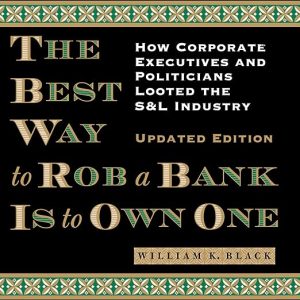
Charles Keating is the name most people still remember from the savings and loan collapse, and William K. Black is the regulator who was in the room while it happened. This audiobook is his account of it, running thirteen hours and forty-eight minutes with Scotty Drake credited as narrator. Black ran litigation for the Federal Home Loan Bank Board, and what he produced afterward is less a history of one scandal than a manual for recognizing the species, organized around the phrase that holds the whole book together: control fraud.
How Control Fraud Explains the S&L Collapse
The title is the thesis, and it is not a joke. Black's argument is that the most efficient large-scale fraud gets committed by the people running the institution, using the institution itself as the weapon. The description puts it in institutional terms: corrupt chief executives and finance officers operating "in collusion with those who have regulatory oversight of their industries". What makes the book unusual is that Black is not theorizing from outside the glass. He conducted the investigations himself, and every case he cites is one he worked.
The core narrative belongs to the 1980s savings and loan collapse, and to how, in the copy's phrasing, Keating "and hundreds of other S&L owners took advantage of a weak regulatory environment to perpetrate accounting fraud on a massive scale." The edition described here then adds an afterword tying that wreckage to the corporate failures of two decades later, on the argument that the same tactics recur because the underlying incentives never changed. That extension is what keeps the book alive. One reviewer titles an assessment "Sadly, still relevant", which is the shortest available summary of the whole case.
The most interesting thread is not the fraud but the regulation. Al Pal, the single four-star reviewer, files under the heading "Resisting to become a captive regulator" and reads the book as a case study of "a regulator nearly being taken over by those who it is supposed to regulate." Regulatory capture usually gets discussed as an abstraction. Black describes specific pressure applied to specific people by, in that reviewer's own list, "criminals, ideologues, lobbyists," and a category of politicians the review names just before it is cut off. The conclusion follows directly: markets do not police themselves.
Scotty Drake's Clarity Through a Case File
The author's proximity to the events is what makes the audio edition worth considering for material that looks forbidding on paper. This is not a survey of financial crime assembled from secondary sources. It is a participant's account with case files behind it, and first-person institutional memory carries in a reading in a way that statistical argument does not. The reviews confirm the register. M. FRANTZ credits Black with "explaining in detail how control fraud's walk and talk", which is the language of demonstration rather than of lecture.
Scotty Drake carries the full runtime, and the demand here is clarity rather than character. Regulatory history runs on acronyms, agency names, statutory mechanisms and dates, and a listener without a finance background needs each one landed cleanly on first pass, because you cannot glance back up a page in audio. None of the attached reviews reaches the recording. All three concern Black's argument, which is informative in its own way, since it means the enthusiasm on this listing is for the thinking. Whether the delivery suits your tolerance for dense material spoken aloud is something only the sample will settle.
The strongest reason to listen is what the book does to your reading of the news afterward. Once the control fraud framework is installed, a whole class of corporate collapse stops looking like incompetence and starts looking like design. That is a genuinely durable mental tool, and it explains why a book about a 1980s scandal keeps acquiring new readers.
Dated Vintage and an Off-Putting Subtitle
The runtime is a real ask, and the book makes no attempt to lighten itself for a general audience. Black writes as a practitioner and a scholar at once, and the level of institutional detail that makes the argument credible is the same detail that makes the listening heavy.
The framing genuinely puts people off, and one reviewer is candid about it. Rita Sydney describes setting the book aside more than once because of a subtitle referring to the "looting of the S&L industry," wanting something about current financial problems instead, then reports being glad to have finally read it. That reaction is common enough to head off: the 1980s material is the case study, not the subject. The subject is a mechanism, and the afterword exists precisely to show that mechanism operating again two decades later on a far larger stage.
The most enthusiastic review on the page is also the most frustrating. M. FRANTZ builds toward what is clearly the book's key lesson, announces that the most important thing Black teaches is coming, opens a quotation from the text, and the review breaks off two letters in. Whatever line was about to be quoted never arrives. It is a small thing, and it is a useful reminder that the pool here is fragmentary, and that a 4.4 average across 103 ratings rests on material you cannot fully read.
Finally, note the vintage. This is a crisis that ended before a good many listeners were born, updated with an afterword about 2008, which is itself no longer recent. The framework holds. The examples do not map automatically onto the instruments of the present, and anyone wanting analysis of today's financial structures will be translating without help.
Skip It If You Came for a Story
Anyone who followed the 2008 collapse and came away feeling the explanations were incomplete is the natural audience. Black offers a mechanism rather than a narrative about greed, and the evidentiary base under it is his own casework rather than somebody else's reporting.
Three narrower groups are also well served: people working in or near compliance and regulation, students of white-collar crime who want a primary account rather than a summary of one, and anyone whose politics rest on the assumption that markets discipline bad actors by themselves. The description aims squarely at that last group, calling the book "a wake-up call for everyone who believes that market forces alone will keep companies and their owners honest."
Skip it if what you want is a story. This is analysis with case material attached, and its pleasures are those of a well-built argument rather than of pace or character. It is also demanding without a finance vocabulary, and the listing mentions no companion document to lean on. Sample twenty minutes from the regulatory middle rather than the opening, because the opening is the easy part and the middle is where you find out whether this is a book you can actually finish.
Do I need a finance background to follow this audiobook?
It helps, but it is not essential. Black writes as an investigator rather than an economist, so the argument travels through cases rather than through models. The real barrier is density: agencies, statutes and dates arrive quickly, and audio gives you no way to glance back up the page and check what an acronym stood for.
How heavy going is this audiobook?
Heavy. Thirteen hours and forty-eight minutes of statutory mechanism, agency politics and accounting method, assembled by the lawyer who ran the litigation. The drama comes from accumulated evidence rather than from scenes. Anyone expecting a heist story paced like fiction should recalibrate before buying rather than an hour in.
What does control fraud mean?
It names fraud committed by the people who run an institution, using that institution as the weapon rather than breaking in from outside. One reviewer credits Black with showing exactly how such schemes behave in practice. Once the idea lands, a whole category of corporate collapse stops looking accidental.