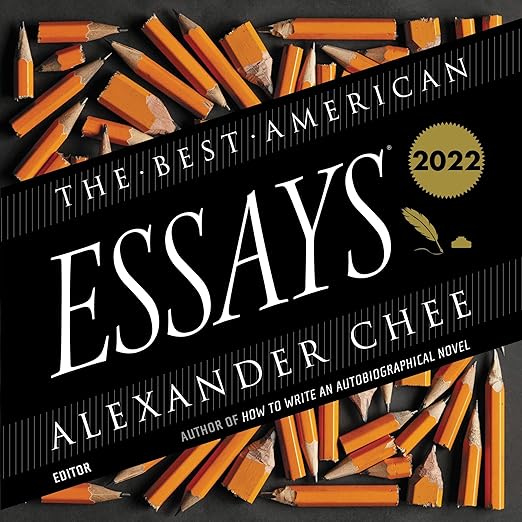
Alexander Chee's curatorial practice as guest editor of The Best American Essays 2022 runs toward formal ambition and demographic breadth, and the nearly thirteen-hour audiobook narrated by Ewan Chung reflects both commitments. Chee, whose own essays are described by the Washington Post as demonstrating virtuosity and power, was not selecting essays that look like essays. The twenty pieces chosen from thousands published in 2021 include documentary work, lyric meditations, reported personal narrative, and forms that resist easy categorization. This audiobook asks something of the listener that genre fiction never does: to adjust your expectations at the start of each new piece and suspend the instinct to know where you are going before you arrive.
Chung narrates with an evenness that serves the collection's diversity without imposing a uniform affect across writers whose styles diverge considerably. The challenge for any narrator of an anthology is that the best single-author narration depends on intimacy with one voice, while anthology narration requires flexibility across many. Chung is more reliable than charismatic, which is the safer choice and probably the right one for a collection this heterogeneous. He honors the formal differences between essays without drawing attention to them, which is the craft a good anthology narrator practices.
Chee's Taste for Formally Experimental Essays
Chee's selection is notably more willing to include formally experimental work than some previous editions of this series. A reader who has followed the Best American Essays since its 1986 inception described this edition as having broader creative variety than any edition they could recall, with ups and downs in enjoyment but no essay that failed to provoke thought. That assessment is accurate and is also, intentionally or not, a precise description of what a strong essay anthology should do. The point is not uniform pleasure. The point is that each piece makes a demand on the reader that print and audiobook formats handle differently.
Jesus Quintero's Anatomy of a Botched Assimilation, mentioned specifically by a reviewer as opening with particular effectiveness, exemplifies what Chee seems to have been selecting for: essays that use personal experience to arrive somewhere structurally surprising rather than essays that confirm what the reader already believes about the subject. The collection is genuinely curious about form, which is unusual in a series that can sometimes privilege the safely accomplished over the formally risky. Chee's own essay practice, drawing on both lyric and reportorial modes, is visible in the range he has curated across the twenty selections.
A Twelve-Hour Anthology Built for Sustained Listening
The twelve-hour-plus runtime makes this a sustained listening project rather than a casual companion, and that length is part of how the collection works. The experience of moving from one essayist's voice to the next over multiple listening sessions creates a cumulative sense of the range of American experience and American prose that no single essay and no single author can produce. A reviewer who appreciated the exposure to many different perspectives in things unknown or little known captures the anthology's specific value: it is educational in the root sense, drawing you outside your existing frame rather than deepening what you already understand.
A supplemental PDF accompanies this audiobook, containing Chee's guest editor introduction and associated materials providing context for the selection criteria and the broader range of essays considered. Listeners who engage with that material will have a richer sense of Chee's curatorial argument and the editorial decisions that shaped the final twenty. Chee is a writer whose stated aesthetic positions are worth knowing before you engage with what he has selected, and the introduction is where those positions are most explicitly argued.
When the Anthology's Essays Refuse to Connect
The anthology format by definition produces uneven listening. Not every essay will connect with every listener, and the formal ambition that makes some pieces compelling will make others feel difficult or diffuse. A reader who described ups and downs in enjoyment is describing the accurate experience of honest engagement with experimental work. The instinct to skip an essay that is not working in the first five minutes is understandable but worth resisting: several of the collection's most interesting pieces take longer to establish their terms than a conventional argumentative essay would require.
Listeners who prefer their nonfiction to have clear argumentative throughlines will find some of these essays frustrating. Chee's taste runs to the associative and the lyric as much as to the thesis-driven, and the audiobook reflects that. The collection is not an easy survey of the year's most accessible nonfiction. It is a demanding anthology that asks the listener to follow formal experiments to their conclusions rather than extracting the useful parts and moving on to the next selection.
Nonfiction Writers Get the Most from Chee's Picks
Writers working in nonfiction will find this audiobook one of the more useful things they can spend thirteen hours with: hearing a wide range of formal choices executed with varying degrees of success calibrates your sense of what the essay form can actually do and where its edges are. Readers curious about the current state of American literary nonfiction but uncertain where to start will find Chee's selection a generous and demanding introduction. Listeners looking for accessible personal narrative rather than formally ambitious work will find some essays more welcoming than others and may want to supplement with previous editions selected by editors with different curatorial priorities. The series has been running since 1986 and remains the most useful annual survey of the essay in English, and this edition under Chee's editorship is among its most formally ambitious installments.
Key Details
- Narration: Ewan Chung reads twenty essays of widely varying register and subject with consistent, unhurried clarity, honoring the collection's formal diversity without flattening it.
- Themes: Identity and assimilation, contemporary American experience, the essay form's capacity for documentary and lyric work
- Mood: Intellectually wide-ranging, uneven by design, and at its best genuinely revelatory
- Verdict: Alexander Chee's selection is the most formally diverse edition of the Best American Essays series in recent memory, and Chung's narration serves the anthology well.
Does the supplemental PDF add significant value to the audiobook experience, and is it easy to access?
The supplemental PDF typically contains the guest editor's introduction, the series editor's preface, and the Notable Essays lists from the annual selection process. These materials provide context for Chee's curatorial choices. Access instructions are provided with the audiobook purchase, and engaging with the PDF is recommended for listeners who want the full critical frame.
Is this audiobook version of The Best American Essays 2022 complete, including all twenty essays?
The audiobook includes all twenty essays Chee selected for the 2022 volume. Some front and back matter, including the guest editor's introduction, may be available only in the supplemental PDF rather than in the audio itself. Check the product listing for the exact table of contents.