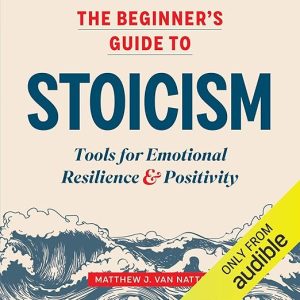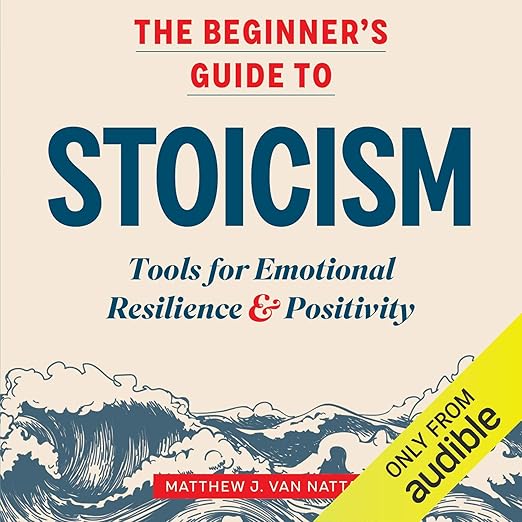
The Short Version
- Performance: Steve Rimpici delivers Matthew Van Natta's philosophical instruction with a calm, unhurried register that models the temperament the book advocates.
- What it covers: Emotional self-regulation, the Stoic three disciplines, practical ancient philosophy for contemporary living
- Feel: Calm and grounding, with the texture of a thoughtful introductory lecture
- Our call: A brief, practical introduction to Stoic practice that pairs ancient philosophy with applied exercises, suited to listeners approaching Stoicism for the first time.
Stoicism has undergone a quiet revival that shows no signs of slowing. From academic philosophy departments back into mainstream self-help, back further into productivity culture, and now into audiobook libraries aimed at people who want something that actually works on a difficult morning when nothing is going right. Matthew Van Natta's audiobook lands in this space with deliberate accessibility, structured around the Stoic disciplines of Desire, Action, and Assent rather than the more academic frameworks that can make ancient philosophy feel like coursework.
Van Natta approaches the subject as a practitioner rather than a cataloger. The book opens by situating Stoicism historically, tracing its development from the ancient Stoa through the figures most listeners will know by name: Epictetus, Marcus Aurelius, Seneca. That historical grounding matters because Stoicism is one of those philosophical traditions where understanding its origins conditions how you interpret its prescriptions. A philosophy developed in part by a formerly enslaved man, in part by a Roman emperor, and in part by a playwright-turned-statesman was never purely theoretical. It was always a practice for living under actual conditions, and Van Natta keeps that practical dimension foregrounded throughout.
The emotional toolkit Van Natta builds across the book is organized around what he calls the complete mindset: acceptance of what lies outside your control, cultivation of what lies within it, and attention to how you assent to or reject the judgments that generate your emotional states. Reviewer Steve Moeller described the book as combining quotes from the best-known Stoic philosophers with instructions on how to apply their wisdom, calling it an early version of applied positive psychology. The cognitive behavioral echoes in Stoic practice are real, and Van Natta makes the connection explicit enough that listeners with therapeutic or psychological backgrounds will find familiar territory alongside the historical material.
The book's core instruction is about perception rather than behavior. The Stoic position is not that difficult things do not happen but that the distress they cause is generated by the judgments we apply to them, not by the things themselves. Van Natta builds this argument carefully, using examples and exercises rather than simply asserting it. Reviewer Night Train Lane described the book as concise and practical, tailored for modern readers, which is accurate. Van Natta is not writing for philosophy students. He is writing for people who want to manage their emotional lives more effectively and are prepared to look at a twenty-five-hundred-year-old tradition to find out how.
Why Listen to The Beginner's Guide to Stoicism
The three-hour-and-seven-minute runtime is a feature rather than a limitation. Stoic philosophy is frequently misrepresented as emotional suppression or cold indifference, and Van Natta works against that misreading with enough space to develop his argument but not so much space that the material becomes intimidating. He includes ethical questions, reflective exercises, and practical applications throughout rather than reserving all the actionable content for a final chapter. This makes the audiobook usable as a practice guide during the first listen rather than requiring a second pass to extract what is actually useful.
Steve Rimpici's narration carries the instruction with appropriate gravity without becoming ponderous. Philosophy audiobooks can drift toward performance when the narrator treats the material as inherently solemn rather than practically useful. Rimpici avoids that. His pacing is measured but not slow, which suits Van Natta's conversational writing style. The book arrives at each of its three disciplines with the unhurried confidence of someone who has given these ideas real time, and that quality in the narration reinforces the content rather than contradicting it.
What to Watch For in The Beginner's Guide to Stoicism
This is explicitly a beginner's guide and presents itself honestly as such. Listeners who have already read Marcus Aurelius, Epictetus's Discourses, or the popular Stoicism revival texts of recent years will find limited new ground here. The book synthesizes rather than advances the tradition, and that synthesis is done well with practical exercises that add value, but the depth of engagement with primary Stoic texts is necessarily limited by the format and audience the book targets.
The audiobook listing notes that a PDF companion is included in the audio library, which suggests supplementary written exercises or reference material. For a practice-oriented book where the exercises are a meaningful component of the value, listeners should make sure they have access to that supplement. The audio alone covers the philosophical content thoroughly, but working through the reflective questions in writing rather than simply hearing them narrated is likely to produce better retention of the practical material.
One specific element of Van Natta's approach worth highlighting is his treatment of the discipline of Assent, which is the Stoic focus on how we respond to and ratify the impressions that arrive in our minds. This is the aspect of Stoicism that has the clearest resonance with contemporary cognitive behavioral practice, and Van Natta handles it with more nuance than the popular summary of Stoicism as simply do not react would suggest. The discipline of Assent is not about suppressing reactions but about introducing a beat of examination between stimulus and response. That distinction is subtle but consequential, and Van Natta earns credit for not flattening it into a slogan.
Who Should Listen to The Beginner's Guide to Stoicism
Listeners approaching Stoicism for the first time will get the most from this audiobook. It provides a clear framework, historical grounding, and practical exercises that make the philosophy immediately applicable. Listeners processing a difficult period, dealing with sustained uncertainty, or actively looking for tools to improve emotional self-regulation under pressure are exactly the audience Van Natta wrote for. Those with prior Stoic reading should look to more advanced texts. This book is designed to open a door rather than take you through every room behind it.
Questions Listeners Ask
How does this audiobook compare to Ryan Holiday's Stoicism guides?
Van Natta is more directly philosophical and less narrative than Holiday, who uses historical stories to illustrate principles. This guide is closer to a structured introduction with exercises than to an inspirational text built around biographical examples.
What does the included PDF supplement add to this audiobook experience?
The listing notes a PDF is included in the audio library, likely containing written exercises and reflection questions referenced in the audio. For a practice-oriented book, having those prompts in a written format you can respond to adds meaningful value beyond the audio alone.