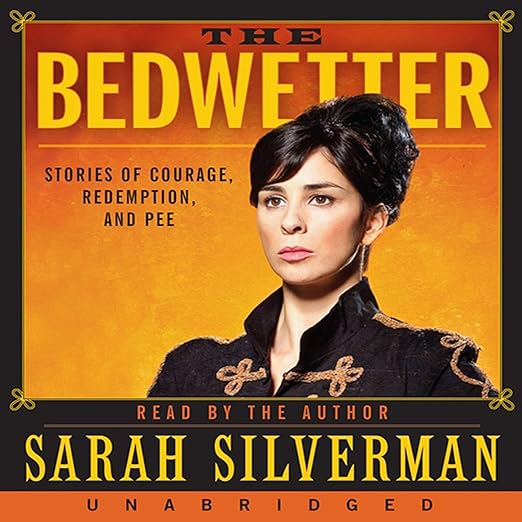
Comic memoir is a genre with a structural trap built into it: the funniest people are rarely the most disciplined storytellers, and a book of bits is not the same thing as a life. The Bedwetter walks straight into that trap, and depending on which reviewer you believe it either escapes or does not. Sarah Silverman narrates her own memoir across five hours and forty-two minutes, which puts this audiobook in the small category where performer and author are the same person and the timing on the page was written to be spoken out loud in the first place.
What We Made of It
Self-narration matters more in comedy than in almost any other nonfiction category, because a stand-up's material is not text that happens to be funny. It is timing rendered as punctuation. The description calls Silverman outrageously filthy and oddly innocent, and that pairing is a delivery effect before it is a writing effect: the innocence lives in how a line is said, not in the words themselves. A hired reader would have to guess where every beat falls. Silverman wrote those beats and knows where they are, which is the single strongest argument for choosing this edition over the printed one. I have heard enough comedian memoirs handed to hired professionals to be confident about this: the jokes survive that transfer, the timing does not.
Reviewers here keep grasping at the word voice without meaning the recording at all. D. Smith, at four stars, writes that the quality which struck hardest was "the sincerity and authenticity of her voice." Blondzilla8 opens by admitting an earlier ambivalence, loving Silverman's authenticity while finding her irritating, then reports that the book resolved the contradiction by revealing how much the two of them had in common. Robert Downs, at three stars, singles out one stretch above all others, having nearly lost composure while reading a foreword that the notice calls "written in expert fashion by the author herself". Three readers, three routes, one conclusion: the appeal here is a person rather than a plot.
What the book actually covers is narrower and stranger than a celebrity memoir usually manages. The title is not a metaphor. Silverman writes about chronic bedwetting well into her teens, and the description signals the range that produces, shockingly personal on one side and crude enough on the other to earn the promise the title makes. S. Herron, writing from the UK, arrived skeptical after a disappointing run with another comedian's autobiography, having found that one try-hard and short on laughs, and came away unable to put this one down and wishing for more of it.
The poignancy is real, and it arrives sideways. Aurora Reixa, four stars from Mexico, offers the fairest summary in the pool: Silverman "writes very well, the book is insightful and honest", a good read for anyone who enjoys the scatological and politically incorrect comedy, and for anyone who does not, a document that still shows, in Reixa's phrasing, "her frame of mind." That second clause is the interesting one. The book has a use for people who find Silverman unfunny, which you cannot say about most performer memoirs, and at under six hours it is short enough to test the proposition cheaply.
Things to Know Before Starting The Bedwetter
Two reviewers, nearly three years apart and with no knowledge of one another, land on the same structural verdict, and it is the most useful thing in the pool. D. Smith describes "a series of seemingly unconnected vignettes" and grades them coldly: "Some are entertaining. Few are revealing." Robert Downs splits the book at its midpoint, calling the first half "literary comedic genius" filled with "chuckles and flat-out bits of hysteria", then registering plain disappointment with what follows. Neither notice dismisses the book. Both say the same thing, which is that it front-loads, and a front-loaded book is harder to abandon gracefully in audio than on paper.
On content, take the description at its word and then add a little. Blondzilla8's route into the book ran through a Howard Stern interview and one notorious comedy video, which maps the register accurately enough. Reixa's phrase, scatological and politically incorrect, is doing honest work rather than hedging. The score wants separate handling: a 3.8 average built from just two ratings supports no conclusion whatsoever, while the five written notices average well above it and disagree with each other in genuinely interesting ways. Read the notices and ignore the number. One further oddity: the product copy references a 2015 film, though this recording was published in 2010, so the description has clearly been revised long after the fact.
Best Suited For
Anyone who already likes Silverman's stand-up should take the audio over the page without deliberating. The material was built for a voice, and this is the voice it was built for. Comedy-memoir readers more generally will find a strong example of the form's better instincts, honest about humiliation and uninterested in the rise-and-triumph arc that D. Smith notes the book conspicuously declines to supply. Anyone who wants a short, self-contained memoir finishable across a couple of commutes will find the runtime an asset rather than a limitation, and the vignette structure makes it unusually easy to pause and resume.
Another pair of listeners is worth naming. People who write comedy will find the foreword worth the price on its own, given how emphatically Downs singles it out as the high point of the entire book. And anyone who lived through the specific childhood humiliation in the title, an audience no publisher would put on a marketing brief, gets a public figure treating that experience as survivable material rather than as a punchline at somebody else's expense. Neither group is the target market. Both come away with something real.
Avoid it if crude humor about bodily functions is a hard no, because the title functions as a promise rather than a hook. Avoid it too if you want a career narrative with causes and consequences attached, since the most detailed notice in the pool states plainly that it does not supply one. And approach the back half with adjusted expectations rather than the ones the front half earns, which is, oddly, the kindest way to take a comic who is better at the bit than at the arc. For my money the front half alone justifies the purchase, which is an odd thing to say about a memoir and an accurate thing to say about this one.