Quick Take
- Narration: David Tredinnick delivers FitzSimons’s cinematic prose with controlled urgency – his pacing during the firefight sequences earns the tension the material demands, and he handles the quieter testimonial passages with appropriate restraint.
- Themes: Mateship under fire, the politics of a forgotten war, the human cost of command decisions
- Mood: Visceral and reverential – the kind of listening that makes you stop whatever you are doing
- Verdict: FitzSimons at the height of his powers: meticulous research, genuine human emotion, and one of the most harrowing battle reconstructions in Australian military literature.
I started this one on a long flight home from Europe, somewhere over the Gulf, at about the hour when you give up on sleep and put your headphones in properly. By the time we began our descent I was still listening, tablet on the tray table, unable to look away from the transcript of those desperate radio transmissions – the ones FitzSimons reproduces at the very opening of the book: Enemy on left flank. Could be serious. Running short of ammo. Require drop through trees. Those lines do what good military history almost never manages: they put you in the radio operator’s chair rather than the historian’s armchair.
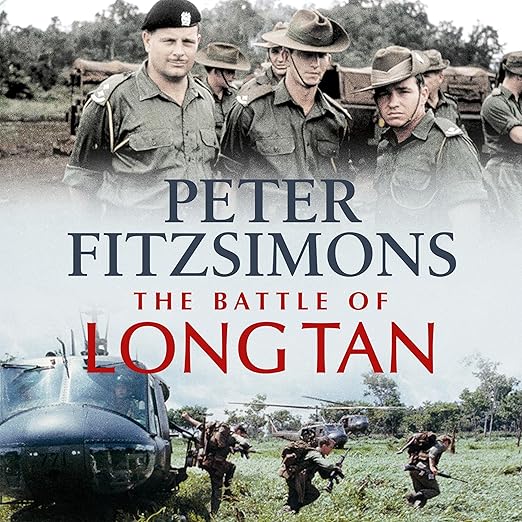
Peter FitzSimons has built a career on reconstructing the defining moments of Australian military history – Kokoda, Gallipoli, Tobruk – and with The Battle of Long Tan he turns to the afternoon of 18 August 1966, when D Company of the 6th Battalion, Royal Australian Regiment walked into the worst ambush of Australia’s Vietnam War. At its core this is a story of about 108 men, surrounded by an estimated 2,500 Viet Cong and North Vietnamese Army soldiers, fighting for six hours in a rubber plantation in the middle of a monsoon downpour. FitzSimons gives you the numbers early and then spends the rest of the book making you feel every one of them.
The Architecture of a Six-Hour Battle
What FitzSimons does particularly well here – and what distinguishes this from a more conventional operational history – is his management of time. He does not simply narrate the battle chronologically. He layers it: strategic context, personal biography, unit movement, individual moment. You understand, before the shooting starts, exactly why a mortar strike on the Nui Dat base the night before changed everything. You know which platoon commander had married only months earlier, which signaller had nearly not re-enlisted, which artillery officer would have to make impossible calculations under fire without being able to see the men he was trying to save. When the rounds start landing, each choice is weighted by the human cost you already understand.
The reconstruction of the artillery support is one of the book’s most genuinely gripping sequences. The New Zealand and Australian battery crews, firing at maximum rate into coordinates dangerously close to their own men, with air support grounded by low cloud and APCs still fighting through mud to reach the perimeter – FitzSimons renders the physics and the terror simultaneously. The daring helicopter resupply mission, which could so easily read as a paragraph of logistics, lands instead as something close to unbearable.
The Political Backstory FitzSimons Will Not Let You Skip
One of the deliberate decisions in the structure of this book is the sustained attention given to how Australian soldiers ended up in Phuoc Tuy Province in the first place. FitzSimons is not content to begin at the base perimeter on the morning of 18 August. He reaches back into the political decisions of the Menzies era, the logic of forward defence, the way conscription was implemented, and the way the war was sold to the Australian public. For some readers who came primarily for the battle narrative, this section has tested patience. But I found it essential. You cannot fully understand why so much weight eventually fell on these 108 men without understanding the bureaucratic and diplomatic chain that placed them there.
There is also an honest reckoning with the aftermath – the decades during which Long Tan’s veterans were denied formal recognition, the arguments over who should have received what medal, the interminable political delays. FitzSimons handles this with genuine anger, carefully controlled. His view on the treatment of Vietnam veterans is clear, but he expresses it through documented fact rather than polemic, which makes it more effective.
What Tredinnick Brings to the Text
David Tredinnick is a strong match for this material. FitzSimons writes in a style that is colloquial without being sloppy, urgent without being breathless, and Tredinnick has the technical fluency to switch registers when the prose demands it – from the measured build of the contextual chapters to the compressed intensity of the firefight itself. He reads Australian military slang without the slight hesitation that sometimes trips up narrators who are technically correct but phonetically cautious. One reviewer noted that he had not known the real story of Long Tan despite growing up with the name in the background of Australian life. Tredinnick’s reading of the survivor testimonials captures exactly that quality of belated recognition – here, finally, is what actually happened.
Who Should Listen, and Who Might Struggle
Listeners who come to this familiar with FitzSimons’s previous books will know what they are getting: immersive popular history written for a general audience, thoroughly researched, occasionally prone to the rhetorical flourish. Those who prefer strict operational analysis – unit positions, enemy order of battle, tactical critique – may find the human-interest framework slows the pace they want. The 21-hour runtime is substantial, but it earns its length; nothing here feels padded. The Spanish-language review in the sample suggests the book has reached readers well beyond Australia, which speaks to how effectively FitzSimons contextualizes Long Tan within the broader Cold War narrative rather than treating it as a purely national story.
If you have any connection to the Australian Vietnam experience – family, professional, or simply as a reader of Pacific military history – this is essential listening. For everyone else, it is still a model of how to reconstruct a battle in audio form: specific, humane, and impossible to set down once the rain starts falling in that plantation.
Frequently Asked Questions
Does FitzSimons take a clear political position on Australia’s involvement in Vietnam, or does he stay neutral?
He does not stay neutral. FitzSimons is openly critical of how Australian Vietnam veterans were treated in the decades after the war, and he has views on the political decisions that committed Australian forces. However, he grounds those positions in documented evidence rather than sustained polemic, so the book reads as argued history rather than advocacy.
How does this compare to other FitzSimons titles like Kokoda or Gallipoli in terms of scope and approach?
Long Tan is narrower in geographic and temporal scope than Gallipoli or Kokoda – it focuses tightly on a single battle and its direct context – but the method is the same: deep personal biography of participants, political backstory, and cinematic reconstruction of the action itself. Readers familiar with those earlier titles will feel immediately at home.
Is the 21-hour runtime justified, or does the book feel padded?
The length is earned. FitzSimons needs the setup time – the political decisions, the mortar strike, the individual biographies – to make the six-hour battle feel as weighted as it should. Listeners who want only the battle narrative may find the first third slower, but the payoff is proportional to the investment.
Does David Tredinnick handle the Australian military slang and pronunciation convincingly?
Yes. Tredinnick reads Australian idiom and military terminology without the slight phonetic caution that sometimes marks narrators unfamiliar with the material. The testimonial passages in particular benefit from his restraint – he lets the words do the work rather than performing emotion over them.