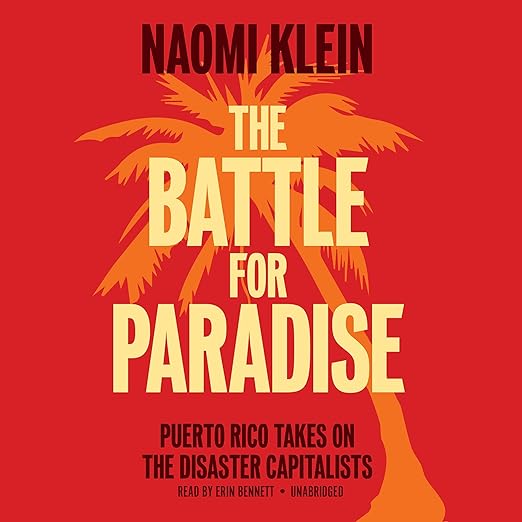
Quick Take
- Narration: Erin Bennett delivers Klein’s measured, investigative prose cleanly and without editorializing – a reliable performance for a text that does its own work.
- Themes: disaster capitalism and crisis opportunism, colonial economics in Puerto Rico, grassroots resistance and community resilience
- Mood: Urgent, politically charged, and carefully argued – dense but rewarding at under two hours
- Verdict: A compressed but powerful investigation that functions as both a standalone argument about Puerto Rico and a case study that extends Klein’s broader framework in The Shock Doctrine.
I came to The Battle for Paradise having already read The Shock Doctrine, Klein’s 2007 examination of how economic shock therapy is imposed on populations rendered vulnerable by disaster. Hurricane Maria hit Puerto Rico in September 2017. This short book arrived in 2018, and reading it as an extension of the Shock Doctrine framework is almost inescapably the right way to read it – Klein herself makes the connection explicit, showing how the mechanisms she identified in Chile and New Orleans were operating again in Puerto Rico before the emergency generators had stopped running.
At under two hours, this is not a long audiobook, but Klein is a focused writer and the compression here is effective rather than superficial. She arrived in Puerto Rico in the immediate aftermath of Maria and what she found there was the familiar shape: the island’s existing debt crisis providing the pretext, the federal government’s disengagement providing the opportunity, and a specific class of investors she calls Puertopians providing the vision of what Puerto Rico might become if the people who had always lived there could be effectively displaced from the decision-making.
Our Take on The Battle for Paradise
The book operates on two tracks simultaneously. The first is the documentary track: what actually happened in the aftermath of Maria, who made which decisions, what legislation was passed under emergency conditions, and which interests benefited from the chaos. This is reported journalism, and Klein’s access and sourcing are evident throughout. The second track is the resistance track: the vision that Puerto Ricans themselves were developing for a just recovery, the solar and community power projects, the cooperative agricultural initiatives, the political organizing that was happening at precisely the moment outside interests were drawing up privatization plans for the island’s assets.
One reviewer who identifies as a history graduate who lived in Puerto Rico and faced Hurricane Hugo writes at extraordinary length about how the book’s analysis maps onto personal experience, describing the colonial policies that preceded Maria – the destruction of agricultural diversity to enforce import dependency, the debt crisis engineered through decades of federal policy. This testimony contextualizes Klein’s arguments in lived experience that the book itself approaches from an outsider’s analytical perspective.
Why Listen to The Battle for Paradise
Erin Bennett’s narration is clean and appropriate. She does not perform the political urgency of the material – she trusts Klein’s prose to carry it – and this restraint is correct. Klein writes with controlled intensity, building arguments through evidence and specific reporting rather than through rhetoric, and Bennett matches that register. At under two hours, this is an audiobook that can be consumed in a single commute or evening, which makes its density accessible rather than demanding.
The book also functions as a reminder of how quickly disaster capitalism operates. The processes Klein documents were already well underway within months of Maria – the opportunity window for shock politics is short, and the coordination between federal policy, private investors, and existing debt instruments moves faster than public consciousness. The temporal compression of the audiobook format actually suits this argument: Klein is describing urgency, and under two hours feels appropriately urgent.
What to Watch For in The Battle for Paradise
Listeners who are unfamiliar with Klein’s broader framework – and in particular with The Shock Doctrine – will find The Battle for Paradise argumentatively complete but may miss some of the resonance that comes from recognizing Puerto Rico as a case in a longer pattern. The book assumes a certain level of familiarity with Klein’s theoretical framework without requiring a prior reading, but the experience is richer for readers who come with context.
The book’s 2018 publication date also means it predates subsequent developments in Puerto Rico’s political situation – the ongoing utility privatization, the constitutional reform debates, and the continuing battles over the island’s debt. Listeners interested in the current state of what Klein describes should seek updated reporting; this audiobook provides the foundation and the analytical tools rather than the current moment.
Who Should Listen to The Battle for Paradise
Anyone interested in the political economy of disaster recovery, Klein’s broader work on shock doctrine, or the specific history of Puerto Rico’s relationship with the federal government will find this essential and efficient. Listeners who want a comprehensive, updated account of Puerto Rico’s current situation will need to supplement this with more recent reporting. Puerto Ricans and those with personal connections to the island – as several reviewers demonstrate – will find Klein’s analysis resonates with and extends their own experience in ways that are both validating and clarifying. For the right listener, under two hours is exactly enough.
Frequently Asked Questions
Do I need to have read The Shock Doctrine before listening to The Battle for Paradise?
No, but it enriches the experience considerably. Klein refers to her broader framework implicitly throughout, and listeners familiar with The Shock Doctrine will recognize the pattern immediately. The book is argumentatively complete as a standalone – she establishes the disaster capitalism framework within the text – but the resonance is deeper with context.
At under two hours, is this audiobook a condensed summary of a larger argument, or does it develop its own full analysis?
It is a full, standalone investigation rather than a condensed version of a longer book. Klein spent time in Puerto Rico reporting specifically for this project, and the analysis is grounded in original reporting rather than repurposed from other work. The compression reflects focused argument rather than truncated thinking.
How does Erin Bennett’s narration serve Klein’s particular prose style?
Well. Klein writes with controlled intensity – she builds arguments through evidence rather than rhetoric, and Bennett does not add performative urgency to material that generates its own. The narration is clean, measured, and trusts the text to do its work. Listeners expecting a more dramatic delivery may find it restrained, but the restraint suits the genre.
The book was published in 2018 – how much of what Klein describes in Puerto Rico has changed since then?
Significantly. The utility privatization Klein warned about has proceeded, the debt restructuring has continued, and several of the community resilience projects she highlights have had mixed outcomes. The analytical framework she provides remains accurate, but the specific facts on the ground have evolved. Listeners interested in the current situation should read this as the 2018 baseline and seek updated reporting for the present state.