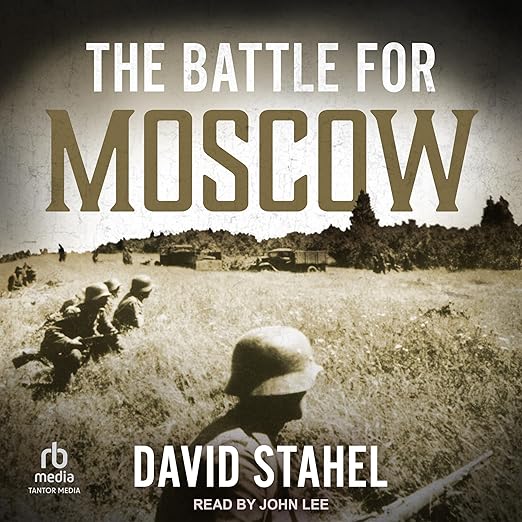
Quick Take
- Narration: John Lee delivers Stahel’s dense military history with authority and precision, handling the German unit designations and strategic terminology without losing the listener.
- Themes: Military operational analysis, the myth of the close-run thing, the limits of willpower as a military doctrine
- Mood: Rigorous and revisionist, occasionally grim but always analytically focused
- Verdict: The definitive audiobook account of the November 1941 German drive on Moscow, essential for anyone serious about the Eastern Front who wants the analysis behind the well-known story.
I returned to the Eastern Front in audiobook form on a grey November weekend, which felt appropriate. The Battle for Moscow is David Stahel’s fourth volume in a series analyzing the German war in the Soviet Union in 1941, and it arrives with the accumulated weight of his previous work already established. Coming in without that foundation, I can report that the book does not require it to function, though reviewers who have followed the series from Operation Barbarossa forward describe it as a culmination of arguments Stahel has been building across four volumes.
The central argument is revisionist and worth stating clearly: Stahel contends that the November 1941 German drive on Moscow was not a dramatic near-miss that failed only because of weather and Soviet winter counterattack, but rather a fundamentally failed operation that was doomed by operational weakness and logistical collapse well before Soviet forces had to do much about it. The common narrative, that the Germans came within a certain number of miles of Moscow and were stopped only by winter and Soviet stubborn resistance, is, in Stahel’s analysis, a myth that serves German veteran memoirs more than historical truth.
Our Take on The Battle for Moscow
Stahel’s research base is exceptional. He draws on previously undocumented army files and soldiers’ letters to reconstruct the state of German formations in November 1941 in granular detail: unit strengths, supply levels, equipment conditions, command decisions, and the gap between what officers told their superiors was achievable and what their own private correspondence revealed they actually believed. This documentary foundation makes the argument difficult to dismiss, and multiple reviewers with historical expertise describe it as correcting decades of accepted misconception.
The framing concept Stahel introduces, that National Socialist military thinking drove the offensive forward against operational reality, is the most intellectually ambitious claim in the book. He argues that the ideology demanded offensive momentum even when military logic dictated halt or withdrawal, and that this doctrinal coercion created the conditions for disaster that the November offensive represented. That argument has implications beyond the specific campaign and touches on broader questions about how political ideology corrupts military judgment.
Why Listen to The Battle for Moscow
John Lee is one of the most reliable military history narrators working in audio, and he brings everything this material needs: authority, precise articulation of German and Soviet proper names and unit designations, and a measured pacing that suits academic history without becoming dry. At twelve and a half hours, the audiobook covers substantial analytical ground, and Lee maintains consistent quality throughout. For listeners who follow military history in audio regularly, Lee’s name on a project is itself a quality signal.
The audio format serves Stahel’s writing style well. His prose is clear and argumentative rather than narrative, building its case systematically across chapters, and listening in sequence forces the kind of sustained engagement with the argument that his methodology requires. You cannot skim to the dramatic bits without losing the analytical context that makes them meaningful.
What to Watch For in the Revisionist Argument
Stahel is writing against a well-established historiographical tradition, and he is aware that readers may arrive with strong preconceptions about how close the Germans came to taking Moscow. He addresses those preconceptions directly and with considerable supporting evidence. One reviewer, a long-term reader of Eastern Front history, describes the book as correcting views that were often repeated and until relatively recently were accepted, which captures the book’s ambition accurately.
The book is analytical rather than narrative in emphasis. Listeners who prefer the experiential focus of soldiers’ memoirs or narrative history in the Anthony Beevor mode will find Stahel’s operational focus somewhat technical. He is interested in why the offensive failed structurally, not primarily in recreating the experience of combat. Both approaches have legitimate value, but they produce different kinds of audiobooks.
Who Should Listen to The Battle for Moscow
Serious students of the Eastern Front who want rigorous operational analysis rather than popular narrative will find this essential. It is particularly valuable for anyone who has read the standard accounts of Operation Typhoon and wants a more critical engagement with those narratives. Listeners without prior knowledge of the 1941 Eastern Front campaigns will find the analytical level demanding, and may benefit from a more introductory work first. For those already familiar with the campaign, Stahel’s challenge to received wisdom is exactly the kind of historiographical engagement that separates good military history from the repetition of comfortable myth.
Frequently Asked Questions
Do I need to read Stahel’s previous volumes about Operation Typhoon and Operation Barbarossa before this one?
The book functions as a standalone analysis, and Stahel explains the preceding operational context clearly. However, reviewers who have followed the entire series describe the argument as building on foundations established in the earlier volumes, and that context enriches the analysis considerably. Reading in sequence is ideal but not required.
What is the main historical claim Stahel makes that differs from standard accounts?
He argues that the November 1941 German drive on Moscow was not a near-miss thwarted primarily by winter and Soviet resistance, but rather an operationally doomed offensive compromised by logistical collapse and depleted unit strength well before the Soviet winter counterattack. He uses previously unpublished army files and soldiers’ private correspondence to support this revision.
John Lee narrates a great deal of military history, how does his performance compare here?
Excellent. Lee handles German and Soviet proper names, military unit designations, and strategic terminology with practiced fluency. His measured pacing suits Stahel’s analytical prose without becoming dry. He is one of the most dependable narrators in the military history genre, and this performance maintains that standard.
Is this appropriate for listeners without deep knowledge of Eastern Front history?
It is demanding without prior context. The book assumes familiarity with the basic timeline of the 1941 German invasion of the Soviet Union and the November drive on Moscow. Complete newcomers to the Eastern Front would benefit from a more introductory account first. For listeners with some background, Stahel’s analytical challenge to the standard narrative is accessible and rewarding.