Quick Take
- Narration: Lisa Armytage handles the dense historical and theological material with measured authority, her cadence keeps the argument legible across a demanding 22-hour runtime.
- Themes: fundamentalism as modernity’s mirror, religious fear and political violence, the dread of secular displacement
- Mood: Scholarly and sobering, with real contemporary urgency
- Verdict: Armstrong’s most important analytical work on religion, a deeply researched and compassionate examination of fundamentalism that has only grown more relevant since publication.
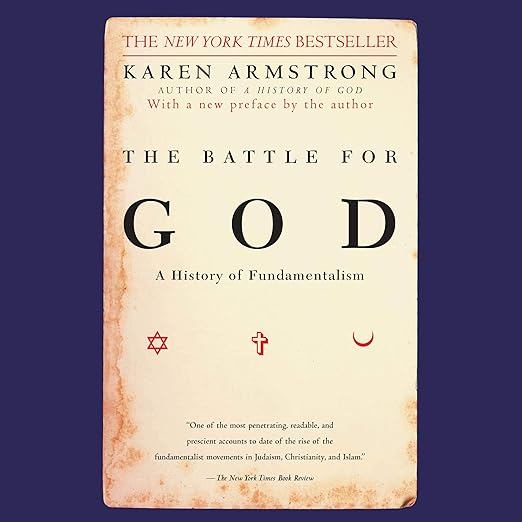
I first encountered Karen Armstrong’s writing in my early twenties, during a period when I was trying to understand how intelligent, educated people arrived at positions that seemed, from the outside, like pure irrationality. The Battle for God was not the first of her books I read, but it was the one that most reoriented my thinking about what I was actually asking. I returned to it recently in the audio version, and the experience of hearing the argument rather than reading it was, if anything, more affecting. Armstrong’s prose has a quality that rewards the pace of reading aloud, and Lisa Armytage’s narration honors that quality throughout the demanding twenty-two-hour runtime.
Published originally in 2000 and now available in a 2020 audio production, The Battle for God examines fundamentalism across three religious traditions: Protestant Christianity in the United States, Jewish fundamentalism in Israel, and Islamic fundamentalism in Egypt and Iran. Armstrong’s central argument is that fundamentalism is not a throwback to medieval religion but a modern response to modernity, arising from genuine dread of what secular rationalism has done to the human need for sacred experience. That argument is stated clearly in the opening chapters and then demonstrated with rigorous historical detail across more than a thousand years of combined religious development.
Our Take on The Battle for God
What Armstrong does that almost no one else manages is to hold genuine sympathy for believers alongside clear-eyed analysis of how that belief can become violent and exclusionary. She does not excuse fundamentalist violence, but she takes seriously the experience of communities whose entire framework for meaning-making was systematically dismantled by the forces of modernization, often violently and without their consent or participation in the decision. Her argument is that if you understand why fundamentalism arose, you cannot dismiss it as mere irrationality, and that dismissing it has made the situation considerably worse. This is not a comfortable argument, but it’s a rigorous one.
The parallel structure, three traditions each traced from the sixteenth century to the late twentieth, is ambitious and occasionally demanding. Armstrong makes connections across traditions that illuminate each individual case: the way Protestant millennialism echoes Islamic reformist movements, the way Jewish settlers in the West Bank understand their relationship to the land in ways that parallel Iranian revolutionary theology. These connections are the book’s intellectual achievement, and they require sustained attention to appreciate fully.
Why Listen to The Battle for God
Lisa Armytage is the right choice for this material. She reads with the kind of careful authority that dense historical argument requires: unhurried, precise, never inflecting for drama in ways that would distort the neutral scholarly register Armstrong works in. The twenty-two-hour runtime is a real commitment, but the argument accumulates in ways that shorter treatments simply cannot achieve. This is a book that needs room, and the audio format respects that need.
The Random House Audio production is clean and professionally executed. For a work this demanding, sound quality and pacing discipline matter considerably. A muddy production or a narrator who rushes the complex passages would undermine the argument’s cumulative effect. Neither problem is present here. Armytage navigates the transliterated Arabic and Hebrew terms with confidence, which is a not-insignificant technical challenge across this length of material, and her consistency across the full runtime is genuinely impressive.
What to Watch For in The Battle for God
Armstrong’s sympathy for her subjects is a genuine analytical virtue, but it requires some calibration from listeners who expect straightforward condemnation of fundamentalist violence. She is clear about the damage caused, including the ways these movements have, in her phrase, failed in religious terms. But she extends genuine compassion to the communities whose dread and displacement produced them. Some readers find this unsatisfying; most find it essential to actually understanding the phenomenon rather than simply documenting its worst expressions.
The book was published in 2000, predating September 11 and the subsequent decades of jihadist violence that have dominated western discourse. Readers familiar with post-2001 events will find Armstrong’s framework applies with chilling precision to what followed, but the book itself stops at the twentieth century’s end. That’s worth knowing if you come looking for specific analysis of post-9/11 movements. What you’ll find instead is the intellectual foundation for understanding those movements, which is arguably more valuable than topical coverage.
Who Should Listen to The Battle for God
This book is essential listening for anyone who wants to understand fundamentalism in any of its three major Western and Abrahamic forms, and particularly for listeners who have found themselves genuinely confused by why intelligent people embrace positions that seem to require abandoning reason. Armstrong’s answer is not that they have abandoned reason. It’s that they have lost something else, something reason cannot replace, and that the response to that loss has consequences we are all living with now.
Reading Armstrong alongside the recent surge of scholarship on political religion and religious nationalism, it becomes clear how precisely she identified the structural conditions that would generate the most destabilizing expressions of fundamentalism in the decades following publication. The symbiotic relationship she describes between aggressive modernity and extreme religious response, each impelling the other toward greater excess, has played out with a fidelity to her analysis that is both gratifying for the scholar and sobering for the citizen. This is the kind of book that makes you want to share it with people whose positions puzzle you.
Listeners looking for quick political analysis or contemporary commentary may find the historical depth frustrating. Armstrong is interested in why fundamentalism exists across centuries, not just in its current expressions. If you’re willing to follow that inquiry at the pace it deserves, The Battle for God will change how you think about modern religious politics. It’s one of those rare works of popular scholarship that improves rather than diminishes with the passage of time.
Frequently Asked Questions
Is The Battle for God sympathetic to fundamentalism, or does Armstrong take sides?
Armstrong is explicitly neither an apologist nor a polemicist. She takes seriously the experiential and historical roots of fundamentalist movements while being clear that they have caused real harm and, in her view, failed on their own religious terms. The compassion she extends to believers is analytical rather than endorsing.
Does the book require prior knowledge of Islamic, Jewish, or Christian theology to follow the argument?
No. Armstrong is one of the best explainers of religious history writing in English, and she builds her argument from first principles. Some familiarity with the broad outlines of these traditions helps, but she provides enough context that general readers can follow the theological claims without specialized background.
Does The Battle for God still hold up given that it was published in 2000, before 9/11?
Many readers and reviewers consider its prescriptive power, the accuracy with which its framework predicts what happened after 2001, to be one of the strongest arguments for reading it. The analysis is structural rather than event-specific, which makes it more rather than less applicable to subsequent decades.
How does Lisa Armytage handle the 22-hour runtime, does the narration stay engaging?
Armytage maintains consistent quality throughout. She reads with measured authority rather than dramatic performance, which suits the scholarly argument well. For a book this long and dense, the stability of her delivery is an asset rather than a limitation.