Quick Take
- Narration: Rainn Wilson reading his own memoir is warm, funny, and genuinely surprising, he deploys the sardonic wit you expect from Dwight Schrute while revealing a person the character never hinted at.
- Themes: Nerddom before nerd culture was cool, the Bahá’í faith as creative foundation, finding yourself through being genuinely lost
- Mood: Self-deprecating, thoughtful, and unexpectedly sincere
- Verdict: A comedy memoir that reveals itself as something more interesting than its celebrity hook suggests, Wilson is funnier and more philosophically engaged than the Dwight Schrute association prepares you for.
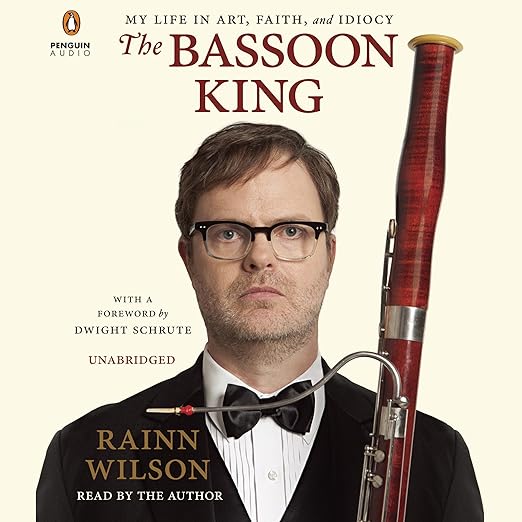
I came to The Bassoon King the way I imagine most people do, through The Office, through Dwight Schrute, through the specific pleasure of watching someone commit completely to a character built from a kind of aggressive obliviousness that is both ridiculous and, at moments, genuinely touching. I expected a behind-the-scenes book about a hit television show. I got something considerably stranger and, it turns out, considerably better.
Rainn Wilson’s memoir covers his upbringing in a household shaped by the Bahá’í faith, his years of adolescent nerdiness so acute that his description of his high school existence reads as both comedy and social document, his struggle through New York acting schools and off-off-Broadway productions that paid nothing, and eventually his path to The Office. But the architecture of the book is not ‘how I became famous.’ It is ‘how a person figures out who they are when who they are does not fit any available template.’
Bone-Numbingly Nerdy Before It Was Acceptable
Wilson’s description of growing up as a drama geek, ‘the highest rung on the vast, pimply ladder of high school losers,’ as he puts it with characteristic precision, is the book’s funniest sustained stretch. But it is funny in a way that has genuine melancholy underneath it, because he is describing a real social isolation that the comedy framing makes survivable to read about rather than merely difficult. The specific details are what make this work: not generic nerd experience but Rainn Wilson’s specific experience, which includes playing the bassoon seriously enough that the instrument becomes a recurring motif throughout the memoir.
He is honest about the fact that the Bahá’í faith was simultaneously a source of community and a further differentiating factor in an adolescence already distinguished by differentness. This is treated with care rather than comedy, he is not mocking the faith or his childhood relationship to it, but he is also not presenting it as unambiguously protective. It gave him something, and it made some things harder, and he holds both of those truths at the same time.
New York, Off-Off-Broadway, and Years of Not Arriving
The New York years are the section that surprised me most. Wilson spent nearly a decade working in theater productions that nobody saw, living the kind of life that seems romantic in retrospect but was apparently genuinely grinding at the time. He writes about these years without the retrospective glow that most famous people apply to their pre-fame struggle. The auditions that went nowhere, the productions that closed immediately, the sense of being exactly talented enough to keep going but not clearly talented enough to break through, these sections are written with an honesty about professional uncertainty that is rare in celebrity memoir.
One reviewer noted that ‘the bassoon and music get extremely little coverage,’ which is accurate, and another came for extensive Office behind-the-scenes material and found the show treated relatively briefly in the second half. Both are fair observations about a book that is genuinely more interested in the before than the after. Wilson seems to find the pre-fame years more interesting to write about, which is consistent with a memoir built around the theme of finding yourself rather than the theme of succeeding.
The Bahá’í Thread and What It Carries
The section dealing with Wilson’s return to the Bahá’í faith after his years of ‘mild debauchery’ is the book’s most genuinely surprising passage, and the one that most clearly distinguishes it from the comedy memoir category it superficially occupies. He is writing about spiritual reconnection with the same earnestness and lack of embarrassment that he brought to the faith as a child, and the absence of ironic distance is striking in a memoir that has been consistently witty up to that point. The decision not to protect himself with comedy there is the book’s most interesting formal choice.
Wilson narrates all of this with the warmth and precision you would expect from someone who has spent twenty-five years as a professional actor. He does not do Dwight Schrute in this recording, the voice is softer, more reflective, more genuinely uncertain. The reviewer who came expecting funny and got important is describing an experience that the narration itself produces.
Who Should Listen and Who Should Skip
Office fans will find less behind-the-scenes television coverage than they might hope for, and high school music nerds hoping for extended bassoon content will also be somewhat disappointed. But listeners willing to follow Wilson into a genuinely idiosyncratic memoir about nerddom, faith, and the particular loneliness of not fitting will find this consistently rewarding. The eight-and-a-half-hour runtime is earned, this is a memoir with ambition beyond its celebrity hook.
Frequently Asked Questions
How much of The Bassoon King actually covers Rainn Wilson’s time on The Office?
The Office material appears in the latter portion of the memoir and is not the book’s primary focus. Wilson is more interested in the years of struggle and formation that preceded the show’s success. Listeners wanting extensive behind-the-scenes Office content will find this covers different ground.
Does the book require or assume familiarity with the Bahá’í faith, or is it accessible to listeners of any background?
Wilson explains the faith’s principles as he discusses his relationship to it, so no prior knowledge is required. He is writing about it as a personal experience rather than as religious instruction, which makes it accessible to readers of any background or belief.
Is the humor consistent throughout, or does the more serious spiritual content shift the tone significantly?
The memoir is genuinely funny throughout its first half and becomes more reflective as it moves toward the spiritual material. The tonal shift is real but not jarring, it feels like the natural progression of a memoir about someone becoming more honest with themselves.
How does Wilson’s self-narration compare to his performance as Dwight Schrute, does the Dwight persona come through?
The narration is noticeably different from the Schrute performance. Wilson reads with warmth and reflective humor rather than the aggressive certainty that defines the character. If anything, the gap between his memoir voice and Dwight’s persona illuminates how much construction that character required.