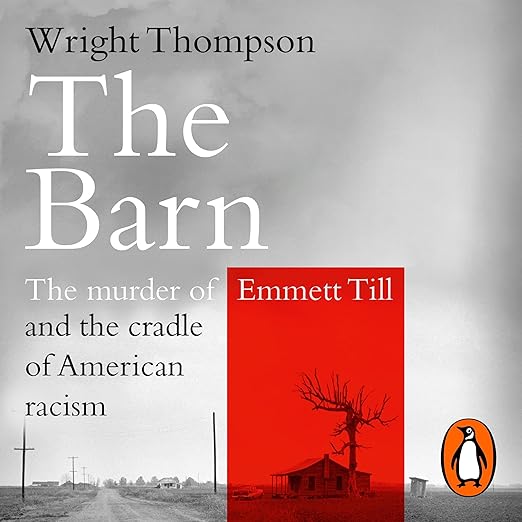
Township 22 North, Range 4 West sounds like paperwork until you learn what stood on it. That string of survey coordinates names a thirty-six square mile grid in the Mississippi Delta, and inside it sits the barn where Emmett Till was murdered on the night of August 28, 1955. Wright Thompson grew up a few miles away and knew none of it until he had left the state. That fact organizes the whole audiobook: not a retelling of a famous crime, but an account of how a place teaches its own children not to know things. Eleven hours and thirty-eight minutes go into showing how thoroughly that teaching works.
Almost Every Part of the Standard Account Is Wrong
Five years of research produced a bold claim, and the copy leads with it: almost every part of the standard account of the killing is wrong. The two men acquitted by an all-white jury later gave a false confession to a journalist, and that confession misled the public about where the murder happened and who stood in the room. The corrected figure the book supplies is at least eight people present and many more complicit. That is the reportage. Around it Thompson builds something much wider, tracing the same thirty-six square miles from Choctaw land to slave plantation to sharecropper's farm to crime scene, which is how one barn becomes an argument about two centuries.
Whether that widening works is the question this record splits on, and it splits hard. A five-star filed from the United Kingdom in October 2024 calls the book truly educational about the death of Emmett Till and about the history and demography of the Delta, closing with the phrase a sobering learning experience. That is the design working: the crime as an entrance to the geography rather than the reverse. Listeners who want that will find eleven hours of it. Listeners who came for the crime alone will spend a great deal of that time somewhere they did not expect to be standing.
Saying a Murdered Child's Name for Eleven Hours
Praise from a critical reader is the most useful kind, and this record supplies some. A three-star filed from the United Kingdom in November 2024 says the account fails to hit the mark, then pauses to concede moments of excellence, particularly in connecting today's experience of racism with the lynching at the heart of this book. That concession identifies precisely what the book does best, which is the through-line running from 1955 into the present tense. Where Thompson holds that line, the writing attempts something no conventional true-crime account goes near, and the eleven-hour scale stops feeling indulgent and starts feeling necessary.
Thompson reads it himself, and on this material the choice carries weight no hired voice could supply. The book's central admission is personal: he grew up a few miles from the barn and knew nothing about it, so the account of a cover-up comes from somebody the cover-up worked on. The material also demands a specific restraint. A reader has to say a murdered child's name for eleven hours without ever tipping into performance, and has to make surveying language, township numbers, range numbers, acreage inside a thirty-six square mile grid, sound like the argument it actually is instead of a deed being read into a record. Neither task is a matter of vocal range.
An Identical Text Under a Cheaper Subtitle
Structural complaints on this record are consistent and specific. A two-star filed from the United Kingdom in August 2025 calls the account incoherent, rambling, repetitive and poorly structured, and asks for an editor to simplify and abridge. That last word deserves attention, because an abridged edition is a real product some publishers issue and this recording is not one. What a buyer gets here is the complete text at speaking pace, which is the least forgiving delivery available for a book accused of drift.
Strangest thing on this page is a five-star advising you to buy something else. Filed from the United States in August 2025, it points buyers toward a differently subtitled volume, The Barn: The Secret History of a Murder in Mississippi, on the grounds that it costs less than half as much. That response reports purchasing both, comparing them, and finding the text block identical, with the differences amounting to a British versus a US publisher, a different ISBN and a different subtitle. Nothing on this record acknowledges any of it. The displayed title carries no subtitle whatsoever, leaving a buyer no way to tell which of the two volumes they are actually looking at.
That edition question echoes across the rest of the page. The description opens with the line Brought to you by Penguin and uses British spelling throughout, four of the five written responses were filed in the United Kingdom, and the publisher field reads Penguin Audio. Meanwhile the badge sits at 4.3 across 60 ratings while the five visible grades run 5, 5, 3, 5 and 2, averaging three tenths of a star lower. One of those five-stars states plainly that the person filing it has not finished the book. The categories, for their part, file a panoramic history of white supremacy under mystery, thriller and suspense.
Checking the Subtitle Before You Buy
Readers who want the Delta as much as the crime are the right audience for this. If you already know the standard accounts of the Till case and want to understand what the land underneath them had been doing for two centuries, Thompson has spent five years assembling exactly that, and the format handles the braided structure better than skeptics might expect, since a long listen absorbs digression more comfortably than an evening with a physical book does. Anyone teaching or studying the period will find the reframing valuable even in the stretches where the prose sprawls.
Tight chronology and a linear narrative are absent by design. Listeners who need momentum at every turn, or who lose patience when a book leaves its subject for a long stretch of land history, will struggle across eleven and a half hours of it. Buyers hunting a conventional true-crime procedural, which the category placement will happily send here, should keep walking. What the book offers instead is a serious, angry, sometimes shapeless attempt to explain a murder by explaining the ground it happened on. Checking the subtitle before you buy is the most practical thing this page can teach you, since its own column reports a cheaper volume carrying the same text.
Questions Listeners Ask
Is this audiobook read by the author?
Yes. Wright Thompson is credited as both writer and reader, so the admission at the center of the book, growing up a few miles from the barn without ever learning what happened there, arrives in the voice it belongs to. No second reader, dramatization or archival audio appears anywhere on the record.
Which edition does this audiobook match?
The record does not say. The displayed title carries no subtitle, the description opens with a British publisher line and uses British spelling, and the publisher field reads Penguin Audio. More than one volume of this book circulates under different subtitles, so match the full title against what you intend to buy.
How much of the audiobook covers the murder itself?
Less than the true-crime tag implies. The killing on the night of August 28, 1955 anchors everything, but a large share of the eleven and a half hours traces the same thirty-six square miles from Choctaw land through plantation and sharecropping. Approach it as history with a crime at its center.
Does it work for someone new to the Emmett Till case?
Workable, though not ideal. The copy assumes you know the case is infamous and moves straight to correcting the record, including the finding that at least eight people were present rather than the two who stood trial. A newcomer can follow it, but the reframing lands hardest on prior knowledge.