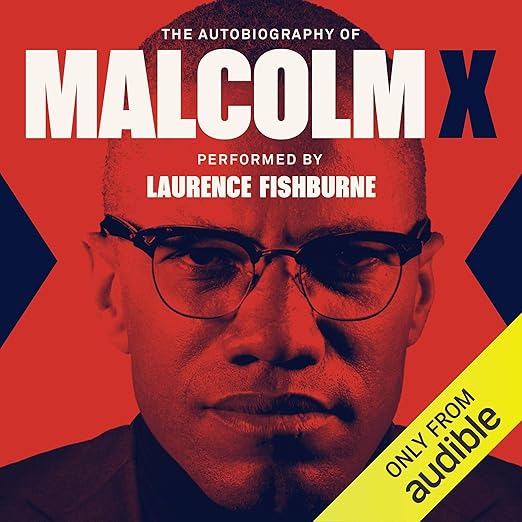
Laurence Fishburne is billed on this audiobook before the book itself is described. The copy opens with a line about Time's ten most important nonfiction works of the twentieth century, then immediately invites you to experience a bold take on the autobiography, performed by a name it takes care to label Oscar-nominated. That ordering is unusual in this catalog, where the reader is normally a field near the bottom of the page, and it changes what is being sold. Not only the text, but an interpretation of it, sixteen hours and fifty-two minutes long.
Reading It Twice, at Sixteen and Thirty-Nine
Sixteen hours is a long time to spend inside one life, and the response that makes the best case for the length reports reading the book twice, first at sixteen and again at thirty-nine. What changed, by that account, was not the book but the reader: boldness and defiance registered on the first pass, discipline and intellectual growth and a willingness to evolve on the second, with the prison chapters landing differently the second time around. That is the most useful thing anybody has written on this page, because it identifies what the material actually is. Not a manifesto, and not a martyrdom. A record of somebody rebuilding a mind on purpose, and of exactly how long that takes.
Fishburne's name doing sales work at the top of the page is a promise, and promises of that kind repay careful reading. A bold take is the copy's phrase, not a listener's, and it commits the edition to interpretation rather than to transparency. For a first-person account by somebody the same copy calls a firebrand, that is a genuine fork in the road. A reading can efface itself and let the sentences do the work, or it can perform them, and this listing is telling you in advance which way it went. Announcing the choice is more than most editions do, and it means you know the terms before you start rather than an hour in.
One Life, One Movement, in the Same Sentences
Time's list is the kind of credential that usually means less than it looks, and the book's claim on attention does not rest on it. What the copy promises is a perspective on the lies and limitations of the American dream, and on the inherent racism of a society that denies its non-White citizens the opportunity to dream, delivered alongside an account of the growth of the Human Rights movement. That pairing is the thing an autobiography can do and a biography cannot: one life and one movement arrive in the same sentences, and no amount of careful reading will separate them out again. A biography of the same subject can be more accurate about dates and considerably less accurate about what it felt like to hold those positions in that decade, and the second thing is precisely what a long recording is equipped to deliver.
Six decades after the text first appeared in 1965, it still gets described as essential rather than important, and the difference is not decorative. Essential means somebody believes you will understand the present less well without it. The copy makes precisely that case, calling the work a definitive statement of a movement and a man whose message it describes as timeless, and framing it as necessary for anyone trying to understand the African American experience and America as a whole. Sales copy is sales copy. This particular example happens to be describing a function the book genuinely performs.
A Performance Decision You Agree to Live With
Because the edition sells itself on performance, it is fair to ask what a performance costs. An interpretation working hard will decide things the text left open, and a listener who wants to reach those places unaccompanied has fewer options in audio than on a page. That is not an objection to the choice; it is the trade audio always makes, and this listing is unusually candid about making it. If your intention is to study the book rather than to be carried by it, a printed copy within reach will save you a great deal of scrubbing backward through a long file. Length compounds it. A performance decision you find distracting in the opening hour is a decision you have agreed to live with for the whole remainder, and audio offers no equivalent of skimming past a paragraph you would rather not have.
Delivery notes turn up in review columns far more often than anybody admits, and one sits here carrying the top grade: a two-line entry praising a quick shipment and calling the item a nice addition to a collection. Nothing about the reading, nothing about the writing, and the maximum score all the same, folded into the same average as the responses that engage with the material. It is a small thing and it deserves naming, because a buyer scanning a number has no way to tell how much of it was earned by a courier rather than by a book.
Few Audiobooks Announce Their Interpretation This Openly
Students meeting the period for the first time are the obvious audience, and one response describes that experience precisely: expecting something bleak, finding it more uplifting than anticipated, and coming away with parts of American history brought into focus that had been known without ever being understood. It rewards anybody willing to sit with a position they may not share and hear it argued at full length by the person who held it, which is a rarer opportunity than the sheer number of political books in print would suggest. Few forms grant it as completely as a first-person account does. The same goes for the listener who has read a great deal about the period without ever reading anybody from inside it, and who suspects that the gap between those two experiences might itself be part of the subject.
If a neutral overview of the era is what you want, this is not it, and it has never claimed to be. The same applies if you need footnotes and cross-references, because an autobiography answers to memory before it answers to the archive. And if you want to meet the prose without an interpreter standing between you and it, the listing states plainly that an interpreter has been engaged. Few audiobooks announce their interpretation this openly, and fewer still have a text underneath capable of taking the weight.
- Performance: Produced by Audible Studios rather than licensed from a print house, with a single performer carrying the entire first-person account
- What it covers: Self-education under confinement, the American dream examined from outside it, the growth of a movement
- Feel: Direct, unsparing, forward-driving
- Our call: A canonical text whose audio edition genuinely adds something, provided you want a reading with a point of view.
Before You Listen
Why does the sales copy for this audiobook lead with Laurence Fishburne?
Because the edition is a studio production built around the reading rather than a recording licensed from a print publisher. Audible Studios holds the publisher field, with a September 2020 release date, more than half a century after the text first appeared, which is long enough that a new edition needs a reason to exist. The performance is that reason.
How long is the audiobook, and is it abridged?
It runs sixteen hours and fifty-two minutes. The title carries no abridged marker and the description mentions none, which is the only assurance the page offers. At that length it becomes a multi-week commitment for most listeners rather than a weekend project, and that is worth planning for rather than discovering at hour four.
What shelves does this audiobook sit on, and does the filing matter?
Three at once: biographies and memoirs, history, and politics and social sciences. The triple filing is accurate rather than promotional, since the book carries a life, a period and an argument in the same telling. It also means the title surfaces for browsers who arrived looking for none of those three in particular.
Was the text originally published in 1965?
The description says so, and dates this recording to September 2020. The gap is worth holding on to while you listen, because the book speaks about its own present rather than about ours, and the listing mentions no introduction, afterword or framing material added for the audio edition.