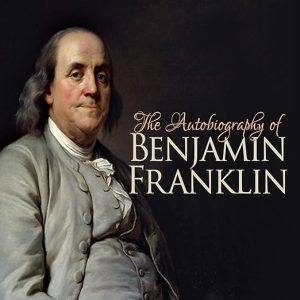
Franklin quit this manuscript in 1760 and never came back to it, which means the audiobook you are considering ends two decades before almost everything a school textbook files under his name. Dreamscape Media issued the recording in 2015 at six hours and thirty-five minutes, and the reading falls to Qarie Marshall. The description attached to the listing promises a life running "to the American Revolution and beyond." It does not go there. That gap between what the copy sells and what the text contains is the single most useful thing a prospective listener can know before starting, and the readers who have responded to this edition say so themselves, without much prompting and without any apparent disappointment.
First, the Big Picture
The book we actually get is a self-made man's account of self-making. Franklin opens in the printing houses of Boston and Philadelphia and moves through apprenticeships, debts, the almanac, and the slow assembly of a public reputation. The September 2009 entry, five stars, marks the boundary precisely, noting that the narrative "stops in 1760, well before his involvement with the Revolution, but it covers in detail his youth, apprenticeships, the formation of his philosophy and ideals, and his path from poor roots to business and social success." That doubles as an accurate table of contents. It is also, I would argue, the reason the book has outlasted his reputation as an inventor and a statesman.
What survives best across two and a half centuries is the specificity. Franklin counts things constantly: pages set, pennies saved, hours kept, faults corrected, arguments won and lost. The prose is eighteenth-century and the sentences run long, but that accounting habit supplies a forward pull most memoirs of the period never manage. The numbers attached to this particular edition repay a look, too. The badge reads 4.3 across ten ratings, while the five responses on display average 4.8. Those two figures reconcile exactly one way: the five ratings held back must total nineteen points between them, which puts the invisible half of this pool at a flat 3.8. Half the audience here liked it distinctly less than the half you can read.
What Makes The Autobiography of Benjamin Franklin Worth Hearing
Thirteen virtues, worked through one at a time, form the section later readers keep stealing from. A December 2025 entry, also five stars, credits that system with making the book "more than just a memoir, it's a guide for personal growth," and traces the arc plainly: a printing apprentice who ends up an inventor, a writer, and a statesman. What keeps the self-improvement material from curdling into a lecture is Franklin's willingness to log his failures at the same resolution as his wins. The same entry puts a finger on it, crediting his honesty about mistakes and successes for making a founding father feel like a person instead of a monument. That balance is genuinely rare in the genre he accidentally invented.
Beyond the virtue ledger sits the civic material, and it plays far better than its reputation suggests. An April 2012 entry, five stars again, makes the case in a single clause, calling Franklin "intimately involved in the evolution of his community," with the fostering of a fire department offered as the opening example. Listeners arriving with the inventor of popular imagination in mind get committee work instead: the patient, unglamorous business of talking a colonial town into paying for things it does not yet know it wants. That same entry flags how close the book came to never existing, pointing at the letter that persuaded Franklin to set his life down as an inspiration to young people. Knowing it was written on encouragement changes how its confidence reads.
A Few Reservations
The promise in the description and the contents of the recording do not line up, and that mismatch deserves weighing first. A life sold as running through the Revolution stops in 1760, well short of it. The second consideration is the prose itself. The August 2013 entry, four stars and the only rating below five here, describes the book as a run of "fascinating vignettes" taking in harrowing sea voyages, private discussions with the rich and famous, and picturesque descriptions of cities and landscapes. Generous and accurate both, but vignettes are exactly what arrives. The book does not build toward anything, because its author died before he could build it. Six and a half hours end mid-project rather than at a conclusion, and no reader can disguise that.
Marshall's assignment on this recording is worth naming before you commit the time. Eighteenth-century English builds by accumulation, subordinate clause stacked on subordinate clause with the main verb arriving late, and a reader has to keep that architecture clear without slowing to a crawl. A listener, in turn, has to accept a rhythm that will never resemble contemporary nonfiction. Worth knowing as well: the responses gathered underneath did not all come from this edition. One entry, five stars, filed from Germany in January 2012, opens by calling this the first book its writer ever downloaded to an e-reader, and four of the five carry dates earlier than the April 2015 release. What the badge measures, then, is a text with a long life across many formats.
Who Should Listen to The Autobiography of Benjamin Franklin
Anyone assembling a reading list on the American eighteenth century should start here rather than with a biography, because this is the primary document every later biographer works from, and six and a half hours is a cheap way to acquire it. The book also earns a specific listener: the person who enjoys watching a system get built, whether that system is a fire department, a business, or a character. Franklin is constructing all three at once and showing the workings throughout. Self-improvement listeners who have exhausted the contemporary productivity shelf will find the original template here, laid out in the voice of the man who drew it up and never pretended the drafting was elegant.
Give it a miss if what you want is Franklin the revolutionary or Franklin the diplomat, because none of that lives in this text and no amount of goodwill will put it there. Steer clear too if unbroken narrative momentum is a requirement, since the book arrives as episodes and ends without ceremony or closure. What you are buying instead is a founding document of American self-invention, at a length that fits a weekend of chores, carrying a badge that quietly reports half its ratings were cooler than the responses you can actually read. Come for the voice and the ledger-keeping, not for the history the listing copy promised you.